On MacOSForge, Apple has announced that they are releasing the Apple Lossless Audio Codec as an open source project:
The Apple Lossless Audio Codec (ALAC) is a lossless audio codec developed by Apple and deployed on all of its platforms and devices for some years now. Apple is making the Apple Lossless Audio Codec (ALAC) available as an open source project. Full details can be found on the Apple Lossless Audio Codec project page.
The Apple Lossless Audio Codec is a similar to other "lossless" codecs such as FLAC which offer audio compression without any loss in audio information. ALAC is said to compress files only by "about half" as compared to the originals.
Formats such as MP3 and AAC are considered "lossy" and result in much greater compression but at the cost of some fidelity. The main advantage of using ALAC over competing lossless formats is that ALAC is supported by all of Apple's iPods and iOS devices. The format had already been reverse engineered prior to this release, but this opens the door to even more products supporting both ALAC creation and playback.
Saturday February 7, 2026 9:26 am PST by Joe Rossignol
Apple today shared an ad that shows how the upgraded Center Stage front camera on the latest iPhones improves the process of taking a group selfie.
"Watch how the new front facing camera on iPhone 17 Pro takes group selfies that automatically expand and rotate as more people come into frame," says Apple. While the ad is focused on the iPhone 17 Pro and iPhone 17 Pro Max, the regular iPhone...
Friday February 6, 2026 3:06 pm PST by Juli Clover
In the iOS 26.4 update that's coming this spring, Apple will introduce a new version of Siri that's going to overhaul how we interact with the personal assistant and what it's able to do.
The iOS 26.4 version of Siri won't work like ChatGPT or Claude, but it will rely on large language models (LLMs) and has been updated from the ground up.
Upgraded Architecture
The next-generation...
Thursday February 5, 2026 12:22 pm PST by Joe Rossignol
Apple plans to announce the iPhone 17e on Thursday, February 19, according to Macwelt, the German equivalent of Macworld.
The report, citing industry sources, is available in English on Macworld.
Apple announced the iPhone 16e on Wednesday, February 19 last year, so the iPhone 17e would be unveiled exactly one year later if this rumor is accurate. It is quite uncommon for Apple to unveil...
Monday February 9, 2026 6:24 am PST by Joe Rossignol
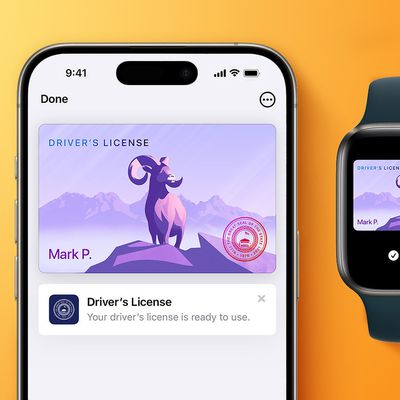
In select U.S. states, residents can add their driver's license or state ID to the Apple Wallet app on the iPhone and Apple Watch, and then use it to display proof of identity or age at select airports and businesses, and in select apps.
The feature is currently available in 13 U.S. states and Puerto Rico, and it is expected to launch in at least seven more in the future.
To set up the...
New MacBook Pro models with the M5 Pro and M5 Max chips could arrive as soon as Monday, March 2, according to Bloomberg's Mark Gurman.
In today's "Power On" newsletter, Gurman said that the release of new MacBook Pro models is tied to the release of macOS Tahoe 26.3. The launch is said to be slated for as early as the week of March 2. He added that the M4 Pro and M4 Max models on sale today...
The main advantage of using competing lossless formats is that they are supported by ALL devices on any platform.
They're not. Many devices do not natively support FLAC. iOS devices will natively support ALAC, so that will outnumber "all devices" as you put it.
Can someone explain what "half as much" means? I though the ALAC didn't create fidelity loss. Or is some compression possible without such?
It doesn't create loss in sound. It's a lossless format. What they mean by compression is the file size. So if the original file is 30MB, ALAC compression will make it 15MB in file size but still sound like the original, with no loss of audio.
Android's market share has long surpassed that of iOS. I'd say theres little debate over which open source format will have more success.
Not to start a platform argument, but Android's marketshare may be bigger than the iPhone's. But if you include all iPods (non iOS ones), iPod Touches, and iPads, that market size is certainly still bigger than Android. In terms of devices which support ALAC.
Good news for widespread support, but one wonders why Apple didn't just go with FLAC in the first place.
As with most things Apple, presumably because they thought they could do better. They don't tend to do anything that they don't think is an improvement on something that already exists. If I recall correctly, isn't ALAC about half the file size?
The main advantage of using competing lossless formats is that they are supported by ALL devices on any platform*.


 On MacOSForge, Apple has announced that they are releasing the Apple Lossless Audio Codec as an open source project: