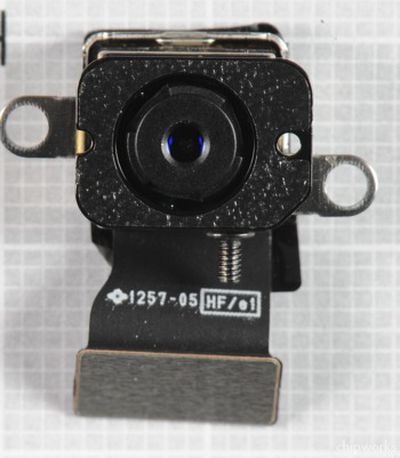
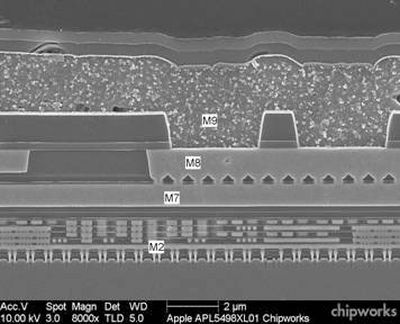
The most interesting -- though perhaps unsurprising -- discovery is that Apple has apparently reused cameras from prior products for both the front and rear cameras on the new iPad. The rear camera, pictured above, appears to be the same 5 megapixel CMOS Image Sensor that was used in the iPhone 4.
That unit was the Omnivision OV5650. The OV5650 is the second generation back illumination (BI) technology from OmniVision. This 5 Mp camera features 1.75 µm pixels, and is designed to deliver DSC quality in a mobile phone application. The sensor supports HD (1080p) video at 60 fps. Apple specifications for the new iPad also tout the same specification. So the analysis we have just completed… drum roll please... says that the 5 Mp back illuminated CMOS Image Sensor in the new iPad is the same, it is the Omnivision OV5650 (die mark OV290BF).
The front camera in the new iPad is the 0.3 megapixel Omnivision OV297AA unit seen previously in the iPad 2 and the old camera-equipped iPod Nano. Chipworks notes that this isn't the first time Apple has recycled parts into new products, and that the strategy keeps costs and technological risks low.
Chipworks has a few other notes from the teardown, as well, including the observation that Apple is dual-sourcing DRAM for the iPad 3. iFixit's unit utilized DRAM from Elpida, while Chipworks' unit has DRAM from Samsung.
Additionally, Samsung is the foundry for the A5X processor and Apple is again using the company's 45nm CMOS manufacturing process. The A5X's die is 36.5% larger than its predecessor, measuring 162.94 mm^2 versus 119.32mm^2 for the A5. Chipworks is continuing to examine the A5X and promises additional cross-section photos soon.
Thursday February 5, 2026 12:54 pm PST by Joe Rossignol
Apple turns 50 this year, and its CEO Tim Cook has promised to celebrate the milestone. The big day falls on April 1, 2026.
"I've been unusually reflective lately about Apple because we have been working on what do we do to mark this moment," Cook told employees today, according to Bloomberg's Mark Gurman. "When you really stop and pause and think about the last 50 years, it makes your heart ...
Thursday February 5, 2026 12:22 pm PST by Joe Rossignol
Apple plans to announce the iPhone 17e on Thursday, February 19, according to Macwelt, the German equivalent of Macworld.
The report, citing industry sources, is available in English on Macworld.
Apple announced the iPhone 16e on Wednesday, February 19 last year, so the iPhone 17e would be unveiled exactly one year later if this rumor is accurate. It is quite uncommon for Apple to unveil...
Friday February 6, 2026 3:06 pm PST by Juli Clover
In the iOS 26.4 update that's coming this spring, Apple will introduce a new version of Siri that's going to overhaul how we interact with the personal assistant and what it's able to do.
The iOS 26.4 version of Siri won't work like ChatGPT or Claude, but it will rely on large language models (LLMs) and has been updated from the ground up.
Upgraded Architecture
The next-generation...
Tuesday February 3, 2026 7:47 am PST by Joe Rossignol
While the iOS 26.3 Release Candidate is now available ahead of a public release, the first iOS 26.4 beta is likely still at least a week away. Following beta testing, iOS 26.4 will likely be released to the general public in March or April.
Below, we have recapped known or rumored iOS 26.3 and iOS 26.4 features so far.
iOS 26.3
iPhone to Android Transfer Tool
iOS 26.3 makes it easier...
The iPhone 18 Pro Max will feature a bigger battery for continued best-in-class battery life, according to a known Weibo leaker.
Citing supply chain information, the Weibo user known as "Digital Chat Station" said that the iPhone 18 Pro Max will have a battery capacity of 5,100 to 5,200 mAh. Combined with the efficiency improvements of the A20 Pro chip, made with TSMC's 2nm process, the...
The iPad 3 is shaping up to be a repeat of the iPhone 3G (read: only survives one iOS update before becoming slow enough to impair its usefulness).
I think that comparison is invalid. The biggest problem with iPhone 3G was its lack of RAM when iOS was upgraded, which isn't a problem with the new iPad as it now has 1G of RAM.
I predict next year the new iPad will be released with 1G of RAM and the same Retina display, and people will complain how that isn't a "true" upgrade because the display, LTE and the RAM have not changed, telling everyone how they'll wait for "iPad 5" which will be the "true hardware upgrade". Then the next year people will complain how the new iPad isn't a true upgrade and...well you get the point ;)
As I've alluded to in other threads, a 45nm A5X is a deal-killer for me :(. The "iPad 3" is essentially an underpowered version of the iPad 2 considering the display's high resolution and lack of CPU/GPU clock increases. The next iPad will benefit from a full node shrink to (presumably) 28nm on BOTH the CPU and the 4G baseband; likely in addition to new CPU (Cortex A15) and GPU architectures. The iPad 3 is shaping up to be a repeat of the iPhone 3G (read: only survives one iOS update before becoming slow enough to impair its usefulness).
This is in addition to the battery problems the iPad 3 is likely to experience: that 45nm A5X is BIG for a mobile SoC, and will be generating a lot of heat. Hot iPad innards = significantly diminished Li-Ion battery lifetime.
Looking forward to the "iPad 4"... Android's non-GPU accelerated UI just won't do it for me.
I fail to see how the GPU being doubled in its architecture is underpowered? The CPU means squat in this case. It is all based upon the GPU in this case. With 4 cores being able to process the display, then I don't get what the problem is. Yes the SoC uses a bigger form factor, but it doesn't seem to be generating outrageous amounts of heat. Definitely not enough to significantly diminish the battery.