How Apple Minimizes its Corporate Tax Burden

In the latest installment of its "iEconomy" series, The New York Times takes a look at how Apple minimizes its corporate tax burden, taking advantage of a number of legal maneuvers and loopholes around the world. Apple's strategies are of course fully legal and used by many other corporations, but with a spotlight on Apple as it has rapidly risen to become the world's most valuable publicly-traded company with record-setting profits, it has obviously attracted much attention about how it handles its money.

Apple, for instance, was among the first tech companies to designate overseas salespeople in high-tax countries in a manner that allowed them to sell on behalf of low-tax subsidiaries on other continents, sidestepping income taxes, according to former executives. Apple was a pioneer of an accounting technique known as the “Double Irish With a Dutch Sandwich,” which reduces taxes by routing profits through Irish subsidiaries and the Netherlands and then to the Caribbean. Today, that tactic is used by hundreds of other corporations — some of which directly imitated Apple’s methods, say accountants at those companies.

Among the tactics used by Apple:

- Setting up subsidiaries in low-tax locations such as Nevada, Ireland, Netherlands, Luxembourg, and the British Virgin Islands, routing as much revenue as possible through these locations. By routing much of its U.S. revenue through its Braeburn Capital subsidiary in tax-free Reno, Nevada, Apple is able to avoid California's corporate tax rate of 8.84%, while also reducing its tax burden on money earned in other states.

- Apple's iTunes S.à r.l. subsidiary in Luxembourg consists mainly of a mailbox and a few dozen employees, but records $1 billion per year in revenue as the entity responsible for all iTunes Store transactions throughout Europe, Africa, and the Middle East. With the iTunes Store offering strictly downloadable goods, Apple is able to take advantage of favorable tax treatment available in Luxembourg as part of the country's efforts to attract businesses.

- Apple has substantial operations in Ireland, but the report notes that one of the main benefits of locating there is that Apple is able to internally transfer its patent royalty earnings to a subsidiary there, with the money being subjected to a 12.5% tax rate rather than the 35% tax rate found in the United States. More than one-third of Apple's worldwide revenue is booked through its Irish subsidiaries.

- Apple records 70% of its revenue overseas, even though much of the product value would normally be considered to derive from their design, which occurs in the United States.
apple taxes profits
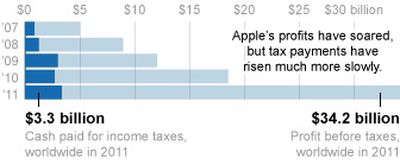
Overall, Apple paid $3.3 billion in corporate taxes in 2011 on earnings of $34.2 billion in profits, an effective tax rate of 9.8%, which is considered low by corporate standards. But with the company's tactics relying on a complex and disjointed system of tax laws throughout the world, it is difficult for the United States to single-handedly require Apple to book more of its revenue in its home country, which currently has the highest corporate tax rates in the world when federal and average state rates are included.

Apple has provided an official response to The New York Times, highlighting its role in job creation in the United States, the tax payments it does make, and its charitable giving. The company also notes that its business practices are in full compliance with all laws and accounting rules.

Update: As noted by Forbes, The New York Times is reporting an incorrect calculation of Apple's effective tax rate for 2011 of 9.8%, simply reusing numbers released several weeks earlier by the Greenlining Institute. Forbes points out that Apple's $3.3 billion in taxes paid during 2011 come from its quarterly estimated tax payments made during the year, but that federal tax guidelines instruct taxpayers to base their calculations on the previous year's earnings.

Consequently, Apple's 2011 quarterly tax payments are actually based on 2010's earnings, with the correct amount of tax for 2011 not being settled until Apple files its final taxes in 2012. And given Apple's strong growth rate, the incorrect assumption that Apple's 2011 tax payments were based on 2011's earnings grossly understates Apple's tax rate.

As outlined in his previous piece debunking the Greenlining Institute's claim, Tim Worstall notes that Apple reports its effective tax rate in its annual 10-K filings with the Securities and Exchange Commission, and that rate came in at 24.2% for 2011, much more in line with industry norms.


Popular Stories

Apple Logo Zoomed

Tim Cook Teases Plans for Apple's Upcoming 50th Anniversary

Thursday February 5, 2026 12:54 pm PST by
Apple turns 50 this year, and its CEO Tim Cook has promised to celebrate the milestone. The big day falls on April 1, 2026. "I've been unusually reflective lately about Apple because we have been working on what do we do to mark this moment," Cook told employees today, according to Bloomberg's Mark Gurman. "When you really stop and pause and think about the last 50 years, it makes your heart ...
wwdc sans text feature

Apple Rumored to Announce New Product on February 19

Thursday February 5, 2026 12:22 pm PST by
Apple plans to announce the iPhone 17e on Thursday, February 19, according to Macwelt, the German equivalent of Macworld. The report, citing industry sources, is available in English on Macworld. Apple announced the iPhone 16e on Wednesday, February 19 last year, so the iPhone 17e would be unveiled exactly one year later if this rumor is accurate. It is quite uncommon for Apple to unveil...
Finder Siri Feature

Why Apple's iOS 26.4 Siri Upgrade Will Be Bigger Than Originally Promised

Friday February 6, 2026 3:06 pm PST by
In the iOS 26.4 update that's coming this spring, Apple will introduce a new version of Siri that's going to overhaul how we interact with the personal assistant and what it's able to do. The iOS 26.4 version of Siri won't work like ChatGPT or Claude, but it will rely on large language models (LLMs) and has been updated from the ground up. Upgraded Architecture The next-generation...
iOS 26

iOS 26.3 and iOS 26.4 Will Add These New Features to Your iPhone

Tuesday February 3, 2026 7:47 am PST by
While the iOS 26.3 Release Candidate is now available ahead of a public release, the first iOS 26.4 beta is likely still at least a week away. Following beta testing, iOS 26.4 will likely be released to the general public in March or April. Below, we have recapped known or rumored iOS 26.3 and iOS 26.4 features so far. iOS 26.3 iPhone to Android Transfer Tool iOS 26.3 makes it easier...
iphone 17 pro dark blue 1

iPhone 18 Pro Max Rumored to Deliver Next-Level Battery Life

Friday February 6, 2026 5:14 am PST by
The iPhone 18 Pro Max will feature a bigger battery for continued best-in-class battery life, according to a known Weibo leaker. Citing supply chain information, the Weibo user known as "Digital Chat Station" said that the iPhone 18 Pro Max will have a battery capacity of 5,100 to 5,200 mAh. Combined with the efficiency improvements of the A20 Pro chip, made with TSMC's 2nm process, the...

Top Rated Comments

rdowns Avatar
180 months ago
Perfectly legal, but this is the kind of behaviour that should get alot of attention in order to bring badwill to the companies doing it.


It's the fault of our corrupt Congress who write a corrupt tax code.
Score: 105 Votes (Like | Disagree)
Lennholm Avatar
180 months ago
Perfectly legal, but this is the kind of behaviour that should get alot of attention in order to bring badwill to the companies doing it.
Score: 48 Votes (Like | Disagree)
bartzumbari Avatar
180 months ago
Minimizing taxes is the ethical thing to do

A company is ethically obligated to minimize its own tax burden IMO. I would fault a company that does otherwise. The humans involved in the company (employees, investors) already pay taxes, as well they should since they're the ones who directly benefit from most government services.

Blaming a company for taking advantage of legal tax loopholes is like blaming water for finding leaks in a boat.
Score: 41 Votes (Like | Disagree)
-Ken- Avatar
180 months ago
Businesses do not pay taxes, ever.

The costs are merely added to the prices of goods and services.

Instead, we should be looking at Apple's payroll. How many hundreds of millions of dollars do their employees get paid?

THEY pay taxes.
Score: 40 Votes (Like | Disagree)
StealthGhost Avatar
180 months ago
You can't fault companies and people for taking advantage of legal loopholes but this is a perfect example of why we should eliminate them.
Score: 39 Votes (Like | Disagree)
Mr_Ed Avatar
180 months ago
I don't blame any corporation for using all legal, available means to reduce their tax burden. It's just good business. Perhaps we should be looking at why corporate tax rates in the U.S. are so high that the other, more convoluted options are economically feasible.

The one thing I will say about this article is that you just know there will be many Apple bashers out there that will grab on to this and continue to single out Apple and paint it in a bad light as a result even though they are not the only ones doing this. Like the whole Foxconn labor issue, where a cursory look at what the media reported made it sound like Apple was the only beneficiary of whatever Foxconn does with regard to labor.
Score: 36 Votes (Like | Disagree)