Amongst the many new products Apple introduced today, they also announced a new storage option called Fusion Drive. Apple's website describes how the drive works:
With Fusion Drive in your iMac, disk-intensive tasks — from booting up to launching apps to importing photos — are faster and more efficient. That’s because frequently used items are kept at the ready on speedy flash storage, while infrequently accessed items go to the hard drive. The file transfers take place in the background, so you won’t even notice.
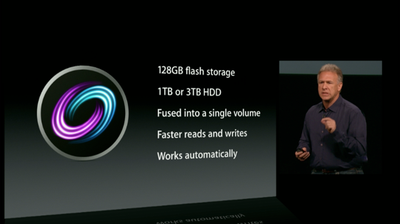
Some thought the drive might be Apple's implementation of a Hybrid drive which uses SSD as a caching system, but it appears that Apple's system is distinct. The MacObserver digs into some details and clarifies:
To be clear, this is not a caching concept, at least not in the current use of the word. Cache would imply that the data on the SSD is duplicated, and it's not. If you have a 1TB mechanical drive paired with the 128GB SSD, you have a 1.12 TB storage platform. This truly is the fusion of all the space on two separate disks.
In a caching solution, like Intel's, files live on the hard disk drive and are temporarily mirrored to the SSD cache as needed. In an enterprise auto-tiering situation, and with Fusion Drive, the data is actually moved from one tier to another, rather than only being temporarily cached there.
The Mac Observer reports that there are two separate drives that appear as one logical partition. As a result, if your Hard Drive fails, it could be replaced with a 3rd party drive and reconfigured as a Fusion Drive.
Meanwhile, they note that all writes take place on the SSD drive, and are later moved to the mechanical drive if needed, resulting in faster initial writes. The Fusion will be available for the new iMac and new Mac mini models announced today.
Thursday February 5, 2026 12:54 pm PST by Joe Rossignol
Apple turns 50 this year, and its CEO Tim Cook has promised to celebrate the milestone. The big day falls on April 1, 2026.
"I've been unusually reflective lately about Apple because we have been working on what do we do to mark this moment," Cook told employees today, according to Bloomberg's Mark Gurman. "When you really stop and pause and think about the last 50 years, it makes your heart ...
Thursday February 5, 2026 12:22 pm PST by Joe Rossignol
Apple plans to announce the iPhone 17e on Thursday, February 19, according to Macwelt, the German equivalent of Macworld.
The report, citing industry sources, is available in English on Macworld.
Apple announced the iPhone 16e on Wednesday, February 19 last year, so the iPhone 17e would be unveiled exactly one year later if this rumor is accurate. It is quite uncommon for Apple to unveil...
Friday February 6, 2026 3:06 pm PST by Juli Clover
In the iOS 26.4 update that's coming this spring, Apple will introduce a new version of Siri that's going to overhaul how we interact with the personal assistant and what it's able to do.
The iOS 26.4 version of Siri won't work like ChatGPT or Claude, but it will rely on large language models (LLMs) and has been updated from the ground up.
Upgraded Architecture
The next-generation...
Tuesday February 3, 2026 7:47 am PST by Joe Rossignol
While the iOS 26.3 Release Candidate is now available ahead of a public release, the first iOS 26.4 beta is likely still at least a week away. Following beta testing, iOS 26.4 will likely be released to the general public in March or April.
Below, we have recapped known or rumored iOS 26.3 and iOS 26.4 features so far.
iOS 26.3
iPhone to Android Transfer Tool
iOS 26.3 makes it easier...
The iPhone 18 Pro Max will feature a bigger battery for continued best-in-class battery life, according to a known Weibo leaker.
Citing supply chain information, the Weibo user known as "Digital Chat Station" said that the iPhone 18 Pro Max will have a battery capacity of 5,100 to 5,200 mAh. Combined with the efficiency improvements of the A20 Pro chip, made with TSMC's 2nm process, the...
Personally, an SSD boot drive and separate large HD seems more practical. No need to "fuse" them into one volume. Just seems like asking for trouble.
The fusion drive is just software to automatically handle that. Most consumers probably don't want to have to deal with having a boot drive and a data drive. Some things can be tricky to get onto an external drive, like iTunes and iPhoto libraries.