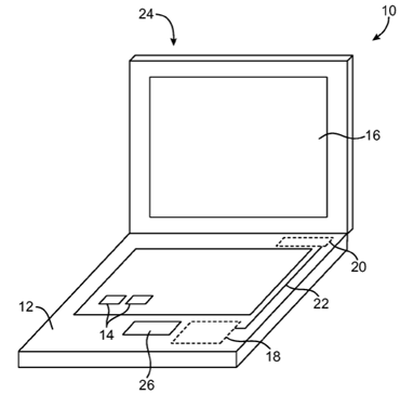
Apple has been awarded a patent (via AppleInsider) for 'microslot antenna' technology, which could enable 'invisible' radio antennas to be embedded into the housing of a Mac, iPhone or iPad to save space inside and allow for more compact devices.
Notebook computer with integrated wireless antenna (20) on device housing
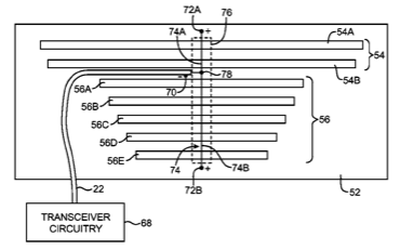
The antennas would use microscopic slots in the housing, with widths of just a few microns, making them almost invisible to the naked eye. The patent shows a variety of possible locations for the antennas on a laptop, though the same approach would likely be taken with iPhones and iPads also.
Top view of microslot antenna design supporting multiple frequencies
Current devices may contain antennas for GSM, 3G/LTE, GPS, wifi and Bluetooth, though some of these may be combined. The iPhone 5, for example, uses just two antennas for the five functions, using rapid frequency switching to enable one antenna to do two jobs. Eliminating the need for internal antenna space altogether would, though, allow for slimmer and smaller devices.
As TechCrunch observes, this could also create the possibility of an all-aluminum case. Apple has previously had to have a small area of glass or plastic to provide radio windows for the internal antennas. Microslot antennas would eliminate this need, perhaps leading to more Mac-like iPhones and iPads in future.
Apple's interest in the possibility of implementing microslot antennas dates back to at least 2007 when the patent was filed, meaning that the concept may be requiring significant refinement before arriving in a shipping product or may have been scrapped entirely by this point. Still, it is clear that Apple is continuing to look for ways to handle the increasing complexity of wireless communications while maintaining its design goals for size and aesthetics.
Saturday February 7, 2026 9:26 am PST by Joe Rossignol
Apple today shared an ad that shows how the upgraded Center Stage front camera on the latest iPhones improves the process of taking a group selfie.
"Watch how the new front facing camera on iPhone 17 Pro takes group selfies that automatically expand and rotate as more people come into frame," says Apple. While the ad is focused on the iPhone 17 Pro and iPhone 17 Pro Max, the regular iPhone...
Friday February 6, 2026 3:06 pm PST by Juli Clover
In the iOS 26.4 update that's coming this spring, Apple will introduce a new version of Siri that's going to overhaul how we interact with the personal assistant and what it's able to do.
The iOS 26.4 version of Siri won't work like ChatGPT or Claude, but it will rely on large language models (LLMs) and has been updated from the ground up.
Upgraded Architecture
The next-generation...
Thursday February 5, 2026 12:22 pm PST by Joe Rossignol
Apple plans to announce the iPhone 17e on Thursday, February 19, according to Macwelt, the German equivalent of Macworld.
The report, citing industry sources, is available in English on Macworld.
Apple announced the iPhone 16e on Wednesday, February 19 last year, so the iPhone 17e would be unveiled exactly one year later if this rumor is accurate. It is quite uncommon for Apple to unveil...
Monday February 9, 2026 6:24 am PST by Joe Rossignol
In select U.S. states, residents can add their driver's license or state ID to the Apple Wallet app on the iPhone and Apple Watch, and then use it to display proof of identity or age at select airports and businesses, and in select apps.
The feature is currently available in 13 U.S. states and Puerto Rico, and it is expected to launch in at least seven more in the future.
To set up the...
New MacBook Pro models with the M5 Pro and M5 Max chips could arrive as soon as Monday, March 2, according to Bloomberg's Mark Gurman.
In today's "Power On" newsletter, Gurman said that the release of new MacBook Pro models is tied to the release of macOS Tahoe 26.3. The launch is said to be slated for as early as the week of March 2. He added that the M4 Pro and M4 Max models on sale today...
I'm always simultaneously fascinated & hopeful when I see patents come through like this. Really makes me curious and optimistic as to the continued and infinite possibilities in technology.
then that means it's not going to be seen in a product.
Something like this would have arrived in a product by 2010. Seeing that it's 2013 already, it's not going to happen. There was something fundamentally wrong with the implementation.
Or they were waiting to be granted the patent before using the technology and/or still perfecting upon it.