Apple announced yesterday that the company has opened up its cryptographic libraries so that third-party developers can build more "advanced security features" into their apps (via VentureBeat). The cryptographic libraries being opened to developers are the same ones Apple uses to protect iOS and OS X, as Apple notes on its updated site.
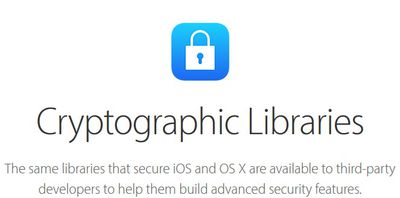
crypto libraries
Developers will have access to two of the company's advanced security features, including Security Framework and Common Crypto. Security Framework gives developers tools for organizing certificates, public and private keys, and trust policies, ensuring that all sensitive information is stored privately in a "secure repository for sensitive user data." Common Crypto library provides additional support for symmetric encryption, hash-based message authentication codes, and digests.

Both Security Framework and Common Crypto rely on the corecrypto library to provide implementations of low level cryptographic primitives. This is also the library submitted for validation of compliance with U.S. Federal Information Processing Standards (FIPS) 140-2 Level 1. Although corecrypto does not directly provide programming interfaces for developers and should not be used by iOS or OS X apps, the source code is available to allow for verification of its security characteristics and correct functioning.

Check out Apple's official website for reference sheets, service guides, and links to the open source releases for Security Framework and Common Crypto libraries.
Top Rated Comments

SpinThis! Avatar
134 months ago
That was my thought as well. Plus, could this knowledge enable a small "back door" that the government has been pestering Apple about?
No. It doesn't matter. Good security isn't based on obscurity. The current security we have is based on our collective knowledge of mathematics. It's good that Apple is opening this up. If developers need to do secure hashing or what not, it's better to use a tried and tested crypto algorithm than trying to roll your own.
Score: 5 Votes (Like | Disagree)
RabidMacFan Avatar
134 months ago
This seems misreported. The only thing new here is the source code for corecrypto. This does not appear to be made to allow third-party-developers to implement new security API's. From the page itself:

Both Security Framework and Common Crypto rely on the corecrypto library to provide implementations of low level cryptographic primitives. This is also the library submitted for validation of compliance with U.S. Federal Information Processing Standards (FIPS) 140-2 Level 1. Although corecrypto does not directly provide programming interfaces for developers and should not be used by iOS or OS X apps, the source code is available to allow for verification of its security characteristics and correct functioning.

(emphasis is mine)

From what I can understand, there are no new usable libraries or API's here. OS X and iOS developers can use Apple's existing Security Framework and Common Crypto services like they have always done.

Whats new is that the source code for the CoreCrypto library that Security Framework and Common Crypto use is available. This allows developers and security professionals to better understand what the existing frameworks were already doing in the background.

One of the benefits of this release is to allow auditing of the source code, and to give assurance to developers with a "trust no one" attitude that the built-in libraries are secure and safe to use.
Score: 4 Votes (Like | Disagree)
Bob Zimmerman Avatar
134 months ago
No, as others said, security comes from having good practices, not by keeping your practices secret.

Linux is generally regarded as the most secure platform, even though it's completely open source. Lots of people have read through the code looking for weaknesses, and lots of people have contributed fixes for any weaknesses they find.
Linux's security reputation is actually pretty bad. BSDs and UNIX variants have a good reputation. OpenBSD in particular is highly-regarded, in part because they audit changes rather stringently. Windows is getting better, and Linux is getting significantly worse.

OpenSSL is an extremely strong proof against the idea that open source is inherently more secure. It had tremendous numbers of very serious flaws that had been in it for years. Just because people can look at the code doesn't mean that they do. That's why the OpenBSD foundation forked OpenSSL, removed tons of options, and started developing it with their audit model as LibreSSL. It's why the OpenBSD guys recently replaced sudo with a new tool called doas that has far fewer options and as a result, far less that can go wrong.

In my experience, much software developed for Linux is built on the platform because it's free and it lets the developers work very quickly. Tons of open-source code runs on Linux, so you just have to download a bunch of libraries and write glue code to get them to do what you want. Unfortunately, many don't take the time to set up their application to run properly under a non-root user account. For that matter, the recommended installation method for a lot of software now is to run curl to fetch a URL, then pipe the output to a root-level bash shell. That is literally telling your system to do whatever some web server or anything claiming to be that server tells it to do.
Score: 3 Votes (Like | Disagree)
ChrisA Avatar
134 months ago
What could go wrong?

:apple:
Not much. Even if the code were kept closed, people can look at the running binary code. It is not that hard to read. In the old days I used to write in Cobol for IBM mainframes and it was common to get a "core dump". This was a printed hexadecimal dump of the computer's RAM to paper. We'd plow through it with a pencil and figure out what went wrong. We did not have debuggers. Anyone can still do this if they take the time. The Intel instruction set is more complex than was IBM360 but not by much.

Certainly the average user can't read a hex dump of a closed source crypto library but many people can. So closing it just makes it harder to read, not impossible.

That said, there are systems were the executable code itself is encrypted. These are completely unreadable and I'd worry there are backdoors and whatever in there
Score: 2 Votes (Like | Disagree)
ArtOfWarfare Avatar
134 months ago
That was my thought as well. Plus, could this knowledge enable a small "back door" that the government has been pestering Apple about?
No, as others said, security comes from having good practices, not by keeping your practices secret.

Linux is generally regarded as the most secure platform, even though it's completely open source. Lots of people have read through the code looking for weaknesses, and lots of people have contributed fixes for any weaknesses they find.
Score: 2 Votes (Like | Disagree)
.max Avatar
134 months ago
This seems misreported.
I agree. The misinterpretation is in this phrase in the article: "Developers will have access to two of the company's advanced security features". Developers have had access to these features for years.

What's different is that now, for example, they can use the open source code and be sure that there are no backdoors. If Apple has (or would be forced in the future to have) backdoors in the system, apps compiled with the open source code would be at less risk.
Score: 1 Votes (Like | Disagree)

Popular Stories

Apple Logo Zoomed

Tim Cook Teases Plans for Apple's Upcoming 50th Anniversary

Thursday February 5, 2026 12:54 pm PST by
Apple turns 50 this year, and its CEO Tim Cook has promised to celebrate the milestone. The big day falls on April 1, 2026. "I've been unusually reflective lately about Apple because we have been working on what do we do to mark this moment," Cook told employees today, according to Bloomberg's Mark Gurman. "When you really stop and pause and think about the last 50 years, it makes your heart ...
wwdc sans text feature

Apple Rumored to Announce New Product on February 19

Thursday February 5, 2026 12:22 pm PST by
Apple plans to announce the iPhone 17e on Thursday, February 19, according to Macwelt, the German equivalent of Macworld. The report, citing industry sources, is available in English on Macworld. Apple announced the iPhone 16e on Wednesday, February 19 last year, so the iPhone 17e would be unveiled exactly one year later if this rumor is accurate. It is quite uncommon for Apple to unveil...
Finder Siri Feature

Why Apple's iOS 26.4 Siri Upgrade Will Be Bigger Than Originally Promised

Friday February 6, 2026 3:06 pm PST by
In the iOS 26.4 update that's coming this spring, Apple will introduce a new version of Siri that's going to overhaul how we interact with the personal assistant and what it's able to do. The iOS 26.4 version of Siri won't work like ChatGPT or Claude, but it will rely on large language models (LLMs) and has been updated from the ground up. Upgraded Architecture The next-generation...
iOS 26

iOS 26.3 and iOS 26.4 Will Add These New Features to Your iPhone

Tuesday February 3, 2026 7:47 am PST by
While the iOS 26.3 Release Candidate is now available ahead of a public release, the first iOS 26.4 beta is likely still at least a week away. Following beta testing, iOS 26.4 will likely be released to the general public in March or April. Below, we have recapped known or rumored iOS 26.3 and iOS 26.4 features so far. iOS 26.3 iPhone to Android Transfer Tool iOS 26.3 makes it easier...
iphone 17 pro dark blue 1

iPhone 18 Pro Max Rumored to Deliver Next-Level Battery Life

Friday February 6, 2026 5:14 am PST by
The iPhone 18 Pro Max will feature a bigger battery for continued best-in-class battery life, according to a known Weibo leaker. Citing supply chain information, the Weibo user known as "Digital Chat Station" said that the iPhone 18 Pro Max will have a battery capacity of 5,100 to 5,200 mAh. Combined with the efficiency improvements of the A20 Pro chip, made with TSMC's 2nm process, the...