The Next Generation Apple Watch Could Identify Users by Their Heart Rate

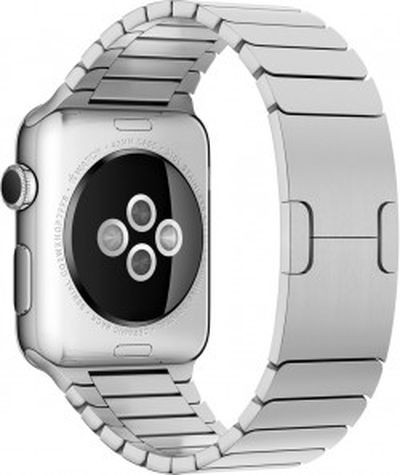
apple_watch_sensorThe U.S. Patent and Trademark Office published an invention today that suggests the next Apple Watch could identify its owner simply by checking their heart rate.

Apple's patent application is titled "User identification system based on plethysmography" and describes how a pulse oximeter is used to determine the biometric signature of a user's cardio rhythms. This data could then be used to identify the wearer and unlock the watch in a manner similar to Touch ID on the iPhone.

The system works similarly to existing monitors, by projecting light on the user's skin and measuring how much of it is absorbed and reflected back to the device. The measurement can then be used to determine the amount of blood present in the vasculature. According to the patent, the data gathered by the two photosensors is either stored or compared against previously saved information to positively identify the user.

In an associated patent also published today, the invention is extended to take in data from motion sensors like accelerometers and gyroscopes to determine user movement. Certain gestures, for example raising the device from waist height to head height, trigger the authentication process.

AppleInsider notes that the system could replace Touch ID during Apple Pay payments and further reduce the watch's reliance on iPhone, although it's unclear if heart rate data can be a unique enough identifier to ensure the same level of security.
Related Roundup: Apple Watch 11
Tag: Patent
Buyer's Guide: Apple Watch (Neutral)

Popular Stories

maxresdefault

Apple Shows Off a Key Reason to Upgrade to the iPhone 17

Saturday February 7, 2026 9:26 am PST by
Apple today shared an ad that shows how the upgraded Center Stage front camera on the latest iPhones improves the process of taking a group selfie. "Watch how the new front facing camera on iPhone 17 Pro takes group selfies that automatically expand and rotate as more people come into frame," says Apple. While the ad is focused on the iPhone 17 Pro and iPhone 17 Pro Max, the regular iPhone...
wwdc sans text feature

Apple Rumored to Announce New Product on February 19

Thursday February 5, 2026 12:22 pm PST by
Apple plans to announce the iPhone 17e on Thursday, February 19, according to Macwelt, the German equivalent of Macworld. The report, citing industry sources, is available in English on Macworld. Apple announced the iPhone 16e on Wednesday, February 19 last year, so the iPhone 17e would be unveiled exactly one year later if this rumor is accurate. It is quite uncommon for Apple to unveil...
Apple Logo Zoomed

Tim Cook Teases Plans for Apple's Upcoming 50th Anniversary

Thursday February 5, 2026 12:54 pm PST by
Apple turns 50 this year, and its CEO Tim Cook has promised to celebrate the milestone. The big day falls on April 1, 2026. "I've been unusually reflective lately about Apple because we have been working on what do we do to mark this moment," Cook told employees today, according to Bloomberg's Mark Gurman. "When you really stop and pause and think about the last 50 years, it makes your heart ...
Finder Siri Feature

Why Apple's iOS 26.4 Siri Upgrade Will Be Bigger Than Originally Promised

Friday February 6, 2026 3:06 pm PST by
In the iOS 26.4 update that's coming this spring, Apple will introduce a new version of Siri that's going to overhaul how we interact with the personal assistant and what it's able to do. The iOS 26.4 version of Siri won't work like ChatGPT or Claude, but it will rely on large language models (LLMs) and has been updated from the ground up. Upgraded Architecture The next-generation...
iOS 26

iOS 26.3 and iOS 26.4 Will Add These New Features to Your iPhone

Tuesday February 3, 2026 7:47 am PST by
While the iOS 26.3 Release Candidate is now available ahead of a public release, the first iOS 26.4 beta is likely still at least a week away. Following beta testing, iOS 26.4 will likely be released to the general public in March or April. Below, we have recapped known or rumored iOS 26.3 and iOS 26.4 features so far. iOS 26.3 iPhone to Android Transfer Tool iOS 26.3 makes it easier...

Top Rated Comments

radiology Avatar
122 months ago
this is just NOT possible. Your heart rate can change a lot in many normal and abnormal conditions. I call this BS.
Score: 10 Votes (Like | Disagree)
manu chao Avatar
122 months ago
this is just NOT possible. Your heart rate can change a lot in many normal and abnormal conditions. I call this BS.
What this sensor measures is how you blood vessels expand as a pressure pulse is travelling through your veins when the heart contracts. The blood pressure (and thus the size of the blood vessel) follows a periodic fluctuation not unlike a sine curve. The heart rate is given by only looking at the frequency of that periodic fluctuation. Studying the whole shape of the curve gives you much more information than just looking at the frequency.
Score: 8 Votes (Like | Disagree)
Gasu E. Avatar
122 months ago
http://dsn.sagepub.com/content/11/6/549134.full
http://www.inderscience.com/storage/f104531211967812.pdf
http://file.scirp.org/pdf/JIS20120100004_57389606.pdf
https://www.ncbi.nlm.nih.gov/pmc/articles/PMC4535678/

Is it that your holding off until the security parity between heartbeat signatures and fingerprints is closed, or do you honestly not believe it is a viable identification technique? The way I read you posts you seemed to dispute that heartbeat signatures are unique. Am I misreading your objection?
Troll trap! He's got you doing his research for you! Meanwhile he just sits back and armchair reacts to your posts. Is it so important to get this guy to agree with you that you have to do his work for him, given he's not intellectually curious enough to do it for himself?
Score: 6 Votes (Like | Disagree)
iapplelove Avatar
122 months ago
That's deliciously clever technology. The Star Trek future gets ever closer.
You would be amazed at the technology our secret space programs keep from us. Stuff we already have, things us normal people won't ever get to experience.
Score: 5 Votes (Like | Disagree)
keysofanxiety Avatar
122 months ago
That's deliciously clever technology. The Star Trek future gets ever closer.
Score: 3 Votes (Like | Disagree)
BMcCoy Avatar
122 months ago
No, my objection is that there is no way this currently works when scaled up to a decent population size, which is of course what would be required for this to be an identification technology.

Did you read those papers, or did you just quickly google, then cut n paste?

"..the majority of the studies have been conducted on a small population (about a few tens of subjects). Therefore, the applicability of ECG biometric recognition on a large scale (real life authentication scenario) it is not yet proven."

"..almost all studies (except for [17 ('https://www.ncbi.nlm.nih.gov/pmc/articles/PMC4535678/#CR17')] and [31 ('https://www.ncbi.nlm.nih.gov/pmc/articles/PMC4535678/#CR31')] ) ignored the variability of the ECG during life span (i.e. variability induced by work, ageing, iterate sport activity etc.); moreover, only few studies [57 ('https://www.ncbi.nlm.nih.gov/pmc/articles/PMC4535678/#CR57'), 83 ('https://www.ncbi.nlm.nih.gov/pmc/articles/PMC4535678/#CR83'), 136 ('https://www.ncbi.nlm.nih.gov/pmc/articles/PMC4535678/#CR136')] considered the applicability of these techniques when subjects suffer from pathological conditions. ECG recognition in pathological subjects is another aspect worth of additional investigations."

"it must be emphasised that, while guidelines are available for ECG acquisition in the clinical scenario, there is still a lack of standardisation on ECG acquisition (number of leads and their positioning, sampling frequency, number of bits, filtering, type of electrodes, number of leads etc.) for biometrics applications. However, ECG databases for biometric recognition should ideally include recordings, at a given sampling frequency and conditions, from the same subjects in different circumstances (e.g. relaxed, during and after physical training) and along a period of several years."

And still no discussion of sensitivity and specificity.

Not even remotely close to being a practical and usable technology.
Score: 3 Votes (Like | Disagree)