Fitbit Announces Deal to Bring Glucose Monitoring Data to its Ionic Smartwatch

Fitbit has announced a new partnership with glucose monitoring device company Dexcom that is set to bring diabetes monitoring capabilities to the fitness tracker company's new Ionic smartwatch.

The deal initially means Ionic users will be able to connect a Dexcom device to the Fitbit app and seamlessly transfer up-to-date glucose level data to the smartwatch, making the information more easily accessible on their wrist.
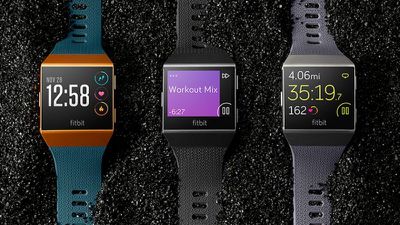
fitbit iconic

"The collaboration between Dexcom and Fitbit is an important step in providing useful information to people with diabetes that is both convenient and discreet," said Kevin Sayer, President and CEO, Dexcom. "We believe that providing Dexcom CGM data on Fitbit Ionic, and making that experience available to users of both Android and iOS devices, will have a positive impact on the way people manage their diabetes."

There's nothing in the partnership to suggest the Ionic smartwatch will be able to give continuous glucose monitoring readouts on its own when it's released next month – current continuous glucose monitoring systems require a small sensor that's worn under the skin to monitor glucose levels – but Fitbit shares jumped 13 percent on the news, a high for the company since January, when it laid off some of its employees and announced its smartwatch plans.

Dexcom also has a deal with Apple to bring its features to the Apple Watch this year, while owners of Dexcom monitors can already view their glucose data on an Apple Watch – advanced devices by Dexcom include a transmitter, which can display glucose information directly to an iPhone app.

Apple is thought to be working on a non-invasive real-time glucose monitor for a future version of Apple Watch. In April, a CNBC report suggested Apple had a team of biomedical engineers working to develop sensors for non-invasively monitoring blood glucose, with work on the sensors far enough along that the company had started conducting feasibility trials.

Apple CEO Tim Cook was reportedly spotted in May testing a prototype glucose monitor that's connected to his Apple Watch. Cook, who is said to be aiming to understand how his blood sugar is affected by food and exercise, has been seen wearing the device around the Apple Campus.

Related Roundup: Apple Watch 11
Tags: Dexcom, Fitbit
Buyer's Guide: Apple Watch (Neutral)

Popular Stories

Apple Logo Zoomed

Tim Cook Teases Plans for Apple's Upcoming 50th Anniversary

Thursday February 5, 2026 12:54 pm PST by
Apple turns 50 this year, and its CEO Tim Cook has promised to celebrate the milestone. The big day falls on April 1, 2026. "I've been unusually reflective lately about Apple because we have been working on what do we do to mark this moment," Cook told employees today, according to Bloomberg's Mark Gurman. "When you really stop and pause and think about the last 50 years, it makes your heart ...
wwdc sans text feature

Apple Rumored to Announce New Product on February 19

Thursday February 5, 2026 12:22 pm PST by
Apple plans to announce the iPhone 17e on Thursday, February 19, according to Macwelt, the German equivalent of Macworld. The report, citing industry sources, is available in English on Macworld. Apple announced the iPhone 16e on Wednesday, February 19 last year, so the iPhone 17e would be unveiled exactly one year later if this rumor is accurate. It is quite uncommon for Apple to unveil...
Finder Siri Feature

Why Apple's iOS 26.4 Siri Upgrade Will Be Bigger Than Originally Promised

Friday February 6, 2026 3:06 pm PST by
In the iOS 26.4 update that's coming this spring, Apple will introduce a new version of Siri that's going to overhaul how we interact with the personal assistant and what it's able to do. The iOS 26.4 version of Siri won't work like ChatGPT or Claude, but it will rely on large language models (LLMs) and has been updated from the ground up. Upgraded Architecture The next-generation...
iOS 26

iOS 26.3 and iOS 26.4 Will Add These New Features to Your iPhone

Tuesday February 3, 2026 7:47 am PST by
While the iOS 26.3 Release Candidate is now available ahead of a public release, the first iOS 26.4 beta is likely still at least a week away. Following beta testing, iOS 26.4 will likely be released to the general public in March or April. Below, we have recapped known or rumored iOS 26.3 and iOS 26.4 features so far. iOS 26.3 iPhone to Android Transfer Tool iOS 26.3 makes it easier...
iphone 17 pro dark blue 1

iPhone 18 Pro Max Rumored to Deliver Next-Level Battery Life

Friday February 6, 2026 5:14 am PST by
The iPhone 18 Pro Max will feature a bigger battery for continued best-in-class battery life, according to a known Weibo leaker. Citing supply chain information, the Weibo user known as "Digital Chat Station" said that the iPhone 18 Pro Max will have a battery capacity of 5,100 to 5,200 mAh. Combined with the efficiency improvements of the A20 Pro chip, made with TSMC's 2nm process, the...

Top Rated Comments

Chupa Chupa Avatar
110 months ago
It would be Great if one day smart watches could also accurately detect heart problems before a heart attack occurs.
Long way to go there. Right now optical HRMs (all, not just the AW) cannot detect electrical heart activity. Optical HRM can only detect pulse based on light transmitted though blood. That is why the AW HR data (and other optical based watches) are inferior to those that require a chest strap for data collection. Optically gleaned data:2D, chest straps:3D.
Score: 3 Votes (Like | Disagree)
Sunny1990 Avatar
110 months ago
It would be Great if one day smart watches could also accurately detect heart problems before a heart attack occurs.
Score: 3 Votes (Like | Disagree)
Kabeyun Avatar
110 months ago
Not Earth-shattering news here, although those who frenzied to buy Fitbit shares didn't appreciate that. The Fitbit will show the data of another device, just as AppleWatch can. Accurate real-time blood glucose monitoring, on the other hand, will be a game changer.
Score: 3 Votes (Like | Disagree)
thisisnotmyname Avatar
110 months ago
Not Earth-shattering news here, although those who frenzied to buy Fitbit shares didn't appreciate that. The Fitbit will show the data of another device, just as AppleWatch can. Accurate real-time blood glucose monitoring, on the other hand, will be a game changer.
The downside is that if someone were to make non-invasive real time glucose metering accurate and incorporate it natively into, say, the Apple Watch, then every update to WatchOS from the point forward would require FDA approval. It's a bureaucratic nightmare which makes me think they'd want to isolate it in some way (e.g. a band with its own reporting/display mechanism that then uses BT to send to the watch for redundant archival, someone focusing to this area of regulation could weigh in but I believe that lowers the bar then).
Score: 3 Votes (Like | Disagree)
thekeyring Avatar
110 months ago
It's still invasive, unlike the sensor Apple have been testing.

I'm tired of hearing news like this and Google's AR efforts. Just enough to steal the sheen from Apple but not better, or even as good as Apple products.

I would love Apple to leapfrog others. Completely smash it out of the park like the gap which existed between iPhone 4S and any Blackberry phone in 2011.
Score: 2 Votes (Like | Disagree)
Chupa Chupa Avatar
110 months ago

2% variance from better monitors isn’t bad at all.
No I don't think you understand the difference between the two technologies. I am not talking about simple pulse. I'm talking about electrical activity, similar to what an EKG does. (Obviously EKGs are medical grade and consumer chest straps are not.) But optical HRMs -- no matter what brand because it's not about brand it's about the technology -- cannot detect electrical activity. There currently is no way to derive heart rate variability (HRV) from an optical sensor -- again regardless of brand.

But yes, if you are training 2% can be the difference from thinking you are in one zone or another -- a zone you don't want to be in. If you don't do heart conditioning then 2% doesn't matter obviously. So it depends what your use it. 2% can be significant and is why people serious about heart conditioning do use a strap.
Score: 1 Votes (Like | Disagree)