Apple's iOS 'Health Records' Feature Now Works With 75+ Providers - MacRumors
Skip to Content

Apple's iOS 'Health Records' Feature Now Works With 75+ Providers

Apple's Health Records feature, introduced in iOS 11.3, now allows iOS users to access their medical records from more than 75 different hospitals and medical providers in the United States.

Apple maintains a list of all of the healthcare institutions that support Health Records on the iPhone, which as VentureBeat points out, was updated in August ahead of a talk from Apple's Clinical and Health Informatics lead Ricky Bloomfield, M.D. given at the ONC 2nd Interoperability Forum (via EHR Intelligence).
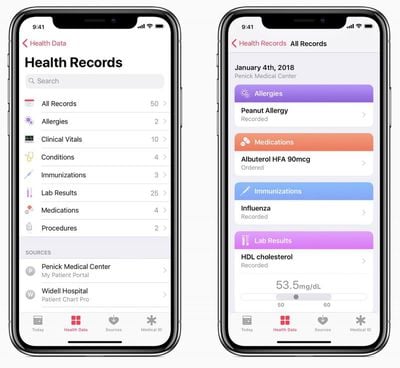
health records ios 11
When the Health Records feature first launched earlier this year, it worked with just 12 healthcare providers, a number that Apple has been working to improve. Recent additions include Kaiser in Oregon and Washington, Baptist Health, Buffalo Health, Greater Hudson Valley Health System, UC San Diego Health, UCLA Health, and others.

Health record data is available in the Health app, and allows patients who have multiple healthcare providers to access all of their information in one convenient place.

According to Bloomfield, Apple's Health app leverages Fast Healthcare Interoperability Resources (FHIR) that were developed to facilitate better data sharing standards. FHIR is in a draft stage and won't be finalized until the end of the year, but Apple's adoption may drive widespread adoption of FHIR in the medical community.

Apple is using an "Argonaut" implementation of the Fast Healthcare Interoperability Resources standard, in fact, because it's simple and will encourage medical providers to adopt it.

The Health Records feature in the Health app is designed to connect with partner systems using FHIR to collect data and display it right on a user's device.

"It makes it very easy for you to manage your health information," Bloomfield told attendees of the ONC 2nd Interoperability Forum on August 8. "You as a user have complete control over who has access to the data. If you don't want to share it, it won't be shared. It stays private on your device until you decide to share it."

As Bloomfield explains, Health Records can be accessed in the Health app under the "Health Data" section. After choosing and authenticating with a provider, all relevant medical data is available through the Health app and is updated automatically following doctor visits.

"That significantly reduces the friction typically associated with accessing your health information where you need to remember your credentials, log in, and then get the information," he continued. "And when you have new information, you may get an email that there's new information, but you still need to log in to access the information."

Health Records is designed to display information that includes allergies, vital signs, conditions, immunizations, medications, labs, and procedures.

As with all Apple features, privacy is a key with Health Records. As Bloomfield says, patients have control over who is able to access their data.

Popular Stories

iPhone Duo Trio

Here's What Apple's Apps Look Like on the iPhone Duo

Tuesday October 20, 2026 11:12 am PDT by
With just three days to go until the iPhone Duo is released, Apple is getting ready for the launch. Behind the scenes, the App Store now has screenshots of Apple's built-in apps running on the Duo. We've seen some apps in marketing materials, but images of the ones we haven't seen give us an idea of what it will be like using the iPhone Duo day to day. Many apps are shown in landscape...

Apple Creator Studio iWork suite

Apple Pulls Keynote, Pages and Numbers From App Store [Update: Back]

Thursday October 22, 2026 11:01 am PDT by
Apple has temporarily removed Keynote, Pages, and Numbers from the App Store, just after releasing an update that added iPhone Duo support and a new Intelligent Assistant. It is not clear if the apps were removed intentionally, or if it is a bug. Apple has not said when the apps will be reinstated, but if it was in error, they should return soon. Update: The Mac versions are back without...
M5 MacBook Pro

RIP, MacBook Ultra

Monday October 19, 2026 9:37 am PDT by
Apple today sent out invites for an experience in Los Angeles on Wednesday, October 28, and the "Pro and tell" tagline on the invitation likely means that the rumored MacBook models with touch-enabled OLED displays will stick with MacBook Pro branding instead of the once-rumored "MacBook Ultra" name. The long-rumored "iPhone Ultra" ended up being named iPhone Duo, so speculation that Apple...

Top Rated Comments

andrewsipes Avatar
107 months ago
Apple will need to do is make the code for this free and create a kit that is cross platform and universal.
Apple is basically implementing an existing standard from an international health organization. This is largely a function of standardized, structured data, not some special sauce. Other companies and medical institutions are free to do the same.

From the information mentioned in the article, FHIR (Fast Healthcare Interoperability Resources) is a spec by HL7 (Health Level Seven), a not-for-profit, ANSI-accredited standards developing organization. Argonaut focuses on subset of the FHIR spec through core API and data services.

Health Level Seven | http://www.hl7.org/
FHIR Specification | https://www.hl7.org/fhir/overview.html
Argonaut Project | http://argonautwiki.hl7.org/index.php?title=Main_Page
Score: 9 Votes (Like | Disagree)
johnnyjibbs Avatar
107 months ago
If they add NHS, that’s the whole of the United Kingdom covered
Score: 9 Votes (Like | Disagree)
107 months ago
This is all fine and good... until your healthcare provider shares all of the detailed information about your previously unknown chronic illness to your insurance company. You might have control over who you share it with, but once it's "out there"... you have no control over it. Crooked insurance companies (and they ALL are crooked) will see this information as a potential gold mine and seek to obtain it any way they can once they know it's available.
HIPAA laws expressly forbids the sharing of patient records with insurance companies without a ROI from the patient. I have been in the pharmaceutical/healthcare industry for over 10 years. And from my experience... no healthcare provider would risk their practice/medical license doing that.
Score: 6 Votes (Like | Disagree)
chucker23n1 Avatar
107 months ago
You do realize your “insurance provider” already has this information from your physician. They pay the bill, and they call the shots.
No, they do not. They can see which drugs you're buying (since they pay a share), they can see you've been visiting a doctor, and they may request a doctor's report (such as to confirm that a costly treatment is advisable), but they don't have a full picture. They can only guess and extrapolate what kind of treatment you're getting. They don't get lab results, and they don't listen in on conversations you have with your doctor (nor do they get regular reports on them).

They know exactly what is going on with your health,
That's a stretch.
Score: 4 Votes (Like | Disagree)
107 months ago
There are a couple inaccuracies here in the comments, so I felt compelled to post. Sorry.

1. HL7 FHIR is the newest standard for healthcare interoperability (i.e. sharing data between systems). The previous standards are 20-30 years old. These standards are really a template but don't speak much to the content of the messages. There are additional standards for certain types of data exchange that HL7 also formulates, mostly leaning back on the HL7 FHIR or HL7 v2 standards, for instance there's a specific guide for immunization data which is typically used for public health reporting. There's more layers than this too, but let's just say healthcare data is extremely complicated and diverse, and so it is very complex to share electronically in a meaningful way.

2. While there would normally not be much motivation to adopt a standard, the U.S. federal government has had a huge part in causing EHR adoption though the HITECH Act and Meaningful Use incentives for providers, and they set standards for Certified Electronic Health Record Technology (CEHRT). The next version of the standards will likely require FHIR adoption, which will make it a lot easier to share data in a more open source way (plug and play apps), unlike now which his heavily controlled by private companies who set very high prices for basic activities.

3. When you sign up for insurance you attest that you have disclosed all illnesses. If you're trying to hide something, it could come back and bite you when you have a complication of that condition. Additionally, you also typically agree to have your insurance company have full access to your records at any provider office you visit. This includes cash payments. This is standard because the insurance company is on the hook for a series of quality measures which are tied to their accreditation, among other reasons. Most states have laws that protect individuals from bad practices on the insurer side. If you were inappropriately denied a claim, etc., you should be able to report it to someone and they will investigate. But if you lie to the insurer no law will protect you much. That's partially because your lie can impact the rates of everyone else covered by the plan and you might not be paying your fair share based upon your cost risk to the plan.

4. HIPAA explains requirements to keep your health information confidential, and circumstances where it is okay for a covered entity (like your doctor's office) to disclose it and whether they need a special consent. There are a lot of scenarios where it is okay without a special consent (called payment, treatment, and operations), such as claims to your health insurer, referrals or records sent to other doctors, data sent to IT companies that host the EHR or apps (like Apple), etc. In some cases the covered entity needs to enter into a data sharing agreement to set the requirements for how the data is protected, in transit and at rest, what happens if there is a breach, etc. I think my point here is that your healthcare data is all over the place and that's absolutely legal, and it also should benefit you because your doctors can have more information or better tools to make sure they know how to treat your illnesses. We often address the sensitive to health data sharing in this way: You don't want your health data shared, but when you get to the hospital you want them to have your whole medical history instantly. These two concepts don't work well together, and at some point there has to be a balance of the desire for absolute privacy and the desire for your trusted healthcare professionals to have the right information at the right time to help you.
Score: 3 Votes (Like | Disagree)
107 months ago
This is all fine and good... until your healthcare provider shares all of the detailed information about your previously unknown chronic illness to your insurance company. You might have control over who you share it with, but once it's "out there"... you have no control over it. Crooked insurance companies (and they ALL are crooked) will see this information as a potential gold mine and seek to obtain it any way they can once they know it's available.
As someone who works for one of these "crooked" companies, if you have a chronic illness, that's going to be hard to hide, if it's hidden at all. We might not have all the details, but we know which drugs you're taking, how often you visit the doctor, which services we're being billed for, what surgeries you're having, etc. That's like saying "You can't guess which coin is in my hand, but I can tell you it's not a penny, dime, quarter, half-dollar or whole-dollar". We don't just get a bill that says "you owe us $80,000 for 'none of your damn business'" and pay it. That's absurd. We also have staff that help those with Chronic Diseases. If you have diabetes for example, we will discover that (it will be shared with us legally) and you're likely to have someone contact you in an attempt to help you better manage your disease (all free of charge). Sure, that helps bring our costs down. But it's also a fantastic benefit for those who accept it.

Your theory that ALL insurance companies are crooked and out to screw you however we can is a complete joke with absolutely no evidence to back that up.
Score: 3 Votes (Like | Disagree)
Latest Stories
iPhone Duo Demand Reportedly Exceeds Apple's Expectations
2 hours ago
iPhone Duo Launch Begins as First Orders Reach Customers
8 hours ago
1Password for Agents Keeps Your Passwords Hidden From AI
9 hours ago
iPhone Duo 24 Hours Later: Your Questions Answered
9 hours ago
Apple's iWork Apps Get 'Intelligent Assistant' and iPhone Duo Support
10 hours ago
Apple is Apparently Considering a Slightly Larger iPhone Duo
10 hours ago
Giant iPhone Duo Displays Coming to Four Apple Stores
11 hours ago
Apple Pulls Keynote, Pages and Numbers From App Store [Update: Back]
12 hours ago
Apple Updates More Apps With iPhone Duo Support
12 hours ago
Apple Will Label Apps 'Made for iPhone Duo' in App Store
15 hours ago
Amazon Takes $49 Off iPad With Prices Starting at $399.99
16 hours ago
F1 on Apple TV Now Available in Dolby Atmos
16 hours ago
Apple Reveals More Than 50 Apps That Will Be Updated for iPhone Duo
17 hours ago
Apple Blocks Certificates That Could Help Attackers Fake Websites
18 hours ago
Giant iPhone Duo Installations Spotted at Apple Fifth Avenue
19 hours ago
iPhone Duo 2 Prototypes Include Under-Display Face ID
19 hours ago
Tesla App Gains iPad and iPhone Duo Support
23 hours ago
Apple Reportedly Boosts iPhone Duo Orders by 44%
1 day ago
Fortnite Returning to Australian App Store After Court Ruling
1 day ago
Apple Ordered to Open iPhone to Rival App Stores in Australia
1 day ago
Apple Suppliers Face Hurdles Cutting Circuit Board Emissions
1 day ago
Things Updated for iPhone Duo With Adaptive Layout
1 day ago
Simplicity and Siri AI Are HomeView's Killer Features, Apple Says
1 day ago
iPhone Duo Reviewers Really Miss Face ID
1 day ago
Does the iPhone Duo Run Hot? Here's What Reviews Found
1 day ago
Apple Music's New Look is Now Live on Apple's Website
1 day ago
Anthropic Launches Claude Duet, a Proactive AI Agent
1 day ago
What 32,000 Folds Did to the iPhone Duo's Hinge
1 day ago
iPhone Duo's Hidden FaceTime Camera Takes 'Trash' Photos
1 day ago
iPhone Duo Has 'Edge Light' Feature That Debuted on Macs Last Year
2 days ago