Security Researcher Shows How Remote macOS Exploit Hoodwinks Safari Users With Custom URL Schemes - MacRumors
Skip to Content

Security Researcher Shows How Remote macOS Exploit Hoodwinks Safari Users With Custom URL Schemes

by

A security researcher has demonstrated how macOS users are vulnerable to remote infection through a malicious exploit involving the "Do you want to allow..." popup that can be encountered when visiting websites in Safari.

In a lengthy breakdown, Patrick Wardle explains how the exploit utilizes document handlers, which request permission to open a link or a file in another app – like a PDF in Preview, for example – and URL handlers, which work similarly in the way they notify macOS that they can accept certain file formats.
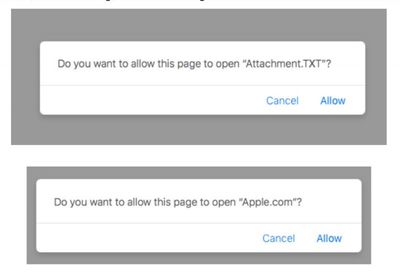
malicious attack safari
The exploit occurs when a user visits a malicious website and a ZIP file is downloaded and automatically unzipped by Safari, whereby the custom URL scheme is initially registered on the user's filesystem.

Once the target visits our malicious website, we trigger the download of an archive (.zip) file that contains our malicious application. If the Mac user is using Safari, the archive will be automatically unzipped, as Apple thinks it's wise to automatically open "safe" files. This fact is paramount, as it means the malicious application (vs. just a compressed zip archive) will now be on the user's filesystem, which will trigger the registration of any custom URL scheme handlers! Thanks Apple!

In the next stage, the malicious web page runs code that can load or "browse" to the custom URL scheme, which causes macOS to activate the URL handler and launch the malicious application.

This action is enabled through the Safari user prompt that includes options to "Allow" or "Cancel" the process, however the popup text and available options are controlled by the attacker, and are therefore easily changed to trick or deceive the user.
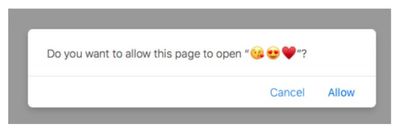
malicious exploit safari
The standard defenses built into macOS – Gatekeeper, for example – are said to be ineffective when it comes to the attack described above, and while Apple could always revoke the malicious app's signature, that course of action would obviously be too late for anyone who had already gone ahead and launched it.

Until then, turning off automatic unzipping of "safe" files should be enough to prevent the malicious procedure from ever occurring. Concerned users can do so by clicking the Safari menu bar, selecting Preferences..., and under the General tab, unchecking Open "safe" files after downloading.


Top Rated Comments

Kebabselector Avatar
100 months ago
Until then, turning off automatic unzipping of "safe" files should be enough to prevent the malicious procedure from ever occurring. Concerned users can do so by clicking the Safari menu bar, selecting Preferences..., and under the General tab, unchecking Open "safe" files after downloading.
Surely this should be the default position for any user regardless of the exploit or not.
Score: 9 Votes (Like | Disagree)
100 months ago
There have been a few previous security vulnerabilities relating to Safari on the Mac, where allowing Safari to open 'safe' files was the entry vector.

Ever since the first such vulnerability, it's been my opinion that the safest approach is to simply leave that option turned off permanently. Particularly as it doesn't really add much convenience. I very rarely want to open a file as soon as it's been downloaded. Also, opening a file manually involves two clicks at the very most.

Anyway, I feel this is one instance where security outweighs convenience by a very wide margin.
Score: 8 Votes (Like | Disagree)
Porco Avatar
100 months ago
I have always turned this option off for any mac I worked with. It should never have been a thing, and certainly never the default.
Score: 7 Votes (Like | Disagree)
twistedpixel8 Avatar
100 months ago
Surely this should be the default position for any user regardless of the exploit or not.
It shouldn’t even be a feature. How lazy do you have to be if you can’t double click an archive?!
Score: 6 Votes (Like | Disagree)
Justanotherfanboy Avatar
100 months ago
His snarky “thanks Apple!” comment seemed a bit unprofessional for a security researcher.
Surely he must be aware that all tech companies don’t try to have security holes... & if none existed whatsoever, he’d be out of a job.
Score: 5 Votes (Like | Disagree)
MrGimper Avatar
100 months ago
I only came here to doff my cap for the use of the word "hoodwinks"
Score: 4 Votes (Like | Disagree)

Popular Stories

Instagram Feature 2

PSA: Instagram Encrypted Messaging Ends on Friday, May 8

Tuesday May 5, 2026 8:24 am PDT by
Instagram will remove end-to-end encryption for direct messages between users from May 8, 2026. When the date comes around, Meta will potentially be able to see the contents of all messages between users on the social media platform. Encrypting messages has been an optional feature in Instagram since 2023, but in March of this year the social media platform quietly updated a help page to say ...
Apple Event Logo

Apple's Next Era Begins September 1

Thursday May 7, 2026 10:36 am PDT by
Apple recently announced that Tim Cook will be stepping down as CEO later this year, after 15 years of leading the company. Effective September 1, Apple's hardware engineering chief John Ternus will become the company's next CEO, while Cook will become executive chairman of Apple's board of directors. In his new role, Apple said Cook will assist with "certain aspects" of the company,...
Four iPhone 18 Pro Colors Mock Feature

iPhone 18 Pro Launching in September With These 10 New Features

Saturday May 9, 2026 6:03 am PDT by
While the iPhone 18 Pro and iPhone 18 Pro Max are not launching until September, there are already plenty of rumors about the devices. It was initially reported that the iPhone 18 Pro models would have fully under-screen Face ID, with only a front camera visible in the top-left corner of the screen. However, the latest rumors indicate that only one Face ID component will be moved under the...