Apple Sued Over Not Letting Customers Disable Two-Factor Authentication After Two Weeks - MacRumors
Skip to Content

Apple Sued Over Not Letting Customers Disable Two-Factor Authentication After Two Weeks

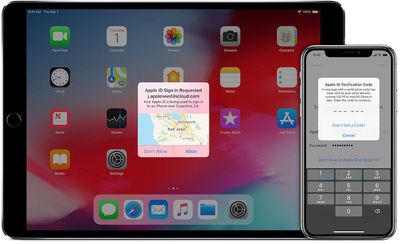
New York resident Jay Brodsky has filed a frivolous class action lawsuit against Apple, alleging that the company's so-called "coercive" policy of not letting customers disable two-factor authentication beyond a two-week grace period is both inconvenient and violates a variety of California laws.
two factor apple
The complaint alleges that Brodsky "and millions of similarly situated consumers across the nation have been and continue to suffer harm" and "economic losses" as a result of Apple's "interference with the use of their personal devices and waste of their personal time in using additional time for simple logging in."

In a support document, Apple says it prevents customers from turning off two-factor authentication after two weeks because "certain features in the latest versions of iOS and macOS require this extra level of security":

If you already use two-factor authentication, you can no longer turn it off. Certain features in the latest versions of iOS and macOS require this extra level of security, which is designed to protect your information. If you recently updated your account, you can unenroll for two weeks. Just open your enrollment confirmation email and click the link to return to your previous security settings. Keep in mind, this makes your account less secure and means that you can't use features that require higher security.

The complaint is riddled with questionable allegations, however, including that Apple released a software update around September 2015 that enabled two-factor authentication on Brodsky's Apple ID without his knowledge or consent. Apple in fact offers two-factor authentication on an opt-in basis.

Brodsky also claims that two-factor authentication is required each time you turn on an Apple device, which is false, and claims the security layer adds an additional two to five minutes or longer to the login process when it in fact only takes seconds to enter a verification code from a trusted device.

The complaint goes on to allege that Apple's confirmation email for two-factor authentication enrollment containing a "single last line" alerting customers that they have a two-week period to disable the security layer is "insufficient."
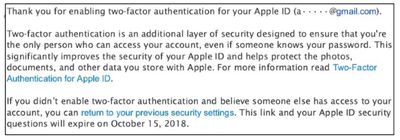
apple two factor email
Brodsky accuses Apple of violating the U.S. Computer Fraud and Abuse Act, California's Invasion of Privacy Act, and other laws. He, on behalf of others similarly situated, is seeking monetary damages as well as a ruling that prevents Apple from "not allowing a user to choose its own logging and security procedure." Read the full document.
Popular Stories

Jon Prosser Rainbow

Jon Prosser Still Not Fully Cooperating in Apple's iOS 26 Trade Secrets Lawsuit

Tuesday April 14, 2026 6:57 am PDT by
A joint status report filed yesterday in Apple's trade secrets lawsuit against YouTuber Jon Prosser and Michael Ramacciotti shows Prosser is still failing to comply with discovery, prompting Apple to seek a court order to compel him. The latest filing, submitted to the U.S. District Court for the Northern District of California yesterday, covers developments since the parties' last update in ...
app store blue banner epic 1

Epic Games Wins Reversal of Stay in App Store Fee Legal Battle

Wednesday April 29, 2026 5:05 am PDT by
Apple will not be able to delay a district court battle over fee calculations while it waits to hear whether the U.S. Supreme Court will weigh in on the latest developments in its long-running dispute with Epic Games. On Tuesday, the Ninth Circuit Court of Appeals reversed an earlier decision letting Apple keep its current zero-fee link-out commission structure in place while it appeals to...
Second Generation AirTag Feature Purple

Apple Faces Dozens of Lawsuits Over AirTag Stalking After Class Action Denied

Friday May 1, 2026 2:39 pm PDT by
Apple is facing over 30 lawsuits from people who claim to have been stalked using Apple AirTags. The filings come after an AirTag lawsuit from 2022 (Hughes v. Apple) failed to get class certification. In each filing, Apple is accused of releasing the AirTag while being aware that it could be "purchased and used by abusive, dangerous individuals, to track, coerce, control, and otherwise...

Top Rated Comments

mentaluproar Avatar
95 months ago
Yea, it's such a pain having to remember my PIN too. The ATM should just give me money.
Score: 87 Votes (Like | Disagree)
95 months ago
*rolls eyes*

So stupid lol.
Score: 50 Votes (Like | Disagree)
calzon65 Avatar
95 months ago
Seems if people want to disable this and stupidly reduce their personal security, it should be their right.

Score: 34 Votes (Like | Disagree)
aaronhead14 Avatar
95 months ago
I think this is great, actually.
To be clear, I do think two-factor authentication is much more secure (obviously). But I hate that Apple is so determined to force its users into using it. If someone doesn't want it then they have the right to disable it. Plain and simple. Our devices and accounts should be ours to control.
Score: 26 Votes (Like | Disagree)
95 months ago
While the plaintiff might have some stupid points, I do agree that enabling or disabling two-factor should be the user's choice.
Score: 26 Votes (Like | Disagree)
trusso Avatar
95 months ago

New York resident Jay Brodsky has filed a frivolous class action lawsuit against Apple, alleging that the company's so-called "coercive" policy of not letting customers disable two-factor authentication beyond a two-week grace period is both inconvenient and violates a variety of California laws.
Without commenting on the merits of this case, I'd prefer that the MacRumors team not editorialize like this. Leave that to the pundits. Share the facts and leave it at that.

We can come to our own conclusions, thankyouverymuch. o_O
Score: 25 Votes (Like | Disagree)