Over 2,000 Participants Received Irregular Heart Rhythm Notification in Apple Watch Study

Stanford Medicine researchers presented their findings of the Apple Heart Study at the American College of Cardiology's 68th Annual Scientific Session and Expo in New Orleans today, as noted by Apple in a press release.
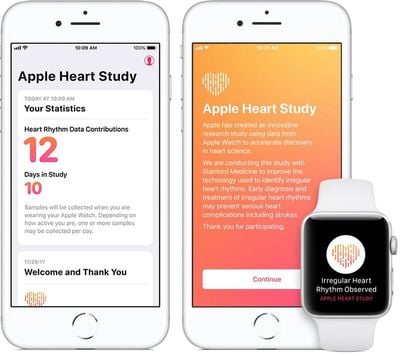
apple heart study
Apple and Stanford created the study to evaluate the Apple Watch's irregular heart rhythm notification feature, which occasionally checks the wearer's heart rhythm in the background and sends a notification if an irregular heart rhythm appears to be suggestive of atrial fibrillation.

419,093 people across the United States participated in the study. As part of the study, if an irregular heart rhythm was identified, participants received a notification on their Apple Watch and iPhone, a phone consultation with a doctor, and an ECG patch for additional monitoring.

Study results showed 0.5 percent of participants - approximately 2,095 people - received an irregular heart rhythm notification. Apple says "many participants sought medical advice following their irregular rhythm notification."

Apple COO Jeff Williams:

We are proud to work with Stanford Medicine as they conduct this important research and look forward to learning more about the impact of Apple Watch alongside the medical community. We hope consumers will continue to gain useful and actionable information about their heart health through Apple Watch.

Apple announced the Heart Study in collaboration with Stanford back in November 2017 and stopped accepting new participants in August 2018.
Related Roundup: Apple Watch 11
Buyer's Guide: Apple Watch (Neutral)

Popular Stories

Apple Logo Zoomed

Tim Cook Teases Plans for Apple's Upcoming 50th Anniversary

Thursday February 5, 2026 12:54 pm PST by
Apple turns 50 this year, and its CEO Tim Cook has promised to celebrate the milestone. The big day falls on April 1, 2026. "I've been unusually reflective lately about Apple because we have been working on what do we do to mark this moment," Cook told employees today, according to Bloomberg's Mark Gurman. "When you really stop and pause and think about the last 50 years, it makes your heart ...
wwdc sans text feature

Apple Rumored to Announce New Product on February 19

Thursday February 5, 2026 12:22 pm PST by
Apple plans to announce the iPhone 17e on Thursday, February 19, according to Macwelt, the German equivalent of Macworld. The report, citing industry sources, is available in English on Macworld. Apple announced the iPhone 16e on Wednesday, February 19 last year, so the iPhone 17e would be unveiled exactly one year later if this rumor is accurate. It is quite uncommon for Apple to unveil...
Finder Siri Feature

Why Apple's iOS 26.4 Siri Upgrade Will Be Bigger Than Originally Promised

Friday February 6, 2026 3:06 pm PST by
In the iOS 26.4 update that's coming this spring, Apple will introduce a new version of Siri that's going to overhaul how we interact with the personal assistant and what it's able to do. The iOS 26.4 version of Siri won't work like ChatGPT or Claude, but it will rely on large language models (LLMs) and has been updated from the ground up. Upgraded Architecture The next-generation...
iOS 26

iOS 26.3 and iOS 26.4 Will Add These New Features to Your iPhone

Tuesday February 3, 2026 7:47 am PST by
While the iOS 26.3 Release Candidate is now available ahead of a public release, the first iOS 26.4 beta is likely still at least a week away. Following beta testing, iOS 26.4 will likely be released to the general public in March or April. Below, we have recapped known or rumored iOS 26.3 and iOS 26.4 features so far. iOS 26.3 iPhone to Android Transfer Tool iOS 26.3 makes it easier...
iphone 17 pro dark blue 1

iPhone 18 Pro Max Rumored to Deliver Next-Level Battery Life

Friday February 6, 2026 5:14 am PST by
The iPhone 18 Pro Max will feature a bigger battery for continued best-in-class battery life, according to a known Weibo leaker. Citing supply chain information, the Weibo user known as "Digital Chat Station" said that the iPhone 18 Pro Max will have a battery capacity of 5,100 to 5,200 mAh. Combined with the efficiency improvements of the A20 Pro chip, made with TSMC's 2nm process, the...

Top Rated Comments

GubbyMan Avatar
90 months ago
So what did this lead to? 0.5% got the notification and then what? Did they all really have irregular heart rhythm or were there false positives?
Score: 31 Votes (Like | Disagree)
ThunderSkunk Avatar
90 months ago
A couple times a month I get a few dropped heartbeats and some fluttering around for a bit while I wonder if this is finally it. But every time, it ends in disappointment. I still have to get up the next day and go to work to prop up this barbaric culture for absolutely no good reason.
Score: 18 Votes (Like | Disagree)
DoctorTech Avatar
90 months ago
No medical screening test is 100% accurate. Early pregnancy tests are about 99% accurate. Even mammogram screening for breast cancer is only 87% accurate https://ww5.komen.org/BreastCancer/AccuracyofMammograms.html

Most people in the medical community agree it is better to have a false positive than a false negative because a false negative would discourage someone from seeking medical treatment and could ultimately lead to worse effects than someone seeking medical treatment for a condition they do not have.

For such a new, low cost, and non-intrusive device, I think the results of this study are actually pretty amazing.
Score: 12 Votes (Like | Disagree)
KPandian1 Avatar
90 months ago
Irregular rhythm happens everyday, even by narrow medical definition; there is variation even with breathing.

The irregularity detected here is reported "if an irregular heart rhythm appears to be suggestive of atrial fibrillation." The software is setup by a medical team with oversight to eliminate the daily variations - A Fib is characteristically different. Even on a 12-lead ECG with Holter monitoring, the interpretation is physician based, preferably a cardiologist.

So, if 200-20 or even 2 of these detected were found with real atrial fibrillation rhythm, it is a win; these are from people with no known heart problems.

The worst a false positive does is send someone for further rhythm monitoring by a pro - worth the hassle.

The first post is sarcasm.
Score: 11 Votes (Like | Disagree)
Khedron Avatar
90 months ago
So what did this lead to? 0.5% got the notification and then what? Did they all really have irregular heart rhythm or were there false positives?
34% were confirmed to have atrial fibrillation with a follow-up.

Not all the other 66% would be false positive since it's an intermittent condition.
Score: 9 Votes (Like | Disagree)
kpeex Avatar
90 months ago
So what did this lead to? 0.5% got the notification and then what? Did they all really have irregular heart rhythm or were there false positives?
I enrolled on the first day that the AHS app was available to the public. From the app, I had 3,144 data contributions in 459 days. As info, I cycled about 6,000 miles during that period, probably about half those days. My heart rate normally goes way up when cycling. RHR tends to be kind of low. I received an "Irregular Heart Rhythm Observed" notification about 45 days into the study:

* I initiated an in-app video call to an AHS cardiologist using the direct link on the notification that popped up. She interviewed me for about 30 minutes. During the interview, she discussed the study as having flagged me for single digit number of SVT events during five different 60-second measurement periods. (Supra-ventricular Tachycardia)
* They overnighted a 7-day ambulatory ECG monitor that I returned at the end of the week.
* When the results were ready, they notified me and sent another in-app video call link.
* A second video conference explained the results -- a few more instances of SVT detected. She recommended that I follow-up with a cardiologist, who was provided the monitor results. I also got pdfs of all records.
* I went to a locally recommended cardiologist, who discussed the SVT events that the watch and monitor picked up.
* He recommended I have an echocardiogram done to establish a baseline, which I did.
* There was a follow-up to discuss the results.

I guess it wasn't a false positive and it wasn't A-fib. The cardiologist seemed surprised that a fitness tracker caught it.
Score: 9 Votes (Like | Disagree)