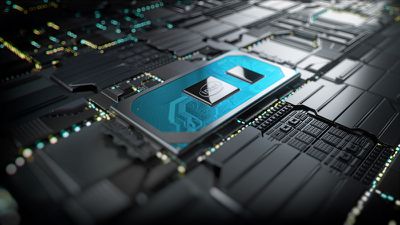
Intel says the Ice Lake chips have increased board integration, allowing manufacturers like Apple to release notebooks with sleeker designs. The chips also feature Intel's all-new Gen11 graphics architecture for up to double the graphics performance, and integrated Thunderbolt 3 and Wi-Fi 6, aka 802.11ax.
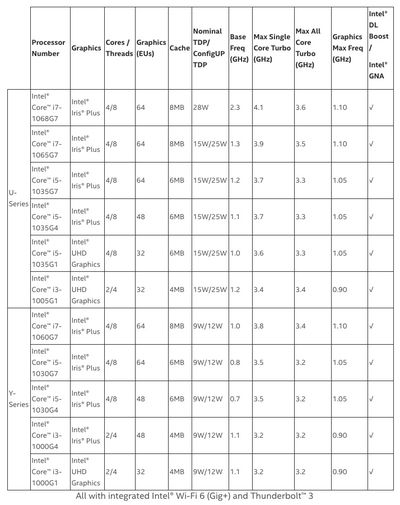
The lineup of 11 new processors includes six U-series chips and five Y-series chips:
Intel is also introducing a new processor number naming structure starting with this first set of 10th-generation Core processors, doing away with Y and U series identifiers and instead emphasizing graphics. The new structure is a bit confusing, but The Verge has a nice breakdown for deciphering them.
Intel expects the first notebooks with Ice Lake chips to be available in time for the holiday shopping season.
iOS 26.4 was released today, and it includes a couple of new features for CarPlay: an Ambient Music widget and support for voice-based chatbot apps.
To update your iPhone 11 or newer to iOS 26.4, open the Settings app and tap on General → Software Update. CarPlay will automatically offer the new features so long as the iPhone connected to your vehicle is running iOS 26.4 or later....
Apple today announced Apple Business, a new all-in-one platform that unifies device management, productivity tools, and customer outreach features.
The service is designed to be a consolidated replacement for several of Apple's existing business-focused offerings, including Apple Business Essentials, Apple Business Manager, and Apple Business Connect. It provides organizations with a single...
Tuesday March 24, 2026 12:31 pm PDT by Juli Clover
Apple today released new firmware for the AirPods Pro 2, AirPods Pro 3, and the AirPods 4. The firmware has a version number of 8B39, up from 8B34 on the AirPods Pro 3, 8B28 on the AirPods Pro 2, and 8B21 on the AirPods 4.
There is no word on what's included in the firmware, but Apple has a support document with limited notes. Most updates are limited to bug fixes and performance...
This CPU line-up is probably as good a clue as any as to why the 12-inch MacBook was killed (for now). The 2015 MacBook launched with a 4.5W Y-series CPU. Last year's Y-series CPUs then went to 5-7W. Now we're at 9W. Apple designed a laptop based on the assumption — presumably promised as such by Intel — that Intel would keep iterating on a roughly 4.5W TDP CPU, and they failed to do so, even after this process shrink.
700MHz base clock. What [S]decade[/S] century is it again?
This is good, actually. Low clock rates means Intel has some breathing room for future generations at the same process size to offer more performance simply by cranking up the clock rate.
Which TDPs are MacBook pro compatible? All of them?
9W: probably the MacBook Air (which is currently at 7W, but presumably Apple has learnt the lesson not to trust Intel on that).
15W: low-end 13-inch MacBook Pro.
28W: possibly the higher-end 13-inch MacBook Pro, but Apple probably wants more options for that. Also, this CPU model won't ship for a while.
Critically, none of these are even remotely an option for the 15-inch (16-inch?) MacBook Pro, which likely won't see another CPU upgrade until Comet Lake-H in Q2 2020. It'll offer up to ten cores, but it will still be at 14nm and still use a revised Skylake architecture. Still no LPDDR4, even.
Can't come soon enough the day that Apple can engineer some A-series chip and release upgrades when the Mac, not Intel, are ready. I could see the MacBook line getting resuscitated as a canary for this