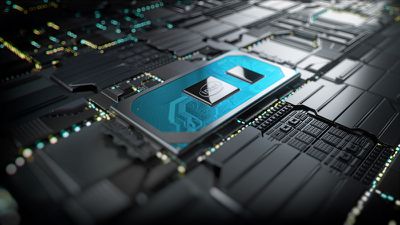
Intel says the Ice Lake chips have increased board integration, allowing manufacturers like Apple to release notebooks with sleeker designs. The chips also feature Intel's all-new Gen11 graphics architecture for up to double the graphics performance, and integrated Thunderbolt 3 and Wi-Fi 6, aka 802.11ax.
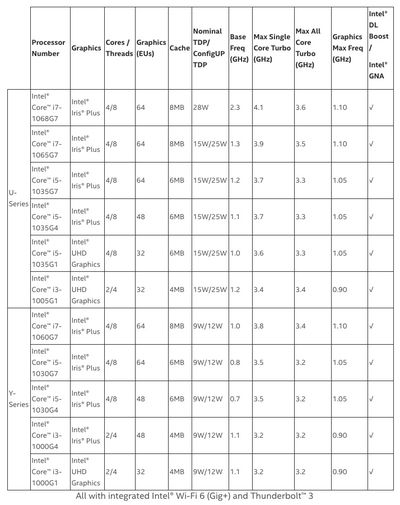
The lineup of 11 new processors includes six U-series chips and five Y-series chips:
Intel is also introducing a new processor number naming structure starting with this first set of 10th-generation Core processors, doing away with Y and U series identifiers and instead emphasizing graphics. The new structure is a bit confusing, but The Verge has a nice breakdown for deciphering them.
Intel expects the first notebooks with Ice Lake chips to be available in time for the holiday shopping season.
Apple has held "exploratory" talks with Intel and Samsung about manufacturing the main processors for its devices in the United States, reports Bloomberg ($).
Apple is said to have had early-stage talks with Intel about using its chipmaking services, while Apple executives have reportedly visited a Samsung plant under construction in Texas that will also make advanced chips.
The talks are ...
After more than a year of discussion, Apple and Intel established a preliminary agreement that will see Intel manufacturing processors for Apple devices, reports The Wall Street Journal.
Intel would make chips based on Apple chip designs, much like TSMC. Prior rumors on Intel's Apple talks have suggested Intel could make some of the lower-end processors used in Apple devices, including the...
Apple recently announced that Tim Cook will be stepping down as CEO later this year, after 15 years of leading the company.
Effective September 1, Apple's hardware engineering chief John Ternus will become the company's next CEO, while Cook will become executive chairman of Apple's board of directors. In his new role, Apple said Cook will assist with "certain aspects" of the company,...
This CPU line-up is probably as good a clue as any as to why the 12-inch MacBook was killed (for now). The 2015 MacBook launched with a 4.5W Y-series CPU. Last year's Y-series CPUs then went to 5-7W. Now we're at 9W. Apple designed a laptop based on the assumption — presumably promised as such by Intel — that Intel would keep iterating on a roughly 4.5W TDP CPU, and they failed to do so, even after this process shrink.
700MHz base clock. What [S]decade[/S] century is it again?
This is good, actually. Low clock rates means Intel has some breathing room for future generations at the same process size to offer more performance simply by cranking up the clock rate.
Which TDPs are MacBook pro compatible? All of them?
9W: probably the MacBook Air (which is currently at 7W, but presumably Apple has learnt the lesson not to trust Intel on that).
15W: low-end 13-inch MacBook Pro.
28W: possibly the higher-end 13-inch MacBook Pro, but Apple probably wants more options for that. Also, this CPU model won't ship for a while.
Critically, none of these are even remotely an option for the 15-inch (16-inch?) MacBook Pro, which likely won't see another CPU upgrade until Comet Lake-H in Q2 2020. It'll offer up to ten cores, but it will still be at 14nm and still use a revised Skylake architecture. Still no LPDDR4, even.
Can't come soon enough the day that Apple can engineer some A-series chip and release upgrades when the Mac, not Intel, are ready. I could see the MacBook line getting resuscitated as a canary for this