Consumer spending on the App Store totaled a record $193 million on Christmas Day 2019, representing a 16 percent increase year on year, according to a new report by Sensor Tower.
Approximately $84 million was spent on the Google Play store, representing year-on-year growth of 2.7 percent. Apple's App Store accounted for 70 percent of spending between the two platforms, which amounted to $277 million combined.
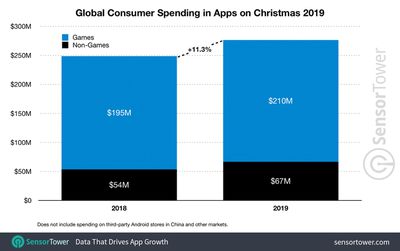
That total represented combined year-over-year growth of 11.3 percent for the two stores, which brought in $249 million combined in user spending on Christmas Day in 2018.
Sensor Tower says the increase in spending was largely due to new mobile device owners and people who received App Store gift cards, with games being the most popular purchase.
The majority of mobile spending on Christmas, approximately $210 million, was focused on the Games category, which generated 76 percent of revenue across both stores and grew about 8 percent Y/Y from $195 million. PUBG Mobile from Tencent’s TiMi studio led in-game spending with $8.5 million, up 431 percent from the $1.6 million players spent in the game on Christmas 2018.
Other apps accounted for approximately 2 percent more of all spending this Christmas compared to a year prior, bringing in an estimated $67 million. The top non-game app for overall spending on Christmas was reportedly the dating app Tinder, which brought in a gross global revenue near $2.1 million.
The App Store makes up a huge portion of Apple's services business. It currently receives a 30 percent cut of all revenue that developers earn from the App Store, with the exception of subscription apps. For apps where a customer maintains a subscription for more than a year, developers are entitled to an 85/15 split, with Apple taking a 15 percent cut rather than a 30 percent cut.
Thursday February 5, 2026 12:54 pm PST by Joe Rossignol
Apple turns 50 this year, and its CEO Tim Cook has promised to celebrate the milestone. The big day falls on April 1, 2026.
"I've been unusually reflective lately about Apple because we have been working on what do we do to mark this moment," Cook told employees today, according to Bloomberg's Mark Gurman. "When you really stop and pause and think about the last 50 years, it makes your heart ...
Thursday February 5, 2026 12:22 pm PST by Joe Rossignol
Apple plans to announce the iPhone 17e on Thursday, February 19, according to Macwelt, the German equivalent of Macworld.
The report, citing industry sources, is available in English on Macworld.
Apple announced the iPhone 16e on Wednesday, February 19 last year, so the iPhone 17e would be unveiled exactly one year later if this rumor is accurate. It is quite uncommon for Apple to unveil...
Friday February 6, 2026 3:06 pm PST by Juli Clover
In the iOS 26.4 update that's coming this spring, Apple will introduce a new version of Siri that's going to overhaul how we interact with the personal assistant and what it's able to do.
The iOS 26.4 version of Siri won't work like ChatGPT or Claude, but it will rely on large language models (LLMs) and has been updated from the ground up.
Upgraded Architecture
The next-generation...
Tuesday February 3, 2026 7:47 am PST by Joe Rossignol
While the iOS 26.3 Release Candidate is now available ahead of a public release, the first iOS 26.4 beta is likely still at least a week away. Following beta testing, iOS 26.4 will likely be released to the general public in March or April.
Below, we have recapped known or rumored iOS 26.3 and iOS 26.4 features so far.
iOS 26.3
iPhone to Android Transfer Tool
iOS 26.3 makes it easier...
The iPhone 18 Pro Max will feature a bigger battery for continued best-in-class battery life, according to a known Weibo leaker.
Citing supply chain information, the Weibo user known as "Digital Chat Station" said that the iPhone 18 Pro Max will have a battery capacity of 5,100 to 5,200 mAh. Combined with the efficiency improvements of the A20 Pro chip, made with TSMC's 2nm process, the...
There's way more Android devices for every Apple device sold. The Google Play revenue is pitiful compared to Apple's. I wonder if Android users have a culture of not-wanting-to-pay for apps, or if some other big factor like piracy is involved.
It’s the same reason why Google pays Apple so much money every year to keep Google search the default engine in Safari. Through the iPhone, Apple has aggregated the best customers (those with the highest propensity to spend). So iphone users by and large are more willing to spend on content.
There is also the issue of higher piracy rates on android compared to iOS, which makes app development a lot less profitable on android.
This is what people who keep proselytising the larger android user base don’t get - it’s not more market share in a vacuum that determines how profitable a platform will be, but usage share.
There's way more Android devices for every Apple device sold. The Google Play revenue is pitiful compared to Apple's. I wonder if Android users have a culture of not-wanting-to-pay for apps, or if some other big factor like piracy is involved.
China. That's the primary explanation you both seemed to overlook. For a bit of perspective: Active Android devices in China - 731 million... and that was in 2018. That's more than twice the population of the entire US.
There's way more Android devices for every Apple device sold. The Google Play revenue is pitiful compared to Apple's. I wonder if Android users have a culture of not-wanting-to-pay for apps, or if some other big factor like piracy is involved.
There are way more devices, but most of them contribute no revenue to the Play Store. The Play Store gets no revenue from the #1 Android market in the world: China. That revenue goes to Chinese companies like Tencent, Baidu, and Xiaomi.
It’s the same reason why Google pays Apple so much money every year to keep Google search the default engine in Safari... {snipped for brevity and clarity}
Not only does the Play Store not get any revenue from the largest Android market, they it also competes with the individual stores from each of the handset makers. Oh, and Amazon. Play Store doesn't get any revenue from Amazon's flavor of Android.
The reasons you guys speculated would fall waaaaaaaaaaaaaaaaay down the list of contributing factors. China is the answer. Imagine Apple's App Store revenue without China.
Logic says iPhone should be available for free or for a ridiculously low price, cross-financed by Games and Services, providing the iOS platform to more people.
Reality however shows that iOS customers love to spend big