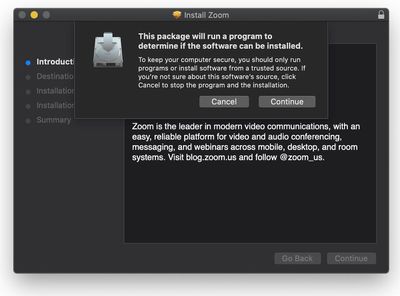
The popular video conferencing company Zoom has been under scrutiny over the past few days for the method used to install the Mac version of its app, which essentially abused a "preflight" compatibility check to install the app without the user needing to explicitly grant installation permission, as highlighted by developer Felix Seele earlier this week.
Screenshot of preflight compatibility check for Zoom; clicking Continue immediately installs the app if the user has admin privileges (via Felix Seele)
Zoom CEO Eric Yuan responded to Seele, noting that while the installation method was "implemented to balance the number of clicks given the limitations of the standard technology," he recognized the issue and promised to "continue to improve."
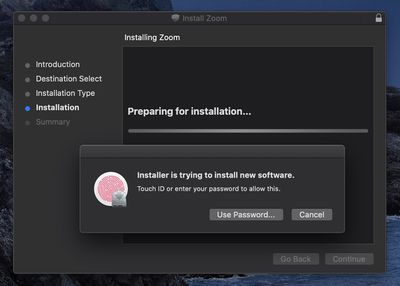
Revised installer with traditional installation process
Zoom has now updated its Mac app installer to no longer use the preflight installation method, instead using a traditional installation authorization process, as noted by The Verge.
“They completely removed the preinstall stuff, so you now need to click through the installer as it ought to be,” explains Seele in a message to The Verge. The fake prompt has also been removed so users have to specifically click through and install Zoom. “I must say that I am impressed,” says Seele. “I expected them to maybe change the dialog, but since the ‘zero-click’ aspect was so important to them, I thought they would stick with the preinstall-trick.”
The Mac app installation issue is hardly Zoom's first controversy, with the company seeing increased attention as its popularity has boomed amid self-isolation. Other recent controversies over just the past week have included its integration with a Facebook SDK that was sending Zoom user data to Facebook and misleading claims of end-to-end encryption.
Saturday February 7, 2026 9:26 am PST by Joe Rossignol
Apple today shared an ad that shows how the upgraded Center Stage front camera on the latest iPhones improves the process of taking a group selfie.
"Watch how the new front facing camera on iPhone 17 Pro takes group selfies that automatically expand and rotate as more people come into frame," says Apple. While the ad is focused on the iPhone 17 Pro and iPhone 17 Pro Max, the regular iPhone...
Friday February 6, 2026 3:06 pm PST by Juli Clover
In the iOS 26.4 update that's coming this spring, Apple will introduce a new version of Siri that's going to overhaul how we interact with the personal assistant and what it's able to do.
The iOS 26.4 version of Siri won't work like ChatGPT or Claude, but it will rely on large language models (LLMs) and has been updated from the ground up.
Upgraded Architecture
The next-generation...
Thursday February 5, 2026 12:22 pm PST by Joe Rossignol
Apple plans to announce the iPhone 17e on Thursday, February 19, according to Macwelt, the German equivalent of Macworld.
The report, citing industry sources, is available in English on Macworld.
Apple announced the iPhone 16e on Wednesday, February 19 last year, so the iPhone 17e would be unveiled exactly one year later if this rumor is accurate. It is quite uncommon for Apple to unveil...
Monday February 9, 2026 6:24 am PST by Joe Rossignol
In select U.S. states, residents can add their driver's license or state ID to the Apple Wallet app on the iPhone and Apple Watch, and then use it to display proof of identity or age at select airports and businesses, and in select apps.
The feature is currently available in 13 U.S. states and Puerto Rico, and it is expected to launch in at least seven more in the future.
To set up the...
New MacBook Pro models with the M5 Pro and M5 Max chips could arrive as soon as Monday, March 2, according to Bloomberg's Mark Gurman.
In today's "Power On" newsletter, Gurman said that the release of new MacBook Pro models is tied to the release of macOS Tahoe 26.3. The launch is said to be slated for as early as the week of March 2. He added that the M4 Pro and M4 Max models on sale today...
Remember when they installed a web server on macs ('https://www.geekwebguides.com/2019/07/09/zoom-videoconferencing-app-vulnerability/') without anyone knowing that resulted in a zero day?
Not a fan of Zoom since then. Nothing they have done since then has endeared me any more. I prefer FaceTime, Skype, or pretty much any other method to connect than Zoom.
Remember when a person could hear you before you picked up a FaceTime call? Bugs happen.
A software bug is one thing, engineering a buggy web server to intentionally bypass a browser security measure, engineering an installer to get around user confirmation prompts, and being deceptive in your advertising and documentation are on a totally different level.
It seems like they made some bad choices, but it also seems like they are recognizing the fact they were bad choices and are quickly taking steps to address them.
It's easy to fault them but perhaps such quick acknowledgement and rapid changes are a good sign.
Let me know when they stop making bazillions auctioning users behavioural surplus on the data markets