Apple maintained its consummate lead in the global wearable products market in the first quarter of this year, based on research conducted by IDC.
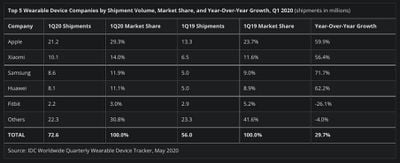
According to the report, Apple's lot grew by 13.3 million units, or 59.9 percent year on year, handing it a 23.7 percent share of the market.
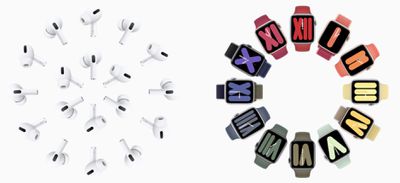
Despite difficulties in the supply chain for Apple Watch, the company saw strong results thanks to its Beats and AirPods range (the report treats "hearables" as a subset of wearables).
IDC put the strong demand for AirPods and Beats down to the ongoing health crisis and the increasing number of people working from home who are in need of headphones.
"Consumers were clamouring for these sophisticated earpieces not only for the abilty to playback audio but also to help them increase productivity, as many of them were forced to work from home and sought ways to reduce surrounding noise while staying connected to their smartphones and smart assistants."
Xaiomi came second in place after Apple, with 10.1 million units shipped in the first quater of this year, amounting to 14 percent market share.
Samsung, Huawei, and Fitbit were the other major companies to make up the rest of the wearables market in the report. Global shipments of wearable devices grew 29.7 percent in Q1 2020 compared to Q1 2019, totalling 72.6 million units.
Production of Apple's rumored over-ear wireless headphones is already said to be underway, and Apple's virtual Worldwide Developers Conference in June could be a good opportunity to introduce them.
Apple is also expected to debut Powerbeats Pro in four new Colors soon, so there would appear to be plenty of reasons for Apple to be confident of maintaining its dominance in the wearables market going forward.
Saturday February 7, 2026 9:26 am PST by Joe Rossignol
Apple today shared an ad that shows how the upgraded Center Stage front camera on the latest iPhones improves the process of taking a group selfie.
"Watch how the new front facing camera on iPhone 17 Pro takes group selfies that automatically expand and rotate as more people come into frame," says Apple. While the ad is focused on the iPhone 17 Pro and iPhone 17 Pro Max, the regular iPhone...
Friday February 6, 2026 3:06 pm PST by Juli Clover
In the iOS 26.4 update that's coming this spring, Apple will introduce a new version of Siri that's going to overhaul how we interact with the personal assistant and what it's able to do.
The iOS 26.4 version of Siri won't work like ChatGPT or Claude, but it will rely on large language models (LLMs) and has been updated from the ground up.
Upgraded Architecture
The next-generation...
Thursday February 5, 2026 12:22 pm PST by Joe Rossignol
Apple plans to announce the iPhone 17e on Thursday, February 19, according to Macwelt, the German equivalent of Macworld.
The report, citing industry sources, is available in English on Macworld.
Apple announced the iPhone 16e on Wednesday, February 19 last year, so the iPhone 17e would be unveiled exactly one year later if this rumor is accurate. It is quite uncommon for Apple to unveil...
Monday February 9, 2026 6:24 am PST by Joe Rossignol
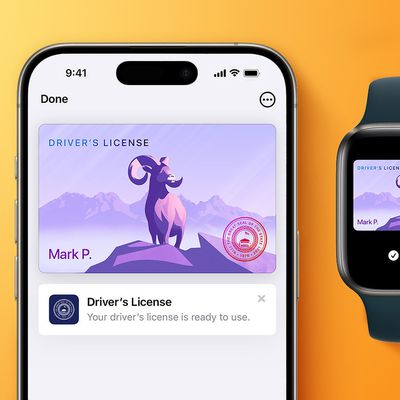
In select U.S. states, residents can add their driver's license or state ID to the Apple Wallet app on the iPhone and Apple Watch, and then use it to display proof of identity or age at select airports and businesses, and in select apps.
The feature is currently available in 13 U.S. states and Puerto Rico, and it is expected to launch in at least seven more in the future.
To set up the...
New MacBook Pro models with the M5 Pro and M5 Max chips could arrive as soon as Monday, March 2, according to Bloomberg's Mark Gurman.
In today's "Power On" newsletter, Gurman said that the release of new MacBook Pro models is tied to the release of macOS Tahoe 26.3. The launch is said to be slated for as early as the week of March 2. He added that the M4 Pro and M4 Max models on sale today...
I 100% agree with your sentiment that they are completely different product types, but although I can’t point to anything specific I feel like the “wearables” category label was created by Wall Street “analysts” and Apple is now following a standard categorization (albeit a silly one).
Would be interested to know if other forum members can shed some light on the question.
If they wanted to hide sales numbers, then why report anything? They could just do what they do with iPhone and report profits only.
When deciding whether or not to believe something, always test the converse question for plausibility. Why wouldn’t they disclose separate revenue numbers for every individual product? Do they not know them? Don’t bother to track them? Don’t think they’re internally important? None of these ideas comes close to passing the sniff test. Naturally they know them, and much more. They know how many of each model, size, color, and capacity of every iPhone they’ve ever sold. They don’t include those numbers in stockholder calls either. I think they’re trying to strike a balance between revenue guidance and hiding individual product data.
Apple became quite tired of Wall Street analysts falling all over themselves counting iPhone unit sales and average sale prices when the Apple Watch and services began ramping up in unit sales, revenue growth, and increased percentages of overall revenue. The narrative Wall Street kept repeating ad nauseum was “Apple will hit the wall with iPhone sales, they are a one-trick pony, Apple is doomed.” When Apple stopped reporting unit sales data and concentrated on overall sales group revenue and profits, Wall Street cried foul, became angry, and the stock dropped for about 2 months. Meanwhile, Apple reported separate groupings for iPhone, Mac, iPad, “Wearables, Home, and Accessories”, and Services. Savvy investors understood this but many analysts still stuck to their old iPhone or nothing narratives, keeping the stock and PE multiple depressed in the mid teens.
Cook kept telling everyone who would listen in early 2017 that Services would double from $24.3B in 2016 to $50B annually by 2020. In 2019, Apple Services were $46.9B, a 16% change from 2018. Apple will be on its way towards beating that goal in FY 2020, as Cook said they would.
Wearables were $12.8B in 2017, $17.38B in 2018 (36% rise), and $24.48B in 2019 (41%) rise, and itself almost doubling like Services did, no doubt fueled by Watch, AirPods/AirPods Pro, and others. iPhones had dropped 14% in 2019 but it was easy to see, if you were looking, that Apple had successfully began and accelerated their revenue diversification. Apple’s blowout 1Q 2020 and better than expected 2Q 2020 Covid affected report still suggest that change is continuing and the iPhone had been doing better than expected. Over the past 3 quarters, analysts were finally waking up and revising their expectations upward, in concert with recognition that Watch, AirPods and now services was leading growth for Apple.
As for “hiding” product data, most all smartphone makers now “hide” individual model data (Samsung included) and only trumpet sales when it suits them (remember Samsung reporting huge first week or month sales, only to later report quarterly or annually sales of mobile devices, especially flagships, would be lacking in revenue and profits?). It’s the quarterly sales, revenue, profits and gross margin which are most important to show a strong business model, and of course, Apple has been much better and stronger at doing that than any other tech company.
I agree they are trying to balance the narrative for investors and analysts alike without revealing too much to competitors who would love to have even a small slice of Apple’s revenue, profits and success. Why else would they copy so much of Apple’s look, design, and experience if not to coattail somehow on Apple.
I 100% agree with your sentiment that they are completely different product types, but although I can’t point to anything specific I feel like the “wearables” category label was created by Wall Street “analysts” and Apple is now following a standard categorization (albeit a silly one).
Would be interested to know if other forum members can shed some light on the question.
I do not believe this was created by Wall Street. It was created by Apple to, in my opinion, limit the detail of their specific product revenue reporting. The category is actually “wearables, home, and accessories” and its revenue is reported as a single number. The more products they can plausibly bundle into one category, the more individual product sales variances are buffered against one another.
Incredible success story. I know we shouldn't be surprised, but a lot of people wrote Apple off even before the Watch was released, and Series 0 didn't help matters either.