As a result, Apple has already had the trademark for the term "Rosetta" for sometime, but this new activity and new application surrounding the name is notable given the increasing rumors that Apple is planning on transitioning from Intel to ARM processors in the near future. Apple officially dropped Rosetta support in Mac OS X 10.7 (Lion) in 2011.
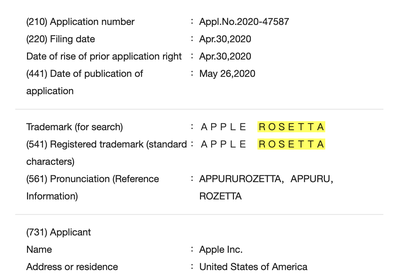
The trademark could simply be ongoing protection of a long existing trademark for Apple, but given the recent rumors, the new activity raises the possibility that Apple may decide to recycle the "Rosetta" name for a new emulation layer to transition from Intel to ARM. The trademark was filed under the following category:
A computers computer network And the computer software in which development of the computer programmes on a global communication network and the download for translating and performing are possible, computer software for computings performed by a cross platform, computer software, Electronic machines [apparatus and their parts]
Apple has been widely rumored to transition from Intel to ARM processors in the coming year, but there has be no rumors about how Apple would handle the transition with regard to emulation. Apple currently lists "Rosetta" without the "Apple" prefix in their list of active trademarks.
Thursday February 5, 2026 12:54 pm PST by Joe Rossignol
Apple turns 50 this year, and its CEO Tim Cook has promised to celebrate the milestone. The big day falls on April 1, 2026.
"I've been unusually reflective lately about Apple because we have been working on what do we do to mark this moment," Cook told employees today, according to Bloomberg's Mark Gurman. "When you really stop and pause and think about the last 50 years, it makes your heart ...
Thursday February 5, 2026 12:22 pm PST by Joe Rossignol
Apple plans to announce the iPhone 17e on Thursday, February 19, according to Macwelt, the German equivalent of Macworld.
The report, citing industry sources, is available in English on Macworld.
Apple announced the iPhone 16e on Wednesday, February 19 last year, so the iPhone 17e would be unveiled exactly one year later if this rumor is accurate. It is quite uncommon for Apple to unveil...
Friday February 6, 2026 3:06 pm PST by Juli Clover
In the iOS 26.4 update that's coming this spring, Apple will introduce a new version of Siri that's going to overhaul how we interact with the personal assistant and what it's able to do.
The iOS 26.4 version of Siri won't work like ChatGPT or Claude, but it will rely on large language models (LLMs) and has been updated from the ground up.
Upgraded Architecture
The next-generation...
Tuesday February 3, 2026 7:47 am PST by Joe Rossignol
While the iOS 26.3 Release Candidate is now available ahead of a public release, the first iOS 26.4 beta is likely still at least a week away. Following beta testing, iOS 26.4 will likely be released to the general public in March or April.
Below, we have recapped known or rumored iOS 26.3 and iOS 26.4 features so far.
iOS 26.3
iPhone to Android Transfer Tool
iOS 26.3 makes it easier...
The iPhone 18 Pro Max will feature a bigger battery for continued best-in-class battery life, according to a known Weibo leaker.
Citing supply chain information, the Weibo user known as "Digital Chat Station" said that the iPhone 18 Pro Max will have a battery capacity of 5,100 to 5,200 mAh. Combined with the efficiency improvements of the A20 Pro chip, made with TSMC's 2nm process, the...
But for anyone that's familiar with the concept of the Rosetta Stone, this could be very well the re-used "new" name for Safari's offline translation software as well. (I know what Apple's Rosetta was, just saying.)
That gives me some hope, because I was becoming increasingly worried that Apple was going to rely entirely on developers re-compiling code and not provide an emulation layer.
Obviously the key question here is going to be performance. How fast will binary translation/emulation be and just as importantly how fast are Apple's ARM chips going to be relative to modern Intel Core/AMD Ryzen.
The original Rosetta's performance was acceptable (quite impressive actually on a technical level), particularly for Apple's notebook lineup, but this was due in large part to just how far behind the PowerPC chips used in Apple's notebooks were compared to x86 at the time. Even the original Core Duos used in the first generation MacBooks absolutely destroyed not only the PowerPC G4s used in Apple's iBook/Powerbooks, but even a lot of PowerPC G5 based Macs.
I highly doubt Apple is going to have quite that large of a performance margin this time around so it will be interesting to see just what they can achieve.
...OTOH, if you put an SSD in an old (circa 2010) Mac with a pre Sandy Bridge Core Ix chip (or even Core 2 Duo) it is surprisingly usable today, so perhaps, for casual users this won't matter as much...
Can't say I'm excited. Please let this just be an additional ISA to be used where it makes sense, and not a whole scale transition (unlikely I know, but I can dream right.)
Oh no. Here we go again. I remember that this was how you had to run Power PC apps on Intel machines. That was living hell. What a kluge. If Apple is going to make us do the same for new ARM computers, I am going to be done with it and get a PC.