In today's iOS 15.4 beta that's available to developers, Apple added a useful new feature that changes the way Face ID works. There's now a Face ID with a Mask option that allows the iPhone to be unlocked when you're wearing a mask, but you need to have an iPhone 12 or newer.
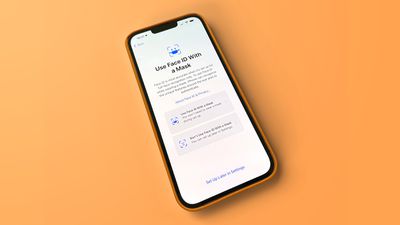
Right now, an iPhone can be unlocked with a mask if you have an Apple Watch for authentication to add an extra layer of security, but the new option removes the need for an Apple Watch. Face ID with a Mask works by recognizing the area around the eye when a mask is worn, which is less secure but more convenient. Unlike Face ID with the Apple Watch, the mask version works with Apple Pay and can be used to authenticate third-party apps.
Unfortunately, Face ID with a Mask is limited to some of Apple's newest iPhones, even though Face ID has been available since 2017 with the launch of the iPhone X. As noted on our forums, Face ID with a Mask is only an option on the iPhone 12 and later, so you'll need an iPhone 12, 12 mini, 12 Pro, 12 Pro Max or an iPhone 13, 13 mini, 13 Pro, or 13 Pro Max.
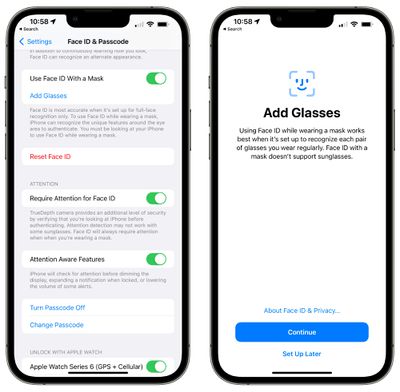
If you have an iPhone 11 or earlier, you will not see the Face ID with a Mask setup screen when updating to iOS 15.4, nor will you have the option to toggle it on in the Settings app.
It is not clear why Apple has limited Face ID with a Mask to the iPhone 12 and newer, but there may be some differences in Face ID hardware over the years that allow it to work for some devices and not others in terms of reasonable security. It's also possible that Apple will expand Face ID with a Mask to older iPhones in future betas.
Thursday February 5, 2026 12:54 pm PST by Joe Rossignol
Apple turns 50 this year, and its CEO Tim Cook has promised to celebrate the milestone. The big day falls on April 1, 2026.
"I've been unusually reflective lately about Apple because we have been working on what do we do to mark this moment," Cook told employees today, according to Bloomberg's Mark Gurman. "When you really stop and pause and think about the last 50 years, it makes your heart ...
Thursday February 5, 2026 12:22 pm PST by Joe Rossignol
Apple plans to announce the iPhone 17e on Thursday, February 19, according to Macwelt, the German equivalent of Macworld.
The report, citing industry sources, is available in English on Macworld.
Apple announced the iPhone 16e on Wednesday, February 19 last year, so the iPhone 17e would be unveiled exactly one year later if this rumor is accurate. It is quite uncommon for Apple to unveil...
Friday February 6, 2026 3:06 pm PST by Juli Clover
In the iOS 26.4 update that's coming this spring, Apple will introduce a new version of Siri that's going to overhaul how we interact with the personal assistant and what it's able to do.
The iOS 26.4 version of Siri won't work like ChatGPT or Claude, but it will rely on large language models (LLMs) and has been updated from the ground up.
Upgraded Architecture
The next-generation...
Tuesday February 3, 2026 7:47 am PST by Joe Rossignol
While the iOS 26.3 Release Candidate is now available ahead of a public release, the first iOS 26.4 beta is likely still at least a week away. Following beta testing, iOS 26.4 will likely be released to the general public in March or April.
Below, we have recapped known or rumored iOS 26.3 and iOS 26.4 features so far.
iOS 26.3
iPhone to Android Transfer Tool
iOS 26.3 makes it easier...
The iPhone 18 Pro Max will feature a bigger battery for continued best-in-class battery life, according to a known Weibo leaker.
Citing supply chain information, the Weibo user known as "Digital Chat Station" said that the iPhone 18 Pro Max will have a battery capacity of 5,100 to 5,200 mAh. Combined with the efficiency improvements of the A20 Pro chip, made with TSMC's 2nm process, the...
Typical Apple. "Hey, if you want this feature, upgrade!".
I don’t think consumers would ever use this as leverage to upgrade. Think about it. They would have to know this feature would even exist in the first place and be annoyed enough to upgrade. (I suspect most average consumers don’t even know how to navigate properly through the settings on iOS.)
My guess? The ML chip on the iPhone 11 or older devices aren't powerful enough to enable FaceID with Mask, whereas the iPhone 12 and newer phones have the ML chip that is more powerful and can handle the FaceID with Mask feature.
This is a hardware limitation and it all has to do with two thing: Neural Engine on Ax series chip and the face mapping sensors on iPhone 12s and iPhone 13s
This is how FaceID with mask will basically work. Lot of it is machine learning that requires more processing power.