Apple's Craig Federighi Explains Why iOS Auto-Updates Often Arrive Several Weeks Late

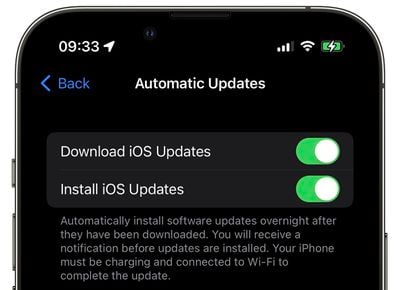
When it comes to downloading iOS software updates, Apple users can be reasonably divided into two camps: Those who manually seek out updates the moment Apple releases them, and those who are happy to let their device's Automatic Updates feature take care of everything in the background with minimal input on their part.
auto updates

While it's generally acknowledged that manually tapping into Settings -> General -> Software Update is the faster option, Apple has never really explained why auto-updates tend to come through to users sometimes days or even weeks later – until now.

Interested iPhone user Mateusz Buda put this question in an email to Craig Federighi, Apple's senior VP of software engineering. In the email, Buda explained that he had turned on auto-updates, and yet after two weeks since the public release of iOS 15.4 he still hadn't received an update notification. "What conditions must be met for this function to work?" Buda asked. To his surprise, Federighi responded and was happy to explain.

Hi Mateusz,

We incrementally rollout new iOS updates by first making them available for those that explicitly seek them out in Settings, and then 1-4 weeks later (after we've received feedback on the update) ramp up to rolling out devices with auto-update enabled.

Hope that helps!

- craig

Given the number of iPhones and iPads in the world, it's not hugely surprising to hear that Apple's software update strategy proceeds in a staged rollout. By implementing an intentional delay of between 1-4 weeks for users with auto-updates turned on, Apple adds a level of protection for its servers so they aren't easily overloaded when a new version of iOS is released.

Still, it's interesting to learn that Apple also considers its auto-update feature to be a safeguard when things go wrong: If early adopters report serious bugs with the software, Apple still has a window of opportunity to resolve any server-side issues or pull the update entirely before the wider user base has automatically downloaded it.

In a somewhat related point, made by several Redditors, Apple hasn't explained why some app auto-updates are also sometimes very late to be delivered to users, but perhaps the reasoning is the same: Server protection and an ability to action feedback before a wider rollout is complete.

Popular Stories

maxresdefault

Apple Shows Off a Key Reason to Upgrade to the iPhone 17

Saturday February 7, 2026 9:26 am PST by
Apple today shared an ad that shows how the upgraded Center Stage front camera on the latest iPhones improves the process of taking a group selfie. "Watch how the new front facing camera on iPhone 17 Pro takes group selfies that automatically expand and rotate as more people come into frame," says Apple. While the ad is focused on the iPhone 17 Pro and iPhone 17 Pro Max, the regular iPhone...
Finder Siri Feature

Why Apple's iOS 26.4 Siri Upgrade Will Be Bigger Than Originally Promised

Friday February 6, 2026 3:06 pm PST by
In the iOS 26.4 update that's coming this spring, Apple will introduce a new version of Siri that's going to overhaul how we interact with the personal assistant and what it's able to do. The iOS 26.4 version of Siri won't work like ChatGPT or Claude, but it will rely on large language models (LLMs) and has been updated from the ground up. Upgraded Architecture The next-generation...
wwdc sans text feature

Apple Rumored to Announce New Product on February 19

Thursday February 5, 2026 12:22 pm PST by
Apple plans to announce the iPhone 17e on Thursday, February 19, according to Macwelt, the German equivalent of Macworld. The report, citing industry sources, is available in English on Macworld. Apple announced the iPhone 16e on Wednesday, February 19 last year, so the iPhone 17e would be unveiled exactly one year later if this rumor is accurate. It is quite uncommon for Apple to unveil...
apple wallet drivers license feature iPhone 15 pro

Apple Says These 7 U.S. States Plan to Offer iPhone Driver's Licenses

Monday February 9, 2026 6:24 am PST by
In select U.S. states, residents can add their driver's license or state ID to the Apple Wallet app on the iPhone and Apple Watch, and then use it to display proof of identity or age at select airports and businesses, and in select apps. The feature is currently available in 13 U.S. states and Puerto Rico, and it is expected to launch in at least seven more in the future. To set up the...
14 inch MacBook Pro Keyboard

New MacBook Pros Could Now Arrive in March

Sunday February 8, 2026 6:02 am PST by
New MacBook Pro models with the M5 Pro and M5 Max chips could arrive as soon as Monday, March 2, according to Bloomberg's Mark Gurman. In today's "Power On" newsletter, Gurman said that the release of new MacBook Pro models is tied to the release of macOS Tahoe 26.3. The launch is said to be slated for as early as the week of March 2. He added that the M4 Pro and M4 Max models on sale today...

Top Rated Comments

idmean Avatar
51 months ago

So in other words let the Guinea pig early adopters beta test the rollout “release” before Apple pushed it to the broader ecosystem. Forget iOS, Why is Monterey seemingly so buggy ??
These comments are so boringly predictable.
Score: 41 Votes (Like | Disagree)
contacos Avatar
51 months ago
I thought this was about "App" updates which has never worked for me either
Score: 20 Votes (Like | Disagree)
chucker23n1 Avatar
51 months ago

Still, it's interesting to learn that Apple also considers its auto-update feature to be a safeguard when things go wrong: If early adopters report serious bugs with the software, Apple still has a window of opportunity to resolve any server-side issues or pull the update entirely before the wider user base has automatically downloaded it.
This isn't very unusual or surprising. In fact, third-party developers can opt in to a similar staggered app release feature. ('https://www.idownloadblog.com/2019/03/21/apple-macos-app-updates-phased-releases/')


a new Phased Release for Automatic Updates feature allows a developer to set their app update to reach one percent of users on day one, increasing from there according to the following schedule:

Day 1—One percent
Day 2—Two percent
Day 3—Five percent
Day 4—Ten percent
Day 5—Twenty percent
Day 6—Fifty percent
Day 7—Hundred percent
This way, developers get several days to see the impact of the update (and, if push comes to shove, pull it): do more crash reports come in? Is aggregate CPU or battery use up? Is more bandwidth being used on their servers? Etc.

For Apple's OS releases, it's basically:

[LIST=1]
* have the thousands of engineers at Apple test it internally
* roll it out to the ~1M third-party developers as a developer beta
* roll it out to AppleSeed (I imagine that's similarly sized)
* roll it out to the ~10M public beta testers
* roll it out, staggered, to the ~1B people of the general public

At any step of the way, they can pull an update. For example, a lot of developer betas never make it to public beta.


So in other words let the Guinea pig early adopters beta test the rollout “release” before Apple pushed it to the broader ecosystem. Forget iOS, Why is Monterey seemingly so buggy ??
I mean, if you want to look at it like that, yes. Early adopters are more likely to face serious bugs than late adopters. That… really isn't shocking, though. You don't have to be an early adopter if you don't want to.
Score: 20 Votes (Like | Disagree)
jprmercado Avatar
51 months ago
Interesting. I’d have thought that people who turn on automatic updates are the ones who would want the updates to be applied as soon as possible.

I turn off automatic updates because I want to be able to decide when I want to update, especially for major releases. [I typically update right away for minor releases, though.]

But the phased rollout does make sense from a capacity management and quality control standpoint.
Score: 17 Votes (Like | Disagree)
MedRed Avatar
51 months ago

So in other words let the Guinea pig early adopters beta test the rollout “release” before Apple pushed it to the broader ecosystem. Forget iOS, Why is Monterey seemingly so buggy ??
No. You realize that there's the whole beta program that the "guinea pig early adopters" beta test new releases well before the final release update is rolled out to the masses...right?
Score: 16 Votes (Like | Disagree)
senttoschool Avatar
51 months ago
This makes perfect sense. You can test as much as you want, but for a piece of software as complicated as iOS, real world users will still find bugs. If it's a breaking bug, at least you haven't pushed it to most people yet.
Score: 13 Votes (Like | Disagree)