Intel today previewed the next generation of Thunderbolt, which would enable ultra-fast data transfer speeds and improved external display support on future Macs that incorporate the standard when it launches in 2023 or later.
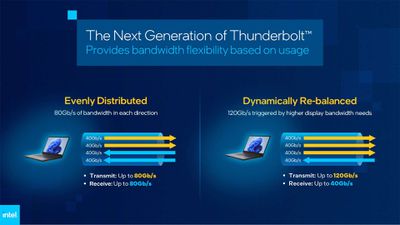
The next generation of Thunderbolt will deliver up to 80 Gbps of bandwidth in each direction, allowing for up to 2× faster data transfer speeds between future Macs and external storage drives that support the standard compared to current speeds. The next generation of Thunderbolt will also have a mode that allows for up to 120 Gbps bandwidth for external displays, which would allow a Mac to support up to dual 8K displays at 60Hz.
The latest 14-inch and 16-inch MacBook Pro models are equipped with Thunderbolt 4/USB4 ports with up to 40 Gbps of bandwidth in each direction.
Currently, no Macs support 8K displays on a plug-and-play basis. The latest 14-inch and 16-inch MacBook Pro models support up to two or three external displays at up to 6K@60Hz depending on whether the laptop is configured with the M1 Pro or M1 Max chip.
The next generation of Thunderbolt is based on the newly released USB4 version 2.0 and DisplayPort 2.1 specifications, and it is backwards compatible with previous versions of Thunderbolt, USB, and DisplayPort. Intel plans to share more details about the next generation of Thunderbolt's official name, features, and capabilities in 2023.
Thursday February 5, 2026 12:22 pm PST by Joe Rossignol
Apple plans to announce the iPhone 17e on Thursday, February 19, according to Macwelt, the German equivalent of Macworld.
The report, citing industry sources, is available in English on Macworld.
Apple announced the iPhone 16e on Wednesday, February 19 last year, so the iPhone 17e would be unveiled exactly one year later if this rumor is accurate. It is quite uncommon for Apple to unveil...
Saturday February 7, 2026 9:26 am PST by Joe Rossignol
Apple today shared an ad that shows how the upgraded Center Stage front camera on the latest iPhones improves the process of taking a group selfie.
"Watch how the new front facing camera on iPhone 17 Pro takes group selfies that automatically expand and rotate as more people come into frame," says Apple. While the ad is focused on the iPhone 17 Pro and iPhone 17 Pro Max, the regular iPhone...
Thursday February 5, 2026 12:54 pm PST by Joe Rossignol
Apple turns 50 this year, and its CEO Tim Cook has promised to celebrate the milestone. The big day falls on April 1, 2026.
"I've been unusually reflective lately about Apple because we have been working on what do we do to mark this moment," Cook told employees today, according to Bloomberg's Mark Gurman. "When you really stop and pause and think about the last 50 years, it makes your heart ...
Friday February 6, 2026 3:06 pm PST by Juli Clover
In the iOS 26.4 update that's coming this spring, Apple will introduce a new version of Siri that's going to overhaul how we interact with the personal assistant and what it's able to do.
The iOS 26.4 version of Siri won't work like ChatGPT or Claude, but it will rely on large language models (LLMs) and has been updated from the ground up.
Upgraded Architecture
The next-generation...
Tuesday February 3, 2026 7:47 am PST by Joe Rossignol
While the iOS 26.3 Release Candidate is now available ahead of a public release, the first iOS 26.4 beta is likely still at least a week away. Following beta testing, iOS 26.4 will likely be released to the general public in March or April.
Below, we have recapped known or rumored iOS 26.3 and iOS 26.4 features so far.
iOS 26.3
iPhone to Android Transfer Tool
iOS 26.3 makes it easier...
If im in the Apple Store and I move the pointer on a Mac Studio with Pro Display XDR and compare it to moving the pointer on a M1 MacBook Pro, the XDR feels like the pointer is underwater- slow and sluggish. Same for all 4k screens I try and exacerbated if MacOS is performing scaling. Now we're cueing up 8k.
Wonder if that will ever be worked out? "Supporting" a screen is one thing, but I still have to pass if it feels sluggish. Is it just me?
An M1 MacBook Pro has a 120Hz display, while the Pro Display XDR is 60Hz. Could that make the difference?