Everything You Need to Know About Apple's New iCloud Encryption Feature

As you may have heard, Apple this week announced it's expanding end-to-end encryption to additional types of data stored in iCloud with a feature called Advanced Data Protection, including device backups, photos, messages, and more. With the new change, even more types of data stored in iCloud will be fully end-to-end encrypted, a higher level of encryption standard.
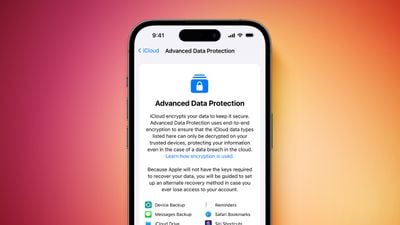
Apple advanced security Advanced Data Protection screen Feature Orange
To help MacRumors readers better understand what the new feature is, how it works, and more, we've created this short post answering some of the most-asked questions about Advanced Data Protection.

What does it do and why is it new?

Before Advanced Data Protection, Apple only encrypted certain types of user data in iCloud, such as passwords and health data. By encrypting data, only a trusted user device can access that information. Other information stored in iCloud, however, such as your photos, messages, and device backups, were not fully end-to-end encrypted meaning if Apple wanted to, it could access your information. With Advanced Data Protection, that all changes.

With Advanced Data Protection enabled for a specific iCloud account, the vast majority of data stored in the cloud will be end-to-end encrypted, meaning no one, not Apple, law enforcement, or governments can ever gain access to that information. Only a trusted device can decrypt that information.

What data will be fully end-to-end encrypted?

With Advanced Data Protection, users will have the following types of data end-to-end encrypted in iCloud alongside Health data and passwords.

  • Device Backup
  • Messages Backup
  • iCloud Drive
  • Photos
  • Reminders
  • Safari Bookmarks
  • Siri Shortcuts
  • Voice Memos
  • Wallet Passes

It's worth noting that iCloud Mail, Contacts, and Calendar will not be end-to-end encrypted as they all require the ability to connect to external sources, such as Gmail, Yahoo, etc.

Is it enabled by default, and if not, how do I enable it?

Advanced Data Protection will not be enabled by default for users. In a recent interview, Apple's senior vice president of software engineering Craig Federighi explained that Advanced Data Protection requires extra effort from the user to enable a recovery method. The extra process and responsibility that lies on the shoulders of users in case they forget their password or lose access to their account make it impractical to force every user to go through that process, Federighi explained.

Nonetheless, even if not enabled by default, it's still easy to enable. When the feature rolls out to all US users by the end of this month, depending on when you activated your device, you'll be able to go into Settings, iCloud, and Advanced Data Protection, enable it and follow the on-screen prompts.

Can I use it now?

Not yet. Advanced Data Protection will roll out to all US users by the end of this month, and Apple says it will launch globally in early 2023. Specific dates for a global rollout are unknown.

Is it free?

Yes, it's free. Advanced Data Protection is an additional layer of protection offered to anyone with an iCloud account, at no extra charge.

What has the reaction been?

As expected, the reaction from users has been positive. With Advanced Data Protection, user data will stay more secure and private. Privacy groups have also praised the decision by Apple, calling it a "victory for user privacy." On the flip side, governments don't seem especially thrilled about the new option given to users.
Popular Stories

Apple Logo Zoomed

Tim Cook Teases Plans for Apple's Upcoming 50th Anniversary

Thursday February 5, 2026 12:54 pm PST by
Apple turns 50 this year, and its CEO Tim Cook has promised to celebrate the milestone. The big day falls on April 1, 2026. "I've been unusually reflective lately about Apple because we have been working on what do we do to mark this moment," Cook told employees today, according to Bloomberg's Mark Gurman. "When you really stop and pause and think about the last 50 years, it makes your heart ...
wwdc sans text feature

Apple Rumored to Announce New Product on February 19

Thursday February 5, 2026 12:22 pm PST by
Apple plans to announce the iPhone 17e on Thursday, February 19, according to Macwelt, the German equivalent of Macworld. The report, citing industry sources, is available in English on Macworld. Apple announced the iPhone 16e on Wednesday, February 19 last year, so the iPhone 17e would be unveiled exactly one year later if this rumor is accurate. It is quite uncommon for Apple to unveil...
Finder Siri Feature

Why Apple's iOS 26.4 Siri Upgrade Will Be Bigger Than Originally Promised

Friday February 6, 2026 3:06 pm PST by
In the iOS 26.4 update that's coming this spring, Apple will introduce a new version of Siri that's going to overhaul how we interact with the personal assistant and what it's able to do. The iOS 26.4 version of Siri won't work like ChatGPT or Claude, but it will rely on large language models (LLMs) and has been updated from the ground up. Upgraded Architecture The next-generation...
iOS 26

iOS 26.3 and iOS 26.4 Will Add These New Features to Your iPhone

Tuesday February 3, 2026 7:47 am PST by
While the iOS 26.3 Release Candidate is now available ahead of a public release, the first iOS 26.4 beta is likely still at least a week away. Following beta testing, iOS 26.4 will likely be released to the general public in March or April. Below, we have recapped known or rumored iOS 26.3 and iOS 26.4 features so far. iOS 26.3 iPhone to Android Transfer Tool iOS 26.3 makes it easier...
iphone 17 pro dark blue 1

iPhone 18 Pro Max Rumored to Deliver Next-Level Battery Life

Friday February 6, 2026 5:14 am PST by
The iPhone 18 Pro Max will feature a bigger battery for continued best-in-class battery life, according to a known Weibo leaker. Citing supply chain information, the Weibo user known as "Digital Chat Station" said that the iPhone 18 Pro Max will have a battery capacity of 5,100 to 5,200 mAh. Combined with the efficiency improvements of the A20 Pro chip, made with TSMC's 2nm process, the...

Top Rated Comments

zorinlynx Avatar
42 months ago
Generally when the people like something and governments are upset about it, it's a good thing. :)
Score: 35 Votes (Like | Disagree)
poorcody Avatar
42 months ago
I for one would like to store information in Notes that I would not want a hacker to ever access, so this is a very positive development for me.
Score: 14 Votes (Like | Disagree)
DEMinSoCAL Avatar
42 months ago

Apple is waiting for the FBI to ramp up their servers for the Apple<->FBI APIs. Apple never said the government could not access the keys.
Yesterday's article ('https://www.geekwebguides.com/2022/12/07/apple-advanced-data-protection/') says that "Not even Apple has access to the encryption keys".
Score: 9 Votes (Like | Disagree)
centauratlas Avatar
42 months ago

What about Notes? Are Notes not included in the advanced protection?
Notes are supposed to be included.

"

* Advanced Data Protection for iCloud ('https://support.apple.com/en-us/HT202303#advanced') is an optional setting that offers our highest level of cloud data security. If you choose to enable Advanced Data Protection, your trusted devices retain sole access to the encryption keys for the majority of your iCloud data, thereby protecting it using end-to-end encryption. Additional data protected includes iCloud Backup, Photos, Notes, and more.

."
https://support.apple.com/en-us/HT202303
Score: 8 Votes (Like | Disagree)
centauratlas Avatar
42 months ago

Which is a lie because in the security document iCould Security Overview ('https://support.apple.com/en-us/HT202303') it says
"You can turn off Advanced Data Protection at any time. Your device will securely upload the required encryption keys to Apple servers, and your account will once again use standard data protection."
Maybe it should say, "Not even Apple has access to the encryption keys unless you tell your phone to give them to Apple by turning ADP off".
Score: 8 Votes (Like | Disagree)
centauratlas Avatar
42 months ago

How so, the keys are sent to Apple so yes they do have access to them. The code exists in the device, the process exists in the device and at Apple, only the claim that it only happens when the user does something. How do you know that there are not other ways to make this happen. Or how do you know that there is not other code that sends the keys directly to the government when requested. No one knows, this is why proprietary security is dangerous.
The keys have to exist on any device as part of the process of encryption and decryption as I am sure you know.

You are right though, there is no guarantee that they are not being uploaded in the background. Opening sourcing the code is one option. Having people monitor the network is another option to see what is going on. Of course if they aren't targeting you right then, you never know what could be sent when.

Of course, one doesn't know if TSMC has inserted a back door into the chipsets without Apple's knowledge at the behest of <name the adversary: CCP, CIA, FBI, MVD etc> or via bribe to employee(s). Or if Motorola etc has in the network chips. Or if the display manufacturer's processor can detect the word "key" on the screen and then send via some backdoor a screenshot.

There are a ton of attack vectors, whether to trust Apple here is a personal choice.

It is certainly better than before. :)
Score: 7 Votes (Like | Disagree)