Apple Likely Planning to Use Bigger, Lower Resolution Displays for Cheaper Vision Headset - MacRumors
Skip to Content

Apple Likely Planning to Use Bigger, Lower Resolution Displays for Cheaper Vision Headset

Apple is exploring new suppliers for OLED-on-Silicon panels, likely signaling the development of a more affordable headset destined to sit alongside the Vision Pro, The Elec reports.
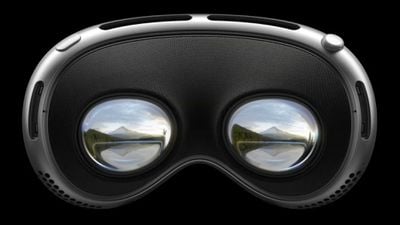
apple vision pro lenses
The Korean website has apparently detected a shift in Apple's supply chain management for OLED-on-Silicon (OLEDoS) panels, a key component in the Vision Pro headset. Currently, Sony provides these high-resolution microdisplays, but its limited production capacity of up to 900,000 panels per year and lack of expansion plans have prompted Apple to seek alternatives for the future. Apple has apparently issued a request for information (RFI) to Samsung Display and LG Display to evaluate their capabilities in producing larger OLEDoS panels, ranging from 2.0 to 2.1 inches in size with a display density of around 1,700 pixels per inch (PPI).

These displays would be larger than those currently used in the Vision Pro and feature a lower resolution. The Vision Pro uses Sony's OLEDoS panels featuring a 1.42-inch screen with a pixel density of nearly 3,400 PPI, employing a white OLED display with color filter (wOLED+CF) technology. This sophisticated display technology is one of the main reasons for the headset's high price point.

At Displayweek 2024, both Samsung and LG showcased advancements in OLED microdisplay technology that could appeal to Apple. Samsung presented a 1.03-inch RGB (direct-emission) OLED microdisplay, developed in collaboration with eMagin, which promises higher brightness levels compared to the wOLED+CF method. Meanwhile, LG revealed a 10,000 nits 1.3-inch 4K OLED microdisplay, utilizing a micro lens array (MLA) to boost brightness by around 40 percent.

Apple's interest in larger OLEDoS panels with lower resolution than those used in the Vision Pro suggests these could be intended for a new, lower-cost mixed reality headset. Apple has been rumored to be working on such a device for over a year, and the latest indications suggest that it may be designed to tether to an iPhone or Mac to eliminate the need for a costly processor. The lower-cost Apple Vision headset could launch as soon as the end of next year.

Related Roundup: Apple Vision Pro
Tags: OLED, The Elec
Buyer's Guide: Vision Pro (Buy Now)
Related Forum: Apple Vision Pro

Popular Stories

ipad air prime day fall

Report: iPad Air to Gain OLED Display Early Next Year

Wednesday April 15, 2026 4:35 am PDT by
Apple will bring OLED displays to its iPad Air models next year, according to a new report from Korea's ET News. Citing industry sources, the outlet says Samsung Display will begin mass production of OLED panels around the end of 2026 or January next year, with a view to supplying panels for Apple's next iPad Air, expected to be released in early 2027. Apple last updated the iPad Air in...
ipad mini 7 feature red and blue

OLED iPad Mini: Release Date, Pricing, and What to Expect

Wednesday April 15, 2026 8:15 am PDT by
According to the latest rumors, Apple is close to launching its next-generation iPad mini. So what should we expect from the successor to the iPad mini 7 that Apple released over a year ago? Read on to find out. Processor and Performance Apple is working on a next-generation version of the iPad mini (codename J510/J511) that features the A19 Pro chip, according to information found in code...
ipad mini 7 feature red and blue

Apple to Upgrade These Two Devices With OLED Displays Later This Year

Friday April 17, 2026 7:49 am PDT by
Apple plans to release iPad mini and MacBook Pro models with OLED displays this year, according to industry sources who spoke to South Korea's ETNews. The current iPad mini and MacBook Pro models have LCD displays with either LED or mini-LED backlighting. The move to OLED technology would result in improved image quality, thanks to richer colors and higher contrast ratio with true blacks. ...

Top Rated Comments

24 months ago
Problem is, lower price for a worse product doesn’t necessarily make it a commercial success.

One of the distinct advantages of AVP is its resolution, and what that enables.
Score: 21 Votes (Like | Disagree)
24 months ago
oh really, I thought they were going to use smaller, higher res, more expensive displays for a cheaper device
Score: 21 Votes (Like | Disagree)
AndyUnderscoreR Avatar
24 months ago
"but its limited production capacity of up to 900,000 panels per year"

I think someone is being wildly overoptimistic about sales figures.
Score: 19 Votes (Like | Disagree)
24 months ago
It’s not the cost that’s stopping me, it’s the fact I hate VR as much as that ridiculous face mask.
Yep. I’m still not working with a headset pressed tightly against face for hours. That’s not happening.

And once again the movies look great. But you’ll quickly lose interest doing that. Not worth the discomfort. Hard to drink or eat. Or share. And you look like you’ve been in a wreck afterwards.

Get a large screen oled and hang on wall. Much better.
Score: 14 Votes (Like | Disagree)
Coolman717 Avatar
24 months ago
Why would someone want to strap a 3D TV + computer onto their face, high or low resolution?
Ohh wait, most people don’t want to do that. What a surprise.

Score: 12 Votes (Like | Disagree)
PsykX Avatar
24 months ago

As long as it has more pixels than Quest Pro, I won't complain. But the price really needs to be at least 33% what the pro is.
This.
It really hit me when I saw it was $5 000 in Canada. Like, I can explore cool tech for $1 500, maybe even stretch it to $2 000, but never $5 000.
Score: 12 Votes (Like | Disagree)