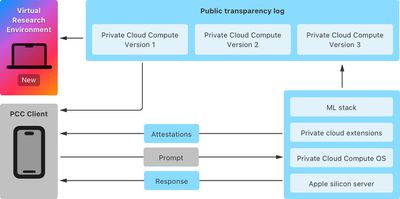
Private Cloud Compute is a cloud intelligence system that Apple designed for private artificial intelligence processing, and it's what Apple is using to keep Apple Intelligence requests secure when they need to be processed in the cloud.
Apple promised to allow security and privacy researchers to verify the end-to-end security and privacy promises that Apple made with Private Cloud Compute, and today, Apple made its Private Cloud Compute Virtual Research Environment (VRE) and other materials publicly available to all security researchers.
Apple has a Private Cloud Compute (PCC) Security Guide that details all of the components of PCC and how they work to provide privacy for cloud-based AI processing. Apple released the source code for select components of PCC that help implement its security and privacy requirements, which allows for a deeper dive into PCC.
The Virtual Research Environment is a set of tools that lets researchers perform their own security analysis on PCC using a Mac. The VRE can be used for inspecting PCC software releases, verifying the consistency of the transparency log, booting a release in a virtualized environment, and modifying and debugging PCC software for deeper investigation. The VRE can be accessed in the macOS 18.1 Developer Preview and can be used with a Mac that has an Apple silicon chip and 16GB+ unified memory.
Along with these tools, Apple is expanding its Apple Security Bounty to include rewards for vulnerabilities that demonstrate a compromise of the fundamental privacy and security guarantees of Private Cloud Compute. Security researchers who locate a vulnerability can earn up to $1 million.
Saturday February 7, 2026 9:26 am PST by Joe Rossignol
Apple today shared an ad that shows how the upgraded Center Stage front camera on the latest iPhones improves the process of taking a group selfie.
"Watch how the new front facing camera on iPhone 17 Pro takes group selfies that automatically expand and rotate as more people come into frame," says Apple. While the ad is focused on the iPhone 17 Pro and iPhone 17 Pro Max, the regular iPhone...
Thursday February 5, 2026 12:22 pm PST by Joe Rossignol
Apple plans to announce the iPhone 17e on Thursday, February 19, according to Macwelt, the German equivalent of Macworld.
The report, citing industry sources, is available in English on Macworld.
Apple announced the iPhone 16e on Wednesday, February 19 last year, so the iPhone 17e would be unveiled exactly one year later if this rumor is accurate. It is quite uncommon for Apple to unveil...
Thursday February 5, 2026 12:54 pm PST by Joe Rossignol
Apple turns 50 this year, and its CEO Tim Cook has promised to celebrate the milestone. The big day falls on April 1, 2026.
"I've been unusually reflective lately about Apple because we have been working on what do we do to mark this moment," Cook told employees today, according to Bloomberg's Mark Gurman. "When you really stop and pause and think about the last 50 years, it makes your heart ...
Friday February 6, 2026 3:06 pm PST by Juli Clover
In the iOS 26.4 update that's coming this spring, Apple will introduce a new version of Siri that's going to overhaul how we interact with the personal assistant and what it's able to do.
The iOS 26.4 version of Siri won't work like ChatGPT or Claude, but it will rely on large language models (LLMs) and has been updated from the ground up.
Upgraded Architecture
The next-generation...
Tuesday February 3, 2026 7:47 am PST by Joe Rossignol
While the iOS 26.3 Release Candidate is now available ahead of a public release, the first iOS 26.4 beta is likely still at least a week away. Following beta testing, iOS 26.4 will likely be released to the general public in March or April.
Below, we have recapped known or rumored iOS 26.3 and iOS 26.4 features so far.
iOS 26.3
iPhone to Android Transfer Tool
iOS 26.3 makes it easier...
If you have proof that's true, let's see it. In comparison to Proton, they have had outsourced firms inspect their servers to verify they're statement of end-to-end encryption is true. Apple has done 0 outsourced audits of their servers.
Right. That's because none of this stuff is ready to go yet. Proton's products are ready to inspect. Apple's aren't. You don't check the doneness of a steak before it hits the grill do you?
You don't have to hear it from me though. You're welcome to read Apple's documentations and promises at that link I provided, but I get the feeling that you're more interested in being skeptical than in being informed.
If you have proof that's true, let's see it. In comparison to Proton, they have had outsourced firms inspect their servers to verify they're statement of end-to-end encryption is true. Apple has done 0 outsourced audits of their servers.
This is quite better, anyone can verify the claims - virtual server Mseries with 16GB is needed: MacStudio will do. Run it yourself.
This is quite a bold step, now iCloud next please.
I'm always curious how many of these bounties are actually collected? One time I sent an iPad OS Lock Screen bypass vulnerability to Apple and nobody ever responded. Feel like that should've been worth something. For how huge some of these vulnerabilities would impact their public image if they were released, you would think Apple would be interested in paying more for them.