Apple Adds Energy and Battery Labels to iPhone and iPad Pages in EU

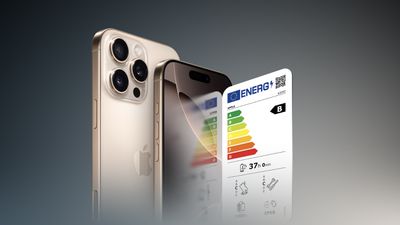
To comply with a new regulation that takes effect today, Apple has added an energy efficiency label to its iPhone and iPad pages in EU countries. Apple is also required to start including a printed version of the label with the devices sold there.
Apple Adds Energy and Battery Labels to iPhone and iPad Pages in EU Feature
The label grades a given iPhone or iPad model's energy efficiency from a high of A to a low of G, based on the EU's testing parameters. However, Apple said that certain aspects of the testing methods outlined by the European Commission are "ambiguous," so it chose to be conservative with its scores until testing is standardized.

In a 44-page document detailing its testing methodology for the labels, Apple said its current iPhone models qualified for the highest energy efficiency grade of A, but the company voluntarily downgraded these scores to a B as a cautionary measure:

As an additional cautionary measure, Apple went one step further and downgraded some of its scores to factor in test method ambiguities and variance. For example, Energy Efficiency Index scores for iPhone models on the EU market in June 2025 all qualified for the highest "A" grade, but Apple chose to voluntarily derate scores to a "B" grade to minimize the probability that a third-party tester interpreting the regulation differently would achieve a lower grade. We also downgraded scores for the Repeated Free Fall Reliability Class for the same reason.

The label also provides details about a given iPhone or iPad model's battery life per full charge cycle, repairability grade, impact resistance, ingress protection rating for water and dust resistance, and how many full charge cycles the battery is rated for. Likewise, this information is based on Apple's interpretation of the EU's testing parameters.

On the web, the label can be viewed by clicking or tapping on the colorful little tag icon on various iPhone and iPad pages on Apple's localized websites for EU countries. It is shown on both Apple's main product marketing pages for all iPhone and iPad models that are currently sold in the EU, and on the purchase page for those devices.

The label is accompanied by a product information sheet (PDF) that provides a comprehensive overview of even more details, such as the device's battery capacity in mAh, screen scratch resistance based on the Mohs hardness scale, the minimum guaranteed timeframe for availability of security updates, and much more.

On the European Commission's website, there is a database that lets you view energy label information for smartphones and tablets sold in the EU.

More details about the label are available on the European Commission's website.

EU countries include Austria, Belgium, Bulgaria, Croatia, Cyprus, Czech Republic, Denmark, Estonia, Finland, France, Germany, Greece, Hungary, Ireland, Italy, Latvia, Lithuania, Luxembourg, Malta, the Netherlands, Poland, Portugal, Romania, Slovakia, Slovenia, Spain, and Sweden. The labels are also shown in Norway and Switzerland.

Popular Stories

maxresdefault

Apple Shows Off a Key Reason to Upgrade to the iPhone 17

Saturday February 7, 2026 9:26 am PST by
Apple today shared an ad that shows how the upgraded Center Stage front camera on the latest iPhones improves the process of taking a group selfie. "Watch how the new front facing camera on iPhone 17 Pro takes group selfies that automatically expand and rotate as more people come into frame," says Apple. While the ad is focused on the iPhone 17 Pro and iPhone 17 Pro Max, the regular iPhone...
Finder Siri Feature

Why Apple's iOS 26.4 Siri Upgrade Will Be Bigger Than Originally Promised

Friday February 6, 2026 3:06 pm PST by
In the iOS 26.4 update that's coming this spring, Apple will introduce a new version of Siri that's going to overhaul how we interact with the personal assistant and what it's able to do. The iOS 26.4 version of Siri won't work like ChatGPT or Claude, but it will rely on large language models (LLMs) and has been updated from the ground up. Upgraded Architecture The next-generation...
wwdc sans text feature

Apple Rumored to Announce New Product on February 19

Thursday February 5, 2026 12:22 pm PST by
Apple plans to announce the iPhone 17e on Thursday, February 19, according to Macwelt, the German equivalent of Macworld. The report, citing industry sources, is available in English on Macworld. Apple announced the iPhone 16e on Wednesday, February 19 last year, so the iPhone 17e would be unveiled exactly one year later if this rumor is accurate. It is quite uncommon for Apple to unveil...
apple wallet drivers license feature iPhone 15 pro

Apple Says These 7 U.S. States Plan to Offer iPhone Driver's Licenses

Monday February 9, 2026 6:24 am PST by
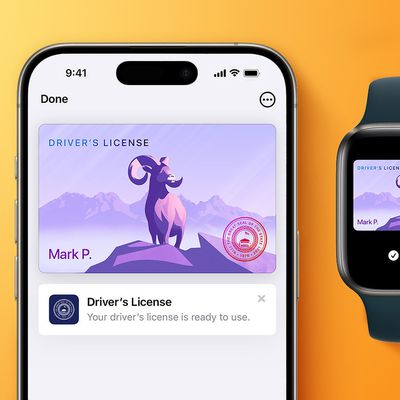
In select U.S. states, residents can add their driver's license or state ID to the Apple Wallet app on the iPhone and Apple Watch, and then use it to display proof of identity or age at select airports and businesses, and in select apps. The feature is currently available in 13 U.S. states and Puerto Rico, and it is expected to launch in at least seven more in the future. To set up the...
14 inch MacBook Pro Keyboard

New MacBook Pros Could Now Arrive in March

Sunday February 8, 2026 6:02 am PST by
New MacBook Pro models with the M5 Pro and M5 Max chips could arrive as soon as Monday, March 2, according to Bloomberg's Mark Gurman. In today's "Power On" newsletter, Gurman said that the release of new MacBook Pro models is tied to the release of macOS Tahoe 26.3. The launch is said to be slated for as early as the week of March 2. He added that the M4 Pro and M4 Max models on sale today...

Top Rated Comments

jz0309 Avatar
9 months ago

Apple is also required to start including a printed version of the label with the devices sold there.
Now that’s a very environmentally solution, well done EU!
Score: 26 Votes (Like | Disagree)
orbital~debris Avatar
9 months ago
I love these labels, and the way they make it possible for people across the EU to compare like-for-like on different products.

Even if some people ignore them, it simultaneously allows others to make purchase choices which are less problematic for our shared environment, and have less of a negative impact on Earth.
Score: 20 Votes (Like | Disagree)
gh0stpr0t0c0lburner Avatar
9 months ago

The label is accompanied by a product information sheet ('https://regulatoryinfo.apple.com/cwt/api/ext/file?fileId=energyLabels/A3293_V1/A3293/A3293_Product_Information_Sheet_EN_EU.pdf') (PDF) that provides a comprehensive overview of even more details, such as the device's battery capacity in mAh, screen scratch resistance based on the Mohs hardness scale, the minimum guaranteed timeframe for availability of security updates, and much more.
Many people here complain bitterly about the EU...but requiring companies to list all this stuff is actually fantastic.
Score: 20 Votes (Like | Disagree)
klasma Avatar
8 months ago

Is anybody going to make a purchasing decision based on that rating?
In a physical store in the EU, these labels are prominently featured on each device that requires them, and similarly displayed on product pages in online stores. People do make purchasing decisions based on that. Traditionally that’s more for household appliances and devices like TVs and PC monitors, but if you have two smartphones side by side where one has A and the other C, then that will influence the buying decision, and hence incentivizes manufacturers to achieve better ratings.
Score: 17 Votes (Like | Disagree)
gh0stpr0t0c0lburner Avatar
9 months ago

Sometimes EU is just dumb. What’s the point of printing a physical copy of the label?
Access. For all that we love to believe we live in the future, the only way to make sure something is 100% accessible is to take it out of the virtual and print it. People pooh poohing it for environmental reasons are being obstinate—this is not the piece of paper that will destroy the earth. That is more likely to be billions of smartphones. :)
Score: 16 Votes (Like | Disagree)
gh0stpr0t0c0lburner Avatar
8 months ago

Don’t understand the purpose of this, the Eau treats smartphones as a “utility” needed to function in normal life, so what’s the point of rating charging efficiency if it’s needed to survive?
It encourages manufacturers to work on its efficiency. We have seen this in many, many different fields of products.
Score: 14 Votes (Like | Disagree)