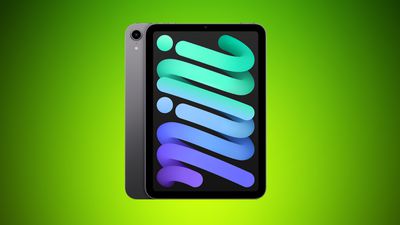
The next-generation iPad mini 8 could feature an updated design that removes the speaker holes for improved water resistance, with Apple considering a new speaker system design. The new system would use vibration-based technology, according to Bloomberg, which would make it unique among Apple products if it's adopted.
It turns out there are already some devices on the market that use vibration-based sound, giving some insight into how the technology works and how Apple might implement the feature.
Vibration-Based Sound
Apple could be planning to use a sound exciter, which creates sound waves by causing a surface like a glass panel or metal frame to vibrate. A piezo or electromagnetic exciter can use almost any surface for resonance, and there's no need for a standard speaker that sends vibrations through a diaphragm.
Apple could attach an exciter to the iPad mini's chassis or display. When playing audio, the exciter could vibrate the panel to move air and create sound with no traditional speaker or need for speaker holes.
The iPad has a decent-sized display that could support multiple exciters to allow for stereo sound, with the screen divided into sub-panels to serve as separate diaphragms.
Patents
Apple has patented a system similar to what's described above. Apple's "mechanically actuated panel acoustic system" patent describes an electronic device with an enclosure that's used as part of an acoustic system.
The enclosure is divided into sub-panels, and each sub-panel has one or more actuators to vibrate the sub-panel. The actuator and attached sub-panel then convert an audio signal to acoustic output.
Real-World Examples
Huawei's 2019 P30 Pro debuted "Acoustic Display Technology," featuring an under-display speaker. It included a tiny exciter that vibrated the glass screen, turning the entire display into a speaker. An iFixit teardown revealed that Huawei was using a small coil with a magnet in the middle paired with a component that vibrated the screen to create sound.
Based on reviews, the Acoustic Display Technology worked well, but Huawei only used it for calls. All the rest of the smartphone's audio was routed through an additional bottom speaker, and the lack of stereo sound wasn't popular. Huawei released one more model with the technology, the P40, before returning to a more traditional system for subsequent smartphones.
Some TVs have used the technology to improve sound. LG's G8 ThinQ used the entire OLED display as a diaphragm, vibrating the screen to produce sound. LG paired it with a bottom speaker for stereo performance and to handle bass.
Sony's OLED TVs have used an "Acoustic Surface" for sound for several years. The TVs include multiple actuators behind the display that vibrate the screen to create sound. Sony says sound is precisely aligned with what you see, for a more immersive viewing experience. The technology is often praised in reviews of Sony TV sets.
It wouldn't be a surprise to see Apple adopt something like the Acoustic Surface, positioning it as a way for users to get immersive, spatial sound even when not wearing AirPods or other headphones that support spatial audio.
There are also plenty of "invisible" speakers that are meant to be mounted behind drywall or in ceilings. They use surface exciters to vibrate the material they're attached to, turning walls into speaker drivers.
Water Resistance
Removing the speaker holes provide fewer paths for water ingress. The current iPad mini has speaker holes at the top and bottom of the device, and no water resistance rating.
It's not clear what water resistance rating the iPad mini might get. The iPhone has IP68 water resistance, which means it can withstand being under water that's six meters deep for at least 30 minutes.
Microphone Holes
If Apple eliminates speaker holes on the iPad mini, microphone holes would likely remain. The iPad mini 7 has one microphone hole at the top and a second microphone hole located below the camera.
The iPhone also has microphone holes, so Apple could use gaskets and adhesive for water resistance without impacting functionality.
Potential Drawbacks
Bass is an issue with vibration-based audio systems. Sony, for example, integrates separate subwoofers in its TVs to add bass. Apple could use a similar hybrid solution, or use digital signal processing to make up for the missing bass frequencies.
Surface speakers can radiate mids and highs across the panel, but perceived width can be narrower because the vibration comes from a single surface rather than two separate drivers in different locations. If Apple uses actuators to vibrate the iPad mini's chassis or display, audio playback might not sound as full as stereo speakers do.
Touch can dampen sound by absorbing vibration. Apple could likely mitigate this with sensors that determine how the iPad is held, adjusting the vibration pattern accordingly.
Other iPad mini 8 Features
Along with water resistance, rumors suggest the iPad mini 8 could be the first iPad other than the iPad Pro to get OLED display technology.
If implemented, Apple's vibration-based sound system could require some fancy audio processing. The iPad mini is expected to have the same A19 Pro chip that Apple introduced in the iPhone Air and the iPhone 17 Pro.
Launch Timing
Apple could release the iPad mini 8 as soon as 2026.