Holiday Gifts Drive New iOS Device Activations Sharply Higher

While it seems obvious that the holiday gift-giving season is a strong driver for iOS device sales, as evidenced in part by past history and Apple's forecast of a blockbuster quarter, it is generally difficult to quantify that holiday boost before Apple reports device sales as part of its quarterly earnings or makes public statements about App Store milestones.

A couple of analytics firms have, however, put out reports today seeking to offer some measure of the bump in demand for iOS devices and those of competing platforms such as Android.

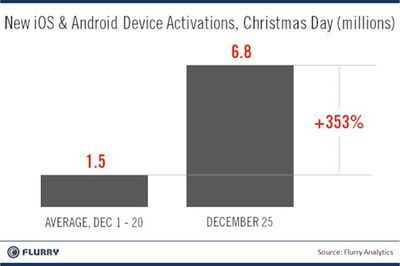
According to Flurry, both iOS and Android saw a "massive influx" of devices registering on the firm's servers, coming in through the over 140,000 apps using Flurry Analytics. Data collated by Flurry shows that combined new device activations for iOS and Android rose from an average of 1.5 million per day during the first three weeks of December to 6.8 million devices on Christmas Day, an increase of 353%. This compares to a total of 2.8 million new devices detected on the previous record-setting day of Christmas 2010.
flurry christmas 2011 activations
All of those new device activations also drove increased App Store activity, with Flurry measuring an increase of 125% in iOS and Android app downloads on Christmas Day compared to the early December baseline. Flurry's data shows that the 242 million app downloads on Christmas Day spiked from an average of 108 million per day during the first three weeks of the month. Flurry notes that the increase in app downloads is smaller than that for new device activations on a percentage basis due to the higher baseline from apps being installed onto the already-large installed base of devices.

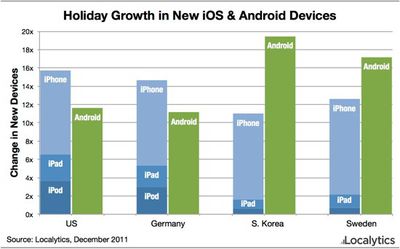
Illustrating how different analytics firms can see somewhat different patterns due in part to what data is used for baseline purposes, Localytics issued a report showing iOS device activations coming in more than 12 times higher during the holiday weekend than they did during previous weekends. The increase was over 15x for iOS devices as a whole in the United States, with the iPod performing strongly at a 21x increase due to the relative lower cost and lack of service contract, factors which make them relatively more popular as gifts than iPhones or iPads.
localytics christmas 2011 devices
Comparing iOS to Android, Localytics found that Android also grew at approximately 12.5x over baseline. Localytics also looked at country-by-country comparisons, showing iOS outpacing Android in terms of growth in the United States, Germany, and the UK, while Android performed better in most of the other top countries.
Popular Stories

Apple Logo Zoomed

Tim Cook Teases Plans for Apple's Upcoming 50th Anniversary

Thursday February 5, 2026 12:54 pm PST by
Apple turns 50 this year, and its CEO Tim Cook has promised to celebrate the milestone. The big day falls on April 1, 2026. "I've been unusually reflective lately about Apple because we have been working on what do we do to mark this moment," Cook told employees today, according to Bloomberg's Mark Gurman. "When you really stop and pause and think about the last 50 years, it makes your heart ...
wwdc sans text feature

Apple Rumored to Announce New Product on February 19

Thursday February 5, 2026 12:22 pm PST by
Apple plans to announce the iPhone 17e on Thursday, February 19, according to Macwelt, the German equivalent of Macworld. The report, citing industry sources, is available in English on Macworld. Apple announced the iPhone 16e on Wednesday, February 19 last year, so the iPhone 17e would be unveiled exactly one year later if this rumor is accurate. It is quite uncommon for Apple to unveil...
Finder Siri Feature

Why Apple's iOS 26.4 Siri Upgrade Will Be Bigger Than Originally Promised

Friday February 6, 2026 3:06 pm PST by
In the iOS 26.4 update that's coming this spring, Apple will introduce a new version of Siri that's going to overhaul how we interact with the personal assistant and what it's able to do. The iOS 26.4 version of Siri won't work like ChatGPT or Claude, but it will rely on large language models (LLMs) and has been updated from the ground up. Upgraded Architecture The next-generation...
iOS 26

iOS 26.3 and iOS 26.4 Will Add These New Features to Your iPhone

Tuesday February 3, 2026 7:47 am PST by
While the iOS 26.3 Release Candidate is now available ahead of a public release, the first iOS 26.4 beta is likely still at least a week away. Following beta testing, iOS 26.4 will likely be released to the general public in March or April. Below, we have recapped known or rumored iOS 26.3 and iOS 26.4 features so far. iOS 26.3 iPhone to Android Transfer Tool iOS 26.3 makes it easier...
iphone 17 pro dark blue 1

iPhone 18 Pro Max Rumored to Deliver Next-Level Battery Life

Friday February 6, 2026 5:14 am PST by
The iPhone 18 Pro Max will feature a bigger battery for continued best-in-class battery life, according to a known Weibo leaker. Citing supply chain information, the Weibo user known as "Digital Chat Station" said that the iPhone 18 Pro Max will have a battery capacity of 5,100 to 5,200 mAh. Combined with the efficiency improvements of the A20 Pro chip, made with TSMC's 2nm process, the...

Top Rated Comments

Oletros Avatar
184 months ago
Showing Android as a single column hides the terrible fragmentation that actually exists on the Android platform.

What has to do "terrible fragmentation" with total sales?
Score: 15 Votes (Like | Disagree)
drwatz0n Avatar
184 months ago
Why is Android always shown as a single unit compared to iPhone, iPad and iPod Touch IOS devices. Certainly each manufacturer's unique version of Android installed on unique equipment is a different device. There should be multiple segments in the Android column for each manufacturer with it's customized Android software just like the IOS column shows the different IOS devices. Showing Android as a single column hides the terrible fragmentation that actually exists on the Android platform.
If you want to talk about fragmentation of the graph, let's discuss how it's fair to compare Android devices, which for the most part are contract cell phones, to iPod touch sales. If you remove the iPod touch from the graph, Android and iPhone/iPad growth are relatively similar.

EDIT: If you remove the iPod touch, the growth rate for the iPhone/iPad is just over 12x, as opposed to Android's mid-11x level (based on US numbers). Not that I am assuming ALL Android sales are on contract, but compared to the iPod touch, it's unfair.
Score: 14 Votes (Like | Disagree)
Shasterball Avatar
184 months ago
Does it take into account the fact that there will be a decrease in activations during December 1-20 as compared to your "average" 3 week period because of people holding off until Christmas? I would suspect you would see the same decrease in activations before a product release. Sounds like this would skew the numbers…
Score: 11 Votes (Like | Disagree)
aerok Avatar
184 months ago
Why is Android always shown as a single unit compared to iPhone, iPad and iPod Touch IOS devices. Certainly each manufacturer's unique version of Android installed on unique equipment is a different device. There should be multiple segments in the Android column for each manufacturer with it's customized Android software just like the IOS column shows the different IOS devices. Showing Android as a single column hides the terrible fragmentation that actually exists on the Android platform.
Why do you care so much? Btw, this has nothing to do with fragmentation?

Gratz to all manufacturers, the CEOs will touch a great end of year bonus!
Score: 9 Votes (Like | Disagree)
kdarling Avatar
184 months ago
Why is Android always shown as a single unit compared to iPhone, iPad and iPod Touch IOS devices.

Not enough info to accurately break out tablets from phones.

There should be multiple segments in the Android column for each manufacturer with it's (sic) customized Android software just like the IOS column shows the different IOS devices.

We also never see the iOS phone column separated into 3GS, 4 and 4S sections. They have different screen resolutions and capabilities.

Showing Android as a single column hides the terrible fragmentation that actually exists on the Android platform.

You mean the amazing selection that exists :)

--

Both Android and iOS have multiple screen sizes and resolutions.

Both have multiple OS versions in use. Just looking at new device sales doesn't speak to that issue. For example, less than half of iOS devices in use are running iOS version 5; the majority are still on 4.x, with a few still on 3.x.

However, from a experienced developer standpoint, the so-called "terrible fragmentation" on both devices isn't that big a deal. It's also not that big a deal to users, since smart developers target the lowest setup possible in order to have as wide an audience as possible.
Score: 7 Votes (Like | Disagree)
aerok Avatar
184 months ago
Just what I wanted to say... Lies, damn lies and statistics, too many 'news' articles are generated from them...

How is this a lie? This news is only to show how successful they both were...
Score: 7 Votes (Like | Disagree)