Apple's 'Macroscalar' Trademark Application Sparks Speculation on Processor Architecture Advances

Patently Apple reports that Apple last week filed a curious new trademark application for the term "macroscalar". The company has typically quietly registered trademarks in countries such as Trinidad & Tobago, only to later apply for the marks in the United States and other major markets once the new products and features have been announced. While an application for "macroscalar" was indeed filed in Trinidad & Tobago last August, the new U.S. application and a similar one in Hong Kong are sparking speculation that Apple may have jumped the gun in announcing some new processor technology.

Apple's "Macroscalar" isn't just a new marketing line; it's a processor architecture that's been in the works at Apple since 2004. In fact, Apple owns at least four granted patents on the technology that has yet to come to light. We first covered it in 2009 and briefly twice last year.
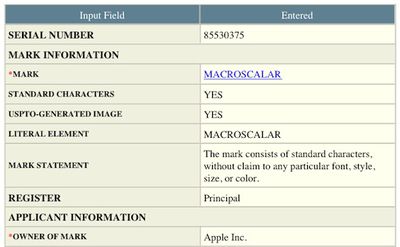
macroscalar trademark application
ZDNet published more on Apple's macroscalar architecture last July following one of those patent disclosures, including an explanation of how the technique could be used to improve processor efficiencies by optimizing data-dependent loops.

The macroscalar processor addresses this problem in a new way: at compile-time it generates contingent secondary instructions so when a data-dependent loop completes the next set of instructions are ready to execute. In effect, it loads another pipeline for, say, completing a loop, so the pipeline remains full whether the loop continues or completes. It can also load a set of sequential instructions that run within or between loops, speeding execution as well.

From a user perspective, the technology could support faster performance and lower power consumption, something Apple would definitely be interested in pursing for its mobile devices.

Since Apple provides its own compilers as well as designing CPUs, it is uniquely positioned to offer a complete macroscalar solution to its large band of iOS developers, further widening the price/performance gap between it and the iPad wannabes.

Is it a breakthrough? It could be if the efficiencies it promises can be realized in practice. We’ll have to see just how good Apple’s compiler engineers are.

While no specifics on Apple's plans have been revealed, the public application for a trademark on the "macroscalar" term is a curious development for the company given that most of its trademarks relate to product and feature names and other promotional descriptions. As a result, speculation suggests that Apple could be preparing to make a significant announcement that will prominently feature the "Macroscalar" term in a similar way to how the company uses "Retina" to describe its high-resolution iPhone and iPod touch displays.
Popular Stories

Apple Logo Zoomed

Tim Cook Teases Plans for Apple's Upcoming 50th Anniversary

Thursday February 5, 2026 12:54 pm PST by
Apple turns 50 this year, and its CEO Tim Cook has promised to celebrate the milestone. The big day falls on April 1, 2026. "I've been unusually reflective lately about Apple because we have been working on what do we do to mark this moment," Cook told employees today, according to Bloomberg's Mark Gurman. "When you really stop and pause and think about the last 50 years, it makes your heart ...
wwdc sans text feature

Apple Rumored to Announce New Product on February 19

Thursday February 5, 2026 12:22 pm PST by
Apple plans to announce the iPhone 17e on Thursday, February 19, according to Macwelt, the German equivalent of Macworld. The report, citing industry sources, is available in English on Macworld. Apple announced the iPhone 16e on Wednesday, February 19 last year, so the iPhone 17e would be unveiled exactly one year later if this rumor is accurate. It is quite uncommon for Apple to unveil...
Finder Siri Feature

Why Apple's iOS 26.4 Siri Upgrade Will Be Bigger Than Originally Promised

Friday February 6, 2026 3:06 pm PST by
In the iOS 26.4 update that's coming this spring, Apple will introduce a new version of Siri that's going to overhaul how we interact with the personal assistant and what it's able to do. The iOS 26.4 version of Siri won't work like ChatGPT or Claude, but it will rely on large language models (LLMs) and has been updated from the ground up. Upgraded Architecture The next-generation...
iOS 26

iOS 26.3 and iOS 26.4 Will Add These New Features to Your iPhone

Tuesday February 3, 2026 7:47 am PST by
While the iOS 26.3 Release Candidate is now available ahead of a public release, the first iOS 26.4 beta is likely still at least a week away. Following beta testing, iOS 26.4 will likely be released to the general public in March or April. Below, we have recapped known or rumored iOS 26.3 and iOS 26.4 features so far. iOS 26.3 iPhone to Android Transfer Tool iOS 26.3 makes it easier...
iphone 17 pro dark blue 1

iPhone 18 Pro Max Rumored to Deliver Next-Level Battery Life

Friday February 6, 2026 5:14 am PST by
The iPhone 18 Pro Max will feature a bigger battery for continued best-in-class battery life, according to a known Weibo leaker. Citing supply chain information, the Weibo user known as "Digital Chat Station" said that the iPhone 18 Pro Max will have a battery capacity of 5,100 to 5,200 mAh. Combined with the efficiency improvements of the A20 Pro chip, made with TSMC's 2nm process, the...

Top Rated Comments

d4rkc4sm Avatar
183 months ago
Apple don't design CPU's, they design SoC's

ipod socks?
Score: 11 Votes (Like | Disagree)
AidenShaw Avatar
183 months ago
Sounds like a prelude to some very, very big things - another shift. This is pretty exciting.

Wow. Just wow.

How excited do you get when something of substance is the thread topic?

This excited over an adjective?
Score: 9 Votes (Like | Disagree)
dasmb Avatar
183 months ago
ANOTHER processor change? If I have to go through this all over again a forth time I will stop programming and become a barista! :confused:

If you, as a programmer, still give two craps what chip your code is running on -- well, you suck. That would also explain why barista is an acceptable move, salary wise.

Abstract, brother, abstract. Use blocks, adapter objects, build lightweight APIs around your process intensive work and use the core APIs wherever possible -- and advances in chips becomes basically free. Stop ice skating uphill.
Score: 8 Votes (Like | Disagree)
Dookieman Avatar
183 months ago
Can someone with a better understanding on the topic break this down into laymans terms?
Score: 8 Votes (Like | Disagree)
pavelbure Avatar
183 months ago
for some reason it took me 2 min. to read that headline.:)
Score: 8 Votes (Like | Disagree)
cmChimera Avatar
183 months ago
It makes sense that Apple will eventually move away from Intel chipsets to their own. The benefits are in abundance;

- Apple nets more profit with each sale, since they won't have to hand Intel various licensing fees. Everyone in the pro community knows just how much the workstation class CPU's have gone up in price, and that has only inflated the Mac Pro's now ridiculous value. It only seems like 3-years ago that the Mac Pro was around £500 cheaper.

- They can control the release schedules and progress of their own technologies, rather than waiting on Intel to release their products.

- Their chipsets will work independently, and they won't have to compromise performance/features as has occurred between the Intel and Nvidia with their own disputes.

- It adds more control to Apple's products, and they market the chips to their hearts content with fancy names.

- Lastly of course, it means they can introduce new technologies now found in Intel chips or those from other rivals.

It all sounds good, but I can't imagine it'll happen for a while.

That doesn't sound good, nor is that likely to be what this is. The biggest problem from switching away from Intel would be the MASSIVE incompatibility problem that would occur.
Score: 7 Votes (Like | Disagree)