Walter Isaacson's 'The Innovators' Charts the History of Computing and the Internet

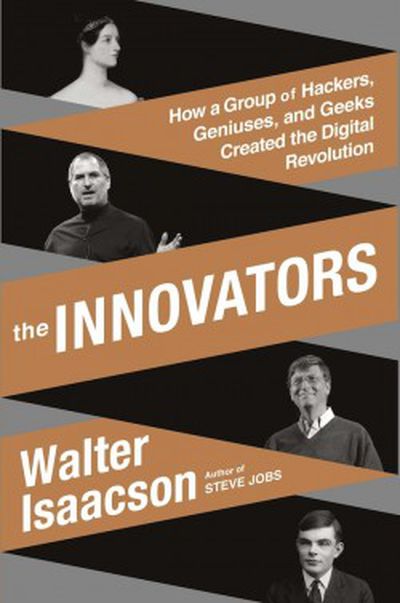
the_innovators_coverMore than a decade ago, Walter Isaacson began working on a book to highlight the history of computers and the Internet, but the project was sidelined in early 2009 when he took on the task of writing Steve Jobs' authorized biography. That book, which debuted just weeks after Jobs' death in October 2011, topped best seller charts and revealed a number of interesting details about Jobs and Apple.

Following the publication of Steve Jobs, Isaacson returned to his earlier project of documenting the history of computing, and that work debuts tomorrow as The Innovators: How a Group of Hackers, Geniuses, and Geeks Created the Digital Revolution. While Apple and Jobs play relatively minor roles in the book, overall it offers an interesting look at how computers and the Internet developed into what they are today.

Isaacson breaks his book into nearly a dozen different sections, highlighting a number of advancements along the way. It begins with Ada Lovelace and Charles Babbage outlining their thoughts on a mechanical "Analytical Engine" in the 1830s and 1840s before jumping ahead nearly 100 years to Vannevar Bush and Alan Turing and their visions for the earliest computers that would follow soon after. Further sections address advances in programming, transistors, microchips, video games, and the early Internet before broaching the topics of the modern personal computer and the World Wide Web.

Throughout the book, Isaacson focuses on the importance of teamwork rather than individual genius in the development of computers, frequently involving contrasting but complementary personalities of visionaries, technical experts, and managers. Popular examples include Steve Jobs and Steve Wozniak at Apple, or Bob Noyce, Gordon Moore, and Andy Grove at Intel, but the observation extends further as time and time again teams have been responsible for many of the biggest innovations.

Innovation comes from teams more often than from the lightbulb moments of lone geniuses. This was true of every era of creative ferment. [...] But to an even greater extent, this has been true of the digital age. As brilliant as the many inventors of the Internet and computer were, they achieved most of their advances through teamwork.

Isaacson also emphasizes the importance of building on previous discoveries, including collaboration both within and between generations of scientists. A number of characters in the book appear at multiple stages, often first as innovators themselves and later helping to foster discoveries by the next generation.

Other observations include the various roles of government, academia, and business in the development of computing and how they frequently came together, particularly in the early days, to lead advancements. Isaacson also uses several cases to argue that innovation works best when different business models compete against each other, particularly in software development as with Apple's integrated systems vying with Microsoft's unbundled model while the free and open-source approach maintained its position in the market.

Each model had its advantages, each had its incentives for creativity, and each had its prophets and disciples. But the approach that worked best was having all three models coexisting, along with various combinations of open and closed, bundled and unbundled, proprietary and free. Windows and Mac, UNIX and Linux, iOS and Android: a variety of approaches competed over the decades, spurring each other on -- and providing a check against any one model becoming so dominant that it stifled innovation.

Packing the entire history of computing into 500 pages leaves some topics feeling brief or left out altogether, but Isaacson's book gives an interesting overview for those who may not be familiar with the technical advances stretching back decades that have given rise to the current state of the art. Focusing more on the people and relationships than the technical details, it offers some insight into how breakthroughs have been made and how some innovators have gained fame and fortune while others slipped into near obscurity.
Popular Stories

Apple Logo Zoomed

Tim Cook Teases Plans for Apple's Upcoming 50th Anniversary

Thursday February 5, 2026 12:54 pm PST by
Apple turns 50 this year, and its CEO Tim Cook has promised to celebrate the milestone. The big day falls on April 1, 2026. "I've been unusually reflective lately about Apple because we have been working on what do we do to mark this moment," Cook told employees today, according to Bloomberg's Mark Gurman. "When you really stop and pause and think about the last 50 years, it makes your heart ...
wwdc sans text feature

Apple Rumored to Announce New Product on February 19

Thursday February 5, 2026 12:22 pm PST by
Apple plans to announce the iPhone 17e on Thursday, February 19, according to Macwelt, the German equivalent of Macworld. The report, citing industry sources, is available in English on Macworld. Apple announced the iPhone 16e on Wednesday, February 19 last year, so the iPhone 17e would be unveiled exactly one year later if this rumor is accurate. It is quite uncommon for Apple to unveil...
Finder Siri Feature

Why Apple's iOS 26.4 Siri Upgrade Will Be Bigger Than Originally Promised

Friday February 6, 2026 3:06 pm PST by
In the iOS 26.4 update that's coming this spring, Apple will introduce a new version of Siri that's going to overhaul how we interact with the personal assistant and what it's able to do. The iOS 26.4 version of Siri won't work like ChatGPT or Claude, but it will rely on large language models (LLMs) and has been updated from the ground up. Upgraded Architecture The next-generation...
iOS 26

iOS 26.3 and iOS 26.4 Will Add These New Features to Your iPhone

Tuesday February 3, 2026 7:47 am PST by
While the iOS 26.3 Release Candidate is now available ahead of a public release, the first iOS 26.4 beta is likely still at least a week away. Following beta testing, iOS 26.4 will likely be released to the general public in March or April. Below, we have recapped known or rumored iOS 26.3 and iOS 26.4 features so far. iOS 26.3 iPhone to Android Transfer Tool iOS 26.3 makes it easier...
iphone 17 pro dark blue 1

iPhone 18 Pro Max Rumored to Deliver Next-Level Battery Life

Friday February 6, 2026 5:14 am PST by
The iPhone 18 Pro Max will feature a bigger battery for continued best-in-class battery life, according to a known Weibo leaker. Citing supply chain information, the Weibo user known as "Digital Chat Station" said that the iPhone 18 Pro Max will have a battery capacity of 5,100 to 5,200 mAh. Combined with the efficiency improvements of the A20 Pro chip, made with TSMC's 2nm process, the...

Top Rated Comments

CalWizrd Avatar
148 months ago
Does this book give adequate treatment to women and people of color who were early pioneers of computing?

Ah, the obligatory politically correct query. Vomit time.

How about just recognizing contributions without questioning gender, race, sexual orientation, country of origin, left-handedness, etc?
Score: 20 Votes (Like | Disagree)
Cougarcat Avatar
148 months ago
This is going to be bashed hard here judging from the Steve Jobs book. :rolleyes:

Well, if Isaacson couldn't get one aspect of the history of computing right, I don't have confidence that he can do all of it...
Score: 10 Votes (Like | Disagree)
engg2000 Avatar
148 months ago
I hope he remembered to include Al Gore as the father of the internet.
Score: 8 Votes (Like | Disagree)
nick42983 Avatar
148 months ago
Does this book give adequate treatment to women and people of color who were early pioneers of computing?

By "adequate" do you mean totally out of proportion to their contributions? Let people's achievements stand for themselves, affirmative action has wreaked enough destruction as it is.
Score: 7 Votes (Like | Disagree)
zoetmb Avatar
148 months ago
Does this book give adequate treatment to women and people of color who were early pioneers of computing?
Did you read what's contained in the book? The book begins with Ada Lovelace, who was a woman.

Unfortunately, because of sexism and racism, not that many women and people of color were early pioneers of computing, although the early Mac team included people like Susan Kare, a woman who designed all the early icons.

There's still a dearth of woman and people of color in tech companies. However, whether that's a result of racism and sexism in the industry, by academia or self-choices by women and people of color is open to question.

Go to a high school or even a junior high school and ask who wants to go into IT fields and my bet is that a lower percentage of women and people of color raise their hands. Unfortunately, people start self-discriminating at very young ages or are stereotyped into roles by their parents.
Score: 5 Votes (Like | Disagree)
apolloa Avatar
148 months ago
I think Tim Berners-Lee and his team have done more then anyone else to change the entire world. Unbelievable just how much the World Wide Web has changed everybody's lives.
Score: 5 Votes (Like | Disagree)