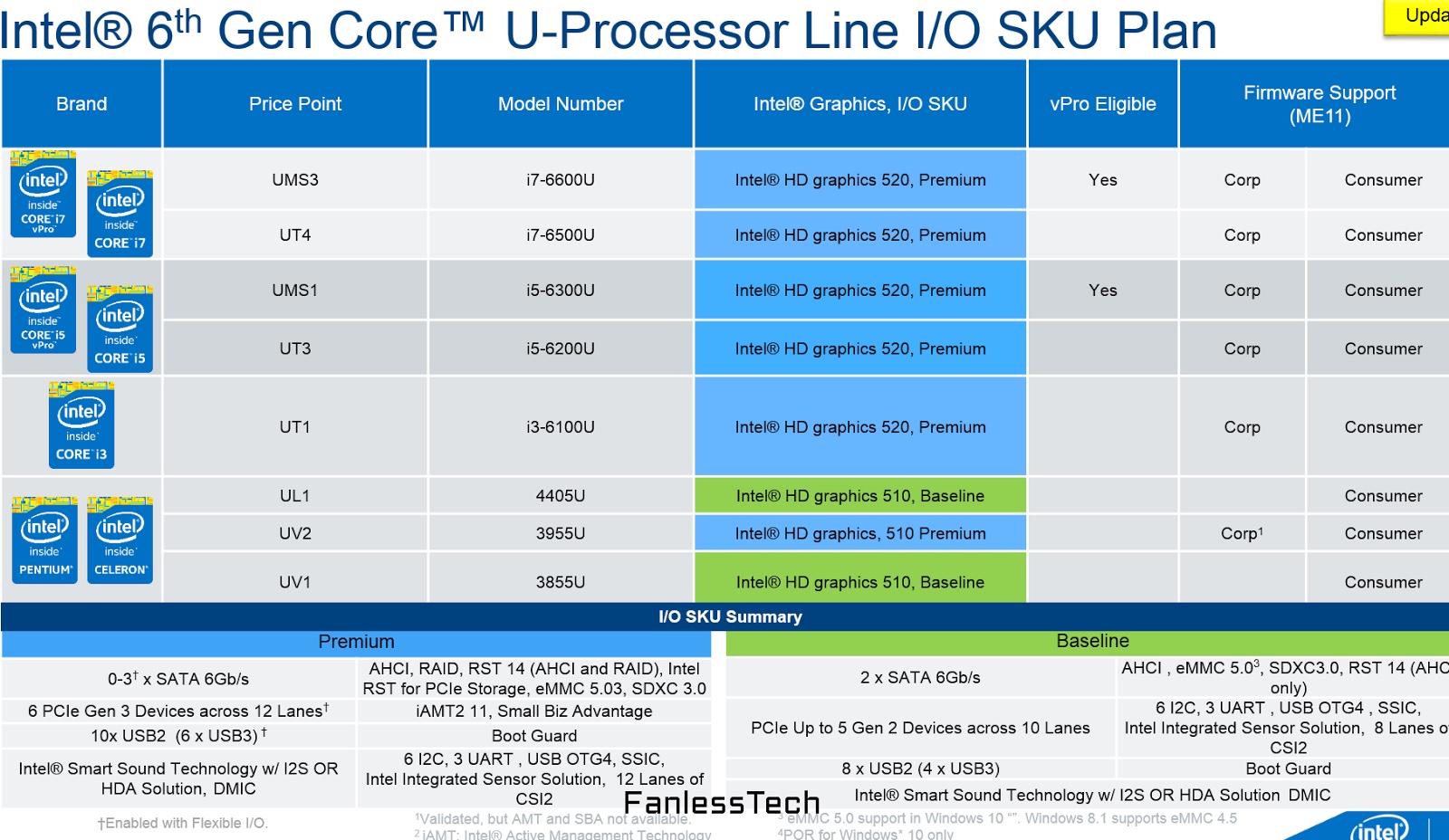
Details on Intel's upcoming 15-watt 6200U - 6600U Skylake processor lineup were shared today by Fanless Tech, giving us a look at what we can expect from the processors that will likely be used in Apple's next MacBook Air update.
Click to view larger version
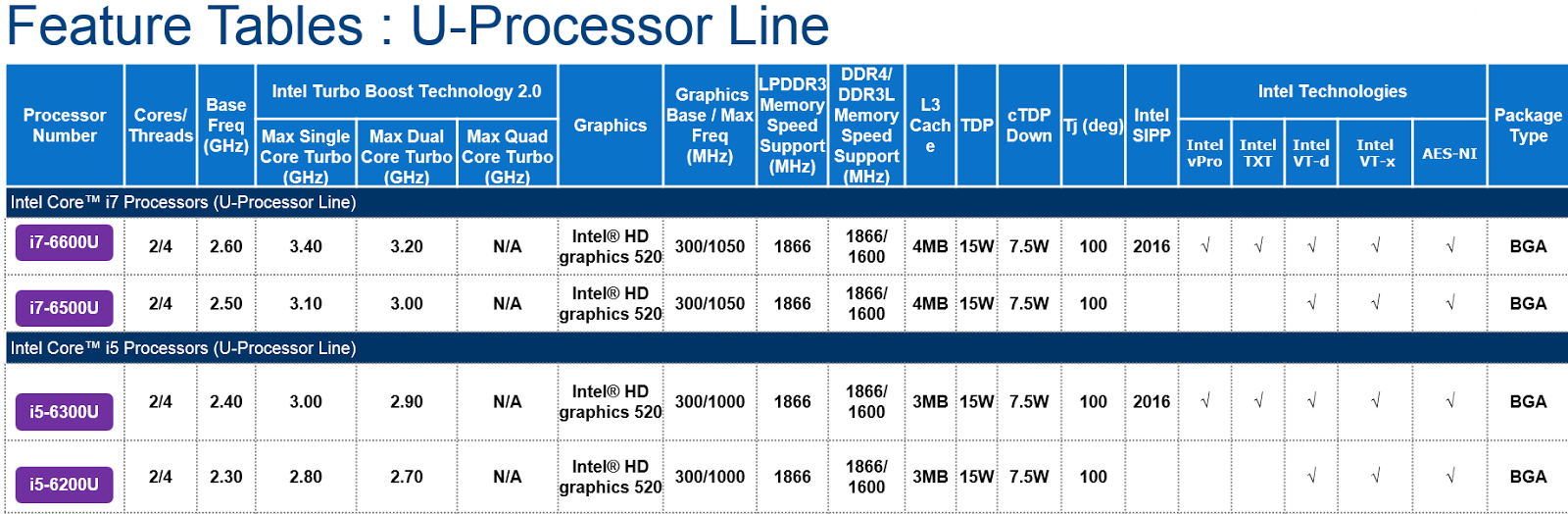
The 2.3GHz i5-6200U and the 2.4GHz i5-6300U chips are appropriate for the lower-end MacBook Air models, while the 2.5GHz i7-6500U and the 2.6GHz i7-6600U would be used in the higher-end MacBook Air models. All four chips include Intel HD 520 graphics. With Skylake, Intel has opted to simplify its graphics naming scheme, adopting 3-digit numbers instead of 4-digit numbers.
Click to view larger version
It is not clear when Intel plans to release the Skylake chips appropriate for the MacBook Air, but with full specs now available, it seems launch is imminent, perhaps planned for next week's Intel Developer Forum.
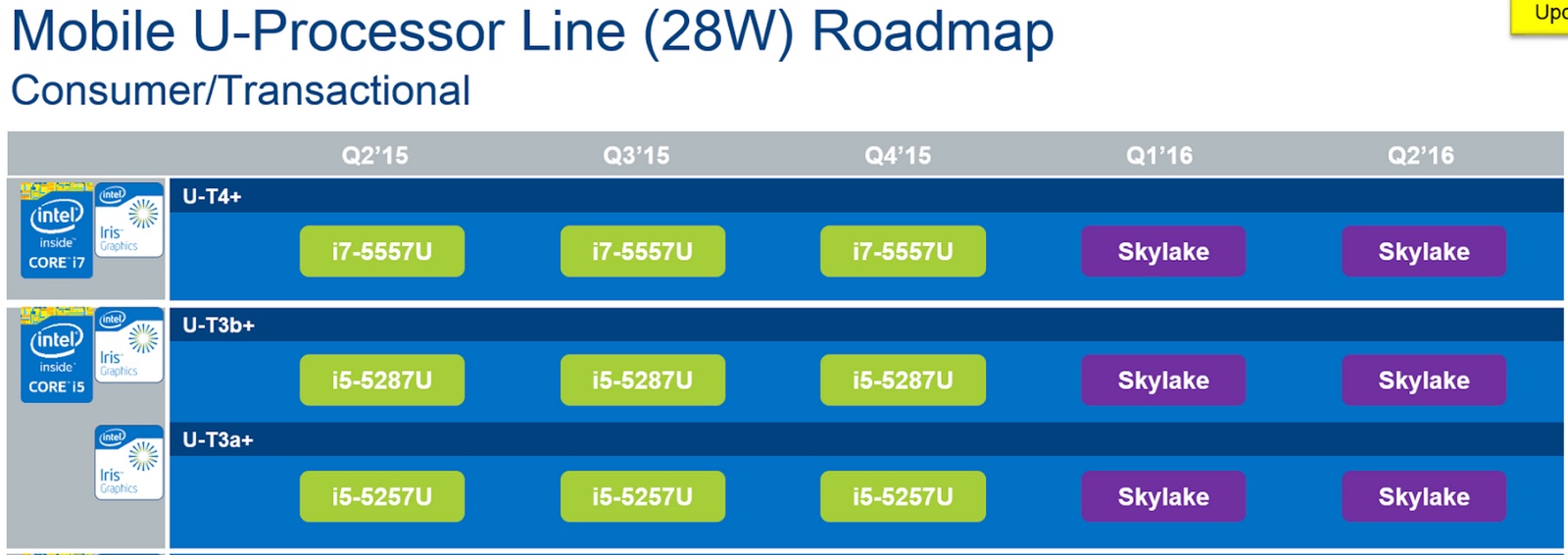
According to the information available, 28-watt chips appropriate for the 13-inch Retina MacBook Pro will not be launching until 2016. Launch dates are equally unclear for the rest of the Skylake lineup, as today's leak only covers chips that would be used in the MacBook Air.
Click to view larger version
Intel's Skylake processors are expected to offer a 10 to 20 percent boost in CPU performance over Broadwell, plus lower power consumption and improved Intel HD integrated graphics performance. Better energy efficiency will also lead to up to 30 percent longer battery life.
Saturday February 7, 2026 9:26 am PST by Joe Rossignol
Apple today shared an ad that shows how the upgraded Center Stage front camera on the latest iPhones improves the process of taking a group selfie.
"Watch how the new front facing camera on iPhone 17 Pro takes group selfies that automatically expand and rotate as more people come into frame," says Apple. While the ad is focused on the iPhone 17 Pro and iPhone 17 Pro Max, the regular iPhone...
Friday February 6, 2026 3:06 pm PST by Juli Clover
In the iOS 26.4 update that's coming this spring, Apple will introduce a new version of Siri that's going to overhaul how we interact with the personal assistant and what it's able to do.
The iOS 26.4 version of Siri won't work like ChatGPT or Claude, but it will rely on large language models (LLMs) and has been updated from the ground up.
Upgraded Architecture
The next-generation...
Thursday February 5, 2026 12:22 pm PST by Joe Rossignol
Apple plans to announce the iPhone 17e on Thursday, February 19, according to Macwelt, the German equivalent of Macworld.
The report, citing industry sources, is available in English on Macworld.
Apple announced the iPhone 16e on Wednesday, February 19 last year, so the iPhone 17e would be unveiled exactly one year later if this rumor is accurate. It is quite uncommon for Apple to unveil...
Monday February 9, 2026 6:24 am PST by Joe Rossignol
In select U.S. states, residents can add their driver's license or state ID to the Apple Wallet app on the iPhone and Apple Watch, and then use it to display proof of identity or age at select airports and businesses, and in select apps.
The feature is currently available in 13 U.S. states and Puerto Rico, and it is expected to launch in at least seven more in the future.
To set up the...
New MacBook Pro models with the M5 Pro and M5 Max chips could arrive as soon as Monday, March 2, according to Bloomberg's Mark Gurman.
In today's "Power On" newsletter, Gurman said that the release of new MacBook Pro models is tied to the release of macOS Tahoe 26.3. The launch is said to be slated for as early as the week of March 2. He added that the M4 Pro and M4 Max models on sale today...
It's not going to happen, but boy do I wish Intel would do something about their confusing naming schemes.
It was bad enough that we're now up to six generations of "Core i3/5/7" processors, the only way to differentiate between which is a somewhat random part number that means nothing unless you look it up in Intel's Ark, or an arbitrary code name that isn't printed anywhere on the box.
Now they've dropped a zero from the GPU model numbers they've been using for years, which adds additional confusion to anybody who doesn't actively follow these things. "No, no, that's a 520, which is newer and much faster than a 5200."
It's not that the information is impossible to come up with in most cases (apart from computers that come with a "Core i5" CPU without specifying in any way what generation or model it is), but it's needlessly confusing, particularly for the not-wildly technical. "Well, yes, they both say "Core i7" on them, and the GHz number is the same, but this one is way faster because it's actually three generations newer." or "Yes, they both say "i5", but this one has two cores and is a low-power mobile part, while this one has four cores and is a high-power desktop part. And also the generations are completely different."
Even Apple, masters of opaque product names, has a model year associated with each "iMac", has neatly sequentially numbered A-series processors, and their arbitrarily-named OSes have a simple version number to make it clear.