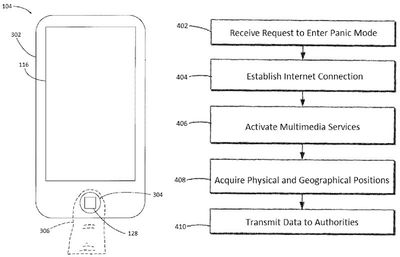
The United States Patent and Trademark Office today published a patent application initially filed by Apple in May of 2014, describing a method for users to designate a specific finger to unlock an iPhone with using Touch ID, which would then cause the iPhone to enter a "panic mode" (via Business Insider). The mode could then tell the iPhone to completely lock down, limiting access to personal data if a user is being forced to unlock their iPhone.

Currently, Apple allows users to enter up to five different fingerprints to unlock an iPhone, so users would just have to designate which is the "emergency" print in the Touch ID settings menu. Apple's patent describes a situation in which a thief attempts to rob someone's iPhone from them to gain access to their personal and private data stored within, and the user being robbed quickly placing the panic mode finger on Touch ID so the thief can't access any data.
panic mode patent iphone
The company is going one step further with the patent application, however, describing a way in which the activation of panic mode turns on the iPhone's camera and microphone to capture a robbery or crime as it happens and sending all the data to both a user's iCloud account and possibly even local police. Another section of the patent details a possible way for the device in panic mode to act as a beacon, alerting nearby devices (other iPhones, computers, etc) to a possible crime in their vicinity so they can alert the authorities and come to the panic mode activator's aid.

In some embodiments, the mobile device 104 may be activated into the panic mode in emergency situations to act as a beacon. If there is a nearby device, the nearby other device (e.g., a PDA carried by another person, a computer in an automobile, etc.) can be alerted with an alarm so that the user of the other device might come to the aid of the user initiating the panic mode.

For example, triggering the panic mode can send out a signal on multiple frequencies, channels, links, etc., to provide location information relative to other devices so that users of the other devices can provide assistance. Furthermore, as discussed in more detail below, the panic mode may include a locator function that uses, for example, global positioning systems (GPS) and/or cellular location systems to provide the location of the mobile device 104 to emergency response providers.

The new patent -- inventor credit going to Karthik Sudhir -- also describes more basic functions of the feature, including a straight-forward klaxon that blares until a user confirms that they're safe and even a way for Touch ID users to set up specific apps to open immediately when they unlock the iPhone with specific fingers. As with all other patents, "panic mode" is far from confirmed and may never even make it into a future version of the iPhone, but it remains an interesting glimpse into the internal discussions at Apple regarding the company's possible future products.
Tags: Patent, USPTO
Related Forum: iPhone

Top Rated Comments

antiprotest Avatar
134 months ago
You'll really feel the panic when you try to use 'panic mode' when your iPhone's battery dies.
Some people react in the strangest way.

I remember when I was a kid I told my mother about my bike's u-lock and she said, "What if someone just breaks the lock?" I was talking to another person about locking a car and he said, "What if someone smashes the window?" Later, when I was talking to someone about having a password on the computer, he said, "What if someone just guesses the password?"

Well, the same thing that happens when the earth explodes and destroys everything -- the feature would not work.

But what if someone doesn't break the lock? What if someone doesn't smash the window? What if someone doesn't guess the password?

What if the person faints before he could activate this feature? What if the other guy grabs the phone before you can activate this feature?

But what if Apple doesn't put in this feature at all? What if you don't use a bike lock? What if you don't lock your car? What if you don't set a password?

What if the battery doesn't die?
Score: 23 Votes (Like | Disagree)
tobefirst ⚽️ Avatar
134 months ago
From what I have heard, fingerprints aren't handled the same way a password is under the law. A law enforcement officer cannot force you to give up your password, but he/she can require you to give up your finger. In this specific instance, a fingerprint is not as secure as a password. Apple's solution here may be a way around that, allowing a citizen to quickly put their phone in a mode that isn't unlock able by a normal fingerprint and thus needs to be unlocked using a separate password, which can't be required by LEO. This would fit in nicely with Apple's stance that they cannot (and will not) give up information that is stored on someone's phone.
Score: 7 Votes (Like | Disagree)
antiprotest Avatar
134 months ago
If we never created new things or features just because someone may circumvent them, we'd never make any progress.

I'll take anything I can get.
But what if a bunch of fire ants suddenly rush up your body and bite that special finger you use to activate the feature?

What if a meteor falls to the ground just as you need to activate it, and a shred of space rock flies by and cuts the tip of that particular finger you need?!
Score: 6 Votes (Like | Disagree)
keysofanxiety Avatar
134 months ago
If Apple advertises the feature wouldn't the criminal know about this and then do what they can to prevent you from using such a mode?
All criminals know that modern cars have central locking. Doesn't stop the fact that additional protection and security. If security measures like this help in just 1% of cases, that's 1% that wouldn't have been safe beforehand. Still a victory IMHO, you can never do enough to stop thieves.
Score: 4 Votes (Like | Disagree)
Allthings-I Avatar
134 months ago
Along with it, Apple should implement 2 more things when Panic mode is activated:

1) Disable the power switch so thief / would be thief cannot power off the device until battery dies.

2) lock SIM tray, so thief / would be thief cannot disconnect the device's communication to the cellular network, allowing greater possibility of recovery.
Score: 3 Votes (Like | Disagree)
wesk702 Avatar
134 months ago
From what I have heard, fingerprints aren't handled the same way a password is under the law. A law enforcement officer cannot force you to give up your password, but he/she can require you to give up your finger. In this specific instance, a fingerprint is not as secure as a password. Apple's solution here may be a way around that, allowing a citizen to quickly put their phone in a mode that isn't unlock able by a normal fingerprint and thus needs to be unlocked using a separate password, which can't be required by LEO. This would fit in nicely with Apple's stance that they cannot (and will not) give up information that is stored on someone's phone.
This is what I believe is the exact reason they did this. This is what happens when the government tries to outsmart the tech industry.
It's pretty much giving the law "the finger."
Score: 3 Votes (Like | Disagree)

Popular Stories

Apple Logo Zoomed

Tim Cook Teases Plans for Apple's Upcoming 50th Anniversary

Thursday February 5, 2026 12:54 pm PST by
Apple turns 50 this year, and its CEO Tim Cook has promised to celebrate the milestone. The big day falls on April 1, 2026. "I've been unusually reflective lately about Apple because we have been working on what do we do to mark this moment," Cook told employees today, according to Bloomberg's Mark Gurman. "When you really stop and pause and think about the last 50 years, it makes your heart ...
wwdc sans text feature

Apple Rumored to Announce New Product on February 19

Thursday February 5, 2026 12:22 pm PST by
Apple plans to announce the iPhone 17e on Thursday, February 19, according to Macwelt, the German equivalent of Macworld. The report, citing industry sources, is available in English on Macworld. Apple announced the iPhone 16e on Wednesday, February 19 last year, so the iPhone 17e would be unveiled exactly one year later if this rumor is accurate. It is quite uncommon for Apple to unveil...
Finder Siri Feature

Why Apple's iOS 26.4 Siri Upgrade Will Be Bigger Than Originally Promised

Friday February 6, 2026 3:06 pm PST by
In the iOS 26.4 update that's coming this spring, Apple will introduce a new version of Siri that's going to overhaul how we interact with the personal assistant and what it's able to do. The iOS 26.4 version of Siri won't work like ChatGPT or Claude, but it will rely on large language models (LLMs) and has been updated from the ground up. Upgraded Architecture The next-generation...
iOS 26

iOS 26.3 and iOS 26.4 Will Add These New Features to Your iPhone

Tuesday February 3, 2026 7:47 am PST by
While the iOS 26.3 Release Candidate is now available ahead of a public release, the first iOS 26.4 beta is likely still at least a week away. Following beta testing, iOS 26.4 will likely be released to the general public in March or April. Below, we have recapped known or rumored iOS 26.3 and iOS 26.4 features so far. iOS 26.3 iPhone to Android Transfer Tool iOS 26.3 makes it easier...
iphone 17 pro dark blue 1

iPhone 18 Pro Max Rumored to Deliver Next-Level Battery Life

Friday February 6, 2026 5:14 am PST by
The iPhone 18 Pro Max will feature a bigger battery for continued best-in-class battery life, according to a known Weibo leaker. Citing supply chain information, the Weibo user known as "Digital Chat Station" said that the iPhone 18 Pro Max will have a battery capacity of 5,100 to 5,200 mAh. Combined with the efficiency improvements of the A20 Pro chip, made with TSMC's 2nm process, the...