

Apple has begun inviting its retail store employees to try pre-release versions of macOS Sierra, the latest version of its Mac software platform and renamed successor to OS X El Capitan.
Staff who sign up to the voluntary AppleSeed program are set to receive pre-release versions of macOS Sierra to install on their personal computers for use on their own time.
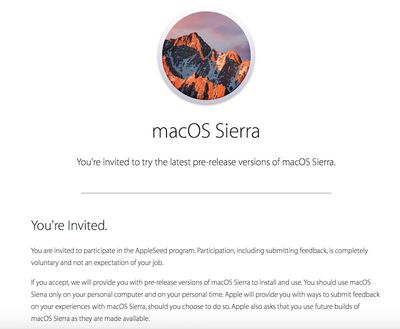
Apple is hoping that staff who get involved will help the company assess how the OS stands up in typical everyday usage scenarios, as outlined in its AppleSeed participation guidelines:
We ask that you use seeded software in your day-to-day activities, which is an environment that cannot be replicated at Apple. We will provide you with a variety of tools that will allow you to give us detailed information about your experience, should you decide to provide feedback to us.
As usual, the AppleSeed program is subject to a strict confidentiality agreement that prevents employees from publicly discussing their involvement in testing the seed.
Apple has invited retail employees to try pre-release software for the past few years, such as the company's Photos app, which replaced iPhoto and was released last year for OS X.
macOS Sierra was announced on Monday at WWDC 2016, and became available to developers for testing immediately after the company's keynote. Apple says a public beta will be launched in July, while the final public release is coming in the fall.
macOS Sierra includes a number of new capabilities, including Siri desktop integration, an automatic unlocking feature, universal Clipboard support, new iCloud integration, Apple Pay for the web, and more. The new Mac OS also features an entirely new file system, dedicated RAID Support, and an intelligent Optimized Storage function.
The macOS name, which does away with Apple's long-standing OS X naming scheme, also brings the name of the Mac operating system in line with iOS, watchOS, and tvOS.


















Top Rated Comments
Side note last I checked unless you're an actual person working for Apple on the software/hardware R & D itself most people ARE NOT Paid to beta test. It may suck but it is what it is
[doublepost=1466157187][/doublepost]Wow does everyone here automatically assume every comment is 100% serious?
Do we need to insert </s> as if we were formatting or something?
I'll agree it does suck for the employees in those regards.
Some people might see it as lucky ONLY in the sense that they get a 1st look at a new product. Seriously tho hoping that anyone else thinking of quoting this and spazzing out can calm their titties :rolleyes:
[doublepost=1466107316][/doublepost]Should have quoted this one. Better whine factor.
AppleSeed ('https://appleseed.apple.com/') is not solely for employees of Apple. It is, or was, primarily for customers.
I don't see any hint that anyone is "expected" to test at all. Consistent with the labor laws of many states and countries, as soon as an hourly-wage employee is expected to do something, they have to be paid. Any hint of coercion to work for free, such as "Do this and it'll look good when salary review comes around" is enough to trigger a lawsuit.
What they are doing is inviting a group of people who are known to be at least marginally interested in Apple products, who have a modicum of knowledge about those products and generally have decent technical and diagnostic skills, to join a voluntary software testing program, a few weeks before the rest of the public can start testing. Like anyone else given the opportunity to beta test, they'll either think it's cool and want to do it for free, or they'll ignore the invitation. Perhaps they'll be glad the company thought enough of them to issue the invitation. Since this is isn't the first time Apple has done this, one has to assume the company has had a good experience with this in the past - positive impact on product quality, neutral-to-positive impact on morale.
I started participating in public beta tests back in the mid-1990s. I'm not one of those pound-on-every-key-until-it-breaks guys... I just use the stuff as I normally would. If I encounter a bug, I report it. If not, the only effort involved is downloading and running an occasional installer. In all those years, I can recall only a couple of major problems. Let's face it, you don't learn how to solve problems unless you encounter problems.