New U.S. Guidelines Could Halt Use of SMS for Two-Factor Authentication
The US National Institute for Standards and Technology has released a new draft of its Digital Authentication Guideline, which sets the rules that all authentication software eventually follows. In the document, NIST deprecates the implementation of SMS as a method with which users validate a second level of security on various accounts, "no longer" allowing its use in future guidelines as it is considered not secure enough (via TechCrunch).
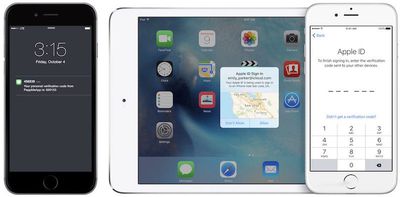
Two-factor authentication via SMS (left) and an alternative trusted iOS device (right)
Setting up two-factor authentication through text messages is one of the most popular ways users add another layer of security onto an account, on top of a basic password, including those for Apple's own software, like Apple ID and iCloud. Other than SMS, Apple allows users to implement two-factor authentication through a simple push notification sent to another "
trusted device," or a phone call.
If the out of band verification is to be made using a SMS message on a public mobile telephone network, the verifier SHALL verify that the pre-registered telephone number being used is actually associated with a mobile network and not with a VoIP (or other software-based) service. It then sends the SMS message to the pre-registered telephone number. Changing the pre-registered telephone number SHALL NOT be possible without two-factor authentication at the time of the change. OOB using SMS is deprecated, and will no longer be allowed in future releases of this guidance.
The new guidelines also make a point for companies to ensure that two-factor authentication notifications aren't going through a VoIP service, which could be easily compromised. NIST also includes "limited use" of biometrics as a way for users to gain access to their second layer of authentication, meaning Apple could pivot to Touch ID as an alternative if SMS support for the security feature officially comes to an end.
Popular Stories
Apple turns 50 this year, and its CEO Tim Cook has promised to celebrate the milestone. The big day falls on April 1, 2026.
"I've been unusually reflective lately about Apple because we have been working on what do we do to mark this moment," Cook told employees today, according to Bloomberg's Mark Gurman. "When you really stop and pause and think about the last 50 years, it makes your heart ...
Apple plans to announce the iPhone 17e on Thursday, February 19, according to Macwelt, the German equivalent of Macworld.
The report, citing industry sources, is available in English on Macworld.
Apple announced the iPhone 16e on Wednesday, February 19 last year, so the iPhone 17e would be unveiled exactly one year later if this rumor is accurate. It is quite uncommon for Apple to unveil...
In the iOS 26.4 update that's coming this spring, Apple will introduce a new version of Siri that's going to overhaul how we interact with the personal assistant and what it's able to do.
The iOS 26.4 version of Siri won't work like ChatGPT or Claude, but it will rely on large language models (LLMs) and has been updated from the ground up.
Upgraded Architecture
The next-generation...
While the iOS 26.3 Release Candidate is now available ahead of a public release, the first iOS 26.4 beta is likely still at least a week away. Following beta testing, iOS 26.4 will likely be released to the general public in March or April.
Below, we have recapped known or rumored iOS 26.3 and iOS 26.4 features so far.
iOS 26.3
iPhone to Android Transfer Tool
iOS 26.3 makes it easier...
The iPhone 18 Pro Max will feature a bigger battery for continued best-in-class battery life, according to a known Weibo leaker.
Citing supply chain information, the Weibo user known as "Digital Chat Station" said that the iPhone 18 Pro Max will have a battery capacity of 5,100 to 5,200 mAh. Combined with the efficiency improvements of the A20 Pro chip, made with TSMC's 2nm process, the...