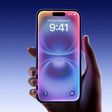
The United States Patent and Trademark Office today granted Apple another patent that could help the company create a bezel-free, edge-to-edge display for future generation iPhones. The new patent describes "electronic devices with display-integrated light sensors" and specifically refers to methods by which the company could stack the iPhone's ambient light sensor underneath the display, instead of next to it on the iPhone's bezel (via AppleInsider).

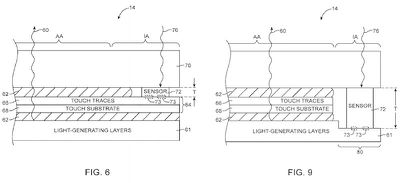
In the patent, there are a few configurations through which Apple could execute the technology. One showcases the light sensors -- which help the iPhone detect the ambient light in a room or outside -- integrated directly above the touch-sensitive layer of the display (figure 6), while another has the sensor placed next to the touch-sensitive layer without intersecting it (figure 9). The patent notes that the methods of executing this technology aren't limited to just light sensors, but could be used for "a proximity sensor, or any other sensor."
apple-patent-sensors-1

In a typical device, a light sensor is laterally displaced from an active display region of the display along a front face of the device. Additional space is therefore provided in common devices at the top, bottom, or side of the active display area to accommodate the light sensor.

This can result in an undesirable increase in the size and weight of the device, if care is not taken, displays may be bulky or may be surrounded by overly large borders. It would therefore be desirable to be able to provide improved electronic devices with light sensors and displays.

In the above images, there are two sections of the device's display that Apple notes in the patent as "AA" and "IA." AA is considered the display area that functionally gives information to the user and which responds to touch-based input, while IA -- covering the proposed screen-integrated sensor technology -- is referred to as an "inactive border region."

The patent describes the inactive region of IA as covered with an "opaque masking material such as a layer of black ink (e.g., a polymer filled with carbon black) or a layer of opaque metal," and surrounding the active region of AA. The ultimate goal of IA is apparently to hide components in the interior of a device from user view by camouflaging the region to look similarly like the active display it borders.

In effect, this could mean a future iPhone would successfully lose the bezels of the current generations and gain an edge-to-edge display, but not all portions of that display would be interactive.

Last week, Apple was granted another patent hinting at future iPhone technology that could integrate a fingerprint sensor directly into the display of a device, instead of requiring a separate component and taking up space below the screen of iPhones and iPads. With these two patents, Apple is slowly discover ways to remove the bezel from the bottom of an iPhone (Home Button/Touch ID) and the top (light sensor), although it remains to be seen how the company would handle the front-facing FaceTime camera and speaker in this scenario.
Tag: Patent
Related Forum: iPhone

Top Rated Comments

keysofanxiety Avatar
122 months ago
Or they just might not want anyone beating them to it since they are getting slow at innovation.
Why the heck does everybody keep saying this? What do you class as innovation in a phone?

In-house designed CPU. Double per-core performance of the closest competitor. Doesn't even explode. Yet throw a few bezels in and people are screaming that the end is nigh.
Score: 11 Votes (Like | Disagree)
AngerDanger Avatar
122 months ago
Potential usability issues aside, the prospect of having an iOS device that is all screen is incredibly exciting.

Apple's ethos of devices deferring to content would be perfected.


It occurred to me, while making this quick-and-dirty edit, that it would look a lot like an Watch… and it's not so bad. The corners of the screen might be an issue, though.


Attachment Image

Attachment Image

Attachment Image
Score: 4 Votes (Like | Disagree)
skwood Avatar
122 months ago
iPhone 8...


Attachment Image
Score: 3 Votes (Like | Disagree)
rjohnstone Avatar
122 months ago
Curious to see how they deal with light bleed from the display itself.
In an LCD stack, this will be tough to filter out.
Score: 3 Votes (Like | Disagree)
lincolntran Avatar
122 months ago
Why the heck does everybody keep saying this? What do you class as innovation in a phone?

In-house designed CPU. Double per-core performance of the closest competitor. Doesn't even explode. Yet throw a few bezels in and people are screaming that the end is nigh.
For the majority of MacRumors readers, innovation means "i wanted it to look different ". In some other cases, "I want it to work like I want it and nobody else", and that's all to it.
[doublepost=1476205260][/doublepost]
Wasn't there a patent filing from several years ago about how they could build a camera into a display? I also thought there was a patent about using the surface glass of the device itself to project sound waves. The downside to that is you end up with vibrations like—and probably even worse than—the iPad Air 2 speakers.

This is how I ultimately see the iPhone design going in the future:

* Hardly any side bezels
* Top and bottom bezels are much thinner. Too thin for a home button, but thick enough for an earpiece top and bottom with a small margin around them

* The top and bottom earpiece act as front facing stereo speakers
* This could possibly help with a water ejection system like the Apple Watch
* This makes the iPhone so you can pick it up and use it in either orientation
* This removes the speakers from the bottom
* The camera is next to one of these speakers. Although I do have this idea in which there are two FaceTime cameras top and bottom, and while using it, it creates a depth map like the 7 Plus camera that can blur out the background. That could be useful during video chat (more privacy for those in the background—I can think of several times my wife has nearly walked fully nude through the background of a video chat over the years), but I think it's unlikely.

* I'm unsure where to put the bottom mic

* TouchID built into the display. Problems I see with that:

* You need a better taptic engine, multiple taptic engines on either end of the device, or perhaps a stronger one in the center of the device. Having it under the home button currently provides a better sensation. What if you can unlock your devices with a press of the finger anywhere on the display?
* If the whole thing is a home button, how do you invoke that—a really deep press?
* Will there only be a certain area of the display, highlighted by a circle, that you must press? Does this circle always stay illuminated, perhaps using OLED or mLED technology to preserve power and only illuminate those pixels making up the circle?

* Wireless charging

* This kills the lightning port
* This adds a smart connector on the back, which is a backup charging method that easiliy attaches with a flat magnetic latch.
* This allows the iPhone to become even thinner over time as the lightning port takes up space in depth and height.
* This will be a pain at first as users have to install wireless chargers around their home and office.
* There will have to be decent software to preserve battery lifespan if there are always chargers sending signals. How do you balance keeping an iPhone always charged while hurting battery lifespan with wanting to charge fully if you're going to be out for the day? Is there a Control Center toggle to switch between maintain charge and completely charge? Sounds like a burden on the user.

* Remove the mute switch like on the iPad and allow control in Control Center and by holding down the volume down button for a couple seconds
* Remove the sim card slot and have everything be a programmable Apple Sim which is easy to transfer by signing in to your wireless provider
* 4", 5", 6" sizes.

* The reduced bezels makes the 5" and 6" sizes about the same width of the 7 and 7 Plus but makes the height smaller.
* The 4" iPhone overall becomes a lot smaller at some point later with an update

* Thinner.

* This is possible due to a shrink in CPU process, as well as new battery technology forecast to come onto the market in the next year which roughly doubles battery life of lithium batteries without significant changes needing to be made to existing factory lines.
* Chip size is not only physically smaller, but more efficient. More room inside means less depth, and not only that, but I think they could even get away with doing this and increasing battery life if those new batteries pan out.

* New materials

* Possibly ceramic, perhaps only for higher end models or a Pro model. Maybe they could work with Corning on this. Glass that is shatterproof from all normal drop heights and yet has a sapphire-like coating to prevent scratches.
* They could always do something with Liquidmetal, which has been rumored on and off for years

* mLED display @3X resolution on both device sizes (including true, non-scaled @3X on the Plus)

* This allows a larger-sized 6" iPhone to stay above 400PPI (422)
* Issue #1: this pushes a 5" iPhone to 459PPI, which would be better than the Plus, but will anybody even care at that resolution?
* Issue #2: Would Apple scale up the UI on a larger display @3X, or give us more display space?
* mLED saves battery life and gives much better contrast

* Electrostatic tactile display

* Enables virtual ridges for things like keyboards to make virtual interfaces more tactile
* Allows simulations of various textures and friction on what is otherwise a smooth glass surface


What I want to know is this: What happens to the exterior design after the big redesign, especially if they reduce the design to the point where it's so simple? What can you do with the design, beyond coming out with different materials, colors, upgraded displays, and perhaps changes to the cameras which would alter the design. Otherwise it's just a slab with a couple buttons and a display. Eventually they might get rid of the volume buttons. I'm not sure how you would get rid of the power button, and you'd need some kind of hardware switch to do a device reset if something freezes up. I think eventually the iPhone inside will be 90% battery, with a little tiny board running across the top 10% of the frame, hooked up to the cameras and display. Personally? I'd like either an iPhone that can go on my wrist like a slap bracelet, or an iPhone that unfolds into an iPad Mini.
I'm looking forward to the day where the phone (and every other electronic devices) will be just a slap and buttons (or other ways of interactions) will appear or become active based on the needs at that time. Button is an indication of old technology where hard knobs are needed. Of course there should always be a hard reset, but that's all that should be there. E.g. I'm looking forward to the day when flying an airplane with a joy stick instead of 5000 buttons and switches.
Score: 2 Votes (Like | Disagree)
Recognition Avatar
122 months ago
Why the heck does everybody keep saying this? What do you class as innovation in a phone?

In-house designed CPU. Double per-core performance of the closest competitor. Doesn't even explode. Yet throw a few bezels in and people are screaming that the end is nigh.
I think some people don't know the difference between innovation and invention.
Score: 1 Votes (Like | Disagree)

Popular Stories

Apple Logo Zoomed

Tim Cook Teases Plans for Apple's Upcoming 50th Anniversary

Thursday February 5, 2026 12:54 pm PST by
Apple turns 50 this year, and its CEO Tim Cook has promised to celebrate the milestone. The big day falls on April 1, 2026. "I've been unusually reflective lately about Apple because we have been working on what do we do to mark this moment," Cook told employees today, according to Bloomberg's Mark Gurman. "When you really stop and pause and think about the last 50 years, it makes your heart ...
wwdc sans text feature

Apple Rumored to Announce New Product on February 19

Thursday February 5, 2026 12:22 pm PST by
Apple plans to announce the iPhone 17e on Thursday, February 19, according to Macwelt, the German equivalent of Macworld. The report, citing industry sources, is available in English on Macworld. Apple announced the iPhone 16e on Wednesday, February 19 last year, so the iPhone 17e would be unveiled exactly one year later if this rumor is accurate. It is quite uncommon for Apple to unveil...
Finder Siri Feature

Why Apple's iOS 26.4 Siri Upgrade Will Be Bigger Than Originally Promised

Friday February 6, 2026 3:06 pm PST by
In the iOS 26.4 update that's coming this spring, Apple will introduce a new version of Siri that's going to overhaul how we interact with the personal assistant and what it's able to do. The iOS 26.4 version of Siri won't work like ChatGPT or Claude, but it will rely on large language models (LLMs) and has been updated from the ground up. Upgraded Architecture The next-generation...
iOS 26

iOS 26.3 and iOS 26.4 Will Add These New Features to Your iPhone

Tuesday February 3, 2026 7:47 am PST by
While the iOS 26.3 Release Candidate is now available ahead of a public release, the first iOS 26.4 beta is likely still at least a week away. Following beta testing, iOS 26.4 will likely be released to the general public in March or April. Below, we have recapped known or rumored iOS 26.3 and iOS 26.4 features so far. iOS 26.3 iPhone to Android Transfer Tool iOS 26.3 makes it easier...
iphone 17 pro dark blue 1

iPhone 18 Pro Max Rumored to Deliver Next-Level Battery Life

Friday February 6, 2026 5:14 am PST by
The iPhone 18 Pro Max will feature a bigger battery for continued best-in-class battery life, according to a known Weibo leaker. Citing supply chain information, the Weibo user known as "Digital Chat Station" said that the iPhone 18 Pro Max will have a battery capacity of 5,100 to 5,200 mAh. Combined with the efficiency improvements of the A20 Pro chip, made with TSMC's 2nm process, the...