

Code42, the company behind the popular cloud backup solution CrashPlan, today announced that it is sunsetting its CrashPlan for Home subscription options in the near future. Starting today, Code42 will no longer offer or renew CrashPlan for Home subscriptions.
In a video message, Code42 CEO Joe Payne said the company is ending its personal subscription options to focus solely on the business and organization market.
For existing Home customers, Code42 suggests they purchase a CrashPlan for Small Business plan or switch over to Carbonite, another backup service.
Customers who choose to use CrashPlan for Small Business can transfer their data within minutes. A Small Business plan is priced at $10 per month per device for unlimited upload space, but current CrashPlan for Home subscribers can get a 75 percent discount for the next 12 months. Code42 is allowing users to migrate cloud backups that are 5TB or smaller.
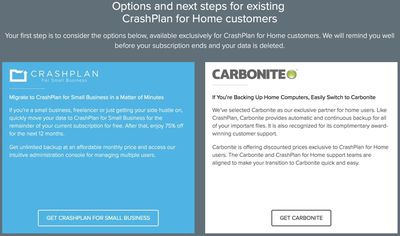
Customers who choose Carbonite can get 50 percent off of select Carbonite plans. Carbonite pricing starts at $60 per year for unlimited storage on a single device.
Current CrashPlan for Home subscribers can continue using CrashPlan until their subscriptions expire, but once that happens, they will need to choose a new backup solution. CrashPlan subscriptions are non-refundable, so customers will want to wait for their subscriptions to end before transferring to a new plan or service.
Code42 is earmarking October 22, 2018 as the end-of-support date for CrashPlan Home, with the company planning to honor all subscriptions until that date. Subscribers who have subscriptions that extend beyond October 22, 2018 will see their accounts upgraded to a CrashPlan for Small Business account with Code42 promising to send along additional information on the upgrade process before the service is discontinued.


















Top Rated Comments
I have to think this spells the death knell for CrashPlan, though. They say they're doing it to focus on enterprise customers, but what enterprise would trust CrashPlan after they exit the consumer market in such an inglorious fashion.
They could have doubled the pricing or achieved the same thing through tiered pricing, and I would have stayed put out of inertia (and the knowledge that I'm backing up a ton of data). But they chose to quit. Once a quitter, always a quitter.
Not ideal but if the above works it still saves 5TB worth of uploads and likely a lot of time.
Anyway I'm disapointed with the news but I'll switch to Pro and take the 75% off. I have four devices currently so the $10 a month is roughly equivalent to my family plan anyway. I didn't use local backups.
Prior to the 18 month mark I'll reconsider the options on the market and weigh up the costs of something self managed or see what Backblaze etc are doing. Right now the family plan and discounted rates still makes Crashplan the best option for me based on the volume of data I have and I feel no urgency to jump given pricing and offerings elsewhere will change with time.
Good
1. Later in 2018 annual payments will be possible
2. They claim migration is simple and takes less than 5 min
3. The same general principles of unlimited retention remains. Adding external drives does not add to your machine total.
5. Mobile devices do not count to the total amount of machines
6.
Bad
1. The migration can only do 5TB.Unclear if you have more what your options are.
2. We still have the weak M-F type hours and support (ie no weekend or after hours)
3. When you must start paying the monthly seems to depend on your subscription
4. Client may still be the lousy java based one.
Bottom line-
I suggest every customer do a web chat with them on their site and see what your exact situation is.
Just some thoughts based on my web chat with them
The big win for Arq (aside from it being time-tested) is that it's a backend-agnostic backup tool (that encrypts with your chosen key before it leaves your machine). The developer is motivated to make a great backup tool, period; he's not selling anyone's backup service, so he isn't imposing limits (e.g. "no backups of external drives", rate limiting, etc.) that are in the favor of someone selling a "complete solution" rather than in the customer's favor (in the "complete solution" scenario, the CEO is balancing desirability of the product against how much storage/bandwidth each customer uses and how much money they get from each customer - this can lead to decisions that are better for the company's bottom line at the expense of the user).