Apple Working With Stanford to Determine If Apple Watch Can Detect Abnormal Heart Rhythms - MacRumors
Skip to Content

Apple Working With Stanford to Determine If Apple Watch Can Detect Abnormal Heart Rhythms

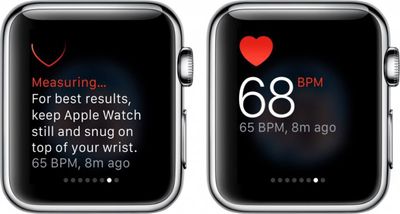
Apple is planning to work with Stanford and telemedicine vendor American Well to determine whether the heart rate sensor in the Apple Watch can be used to detect abnormal heart rhythms and common heart conditions, reports CNBC.

An Apple Watch, if able to accurately detect arrhythmias, or abnormal heart patterns, could identify patients that are at a high risk of atrial fibrillation or similar conditions. Heart arrhythmias aren't always symptoms of a serious disease, but Apple Watch owners could find out about a problem from the Apple Watch and then get it checked out at a doctor if the device is determined to accurately predict heart problems.
Apple Watch Heart Rate Monitor 1

"Atrial fibrillation is a common rhythm disorder and knowing someone has it is medically useful because those people might need specific treatments," said Bob Wachter, chair of the Department of Medicine at the University of California San Francisco.

A study conducted by the University of California, San Francisco and the team behind the Cardiogram app previously determined that the Apple Watch was able to detect abnormal heart rhythms with 97 percent accuracy. Apple could get even better results as it has access to raw data.

Just today, Apple CEO Tim Cook talked about Apple's health interests in an interview with Fortune. He said Apple is "extremely interested" in health, and that it represents a major business opportunity.

If you look at it, medical health activity is the largest or second-largest component of the economy, depending on which country in the world you're dealing with. And it hasn't been constructed in a way where the focus at the device level is making great products from a pure point of view. The focus has been on making products that can get reimbursed through the insurance companies, through Medicare, or through Medicaid. And so in some ways we bring a totally fresh view into this and say, 'Forget all of that. What will help people?'

Cook also said that Apple has been surprised to learn how the heart rate monitoring in the Apple Watch has already been helping people. Many people collect data with the Apple Watch, notice something amiss, and then go to the doctor to get it checked out. "A not-insignificant number have found out if they hadn't come into the doctor they would have died," said Cook.

Apple's study in partnership with American Well and Stanford is set to begin later this year, according to CNBC's sources.
Popular Stories

iOS 26

iOS 26.4 Adds Two New Features to CarPlay

Tuesday March 24, 2026 1:55 pm PDT by
iOS 26.4 was released today, and it includes a couple of new features for CarPlay: an Ambient Music widget and support for voice-based chatbot apps. To update your iPhone 11 or newer to iOS 26.4, open the Settings app and tap on General → Software Update. CarPlay will automatically offer the new features so long as the iPhone connected to your vehicle is running iOS 26.4 or later....
Apple Business hero

Apple Unveils 'Apple Business' All-in-One Platform

Tuesday March 24, 2026 8:53 am PDT by
Apple today announced Apple Business, a new all-in-one platform that unifies device management, productivity tools, and customer outreach features. The service is designed to be a consolidated replacement for several of Apple's existing business-focused offerings, including Apple Business Essentials, Apple Business Manager, and Apple Business Connect. It provides organizations with a single...
AirPods Pro Firmware Feature

Apple Releases New Firmware for AirPods Pro 3, AirPods Pro 2 and AirPods 4

Tuesday March 24, 2026 12:31 pm PDT by
Apple today released new firmware for the AirPods Pro 2, AirPods Pro 3, and the AirPods 4. The firmware has a version number of 8B39, up from 8B34 on the AirPods Pro 3, 8B28 on the AirPods Pro 2, and 8B21 on the AirPods 4. There is no word on what's included in the firmware, but Apple has a support document with limited notes. Most updates are limited to bug fixes and performance...

Top Rated Comments

111 months ago
Apple is planning to work with Stanford and telemedicine vendor American Well to determine whether the heart rate sensor in the Apple Watch can be used to detect abnormal heart rhythms and common heart conditions, reports CNBC ('https://www.cnbc.com/2017/09/11/apple-watch-caridac-arrhythmia-tests-stanford-american-well.html').

An Apple Watch, if able to accurately detect arrhythmias, or abnormal heart patterns, could identify patients that are at a high risk of atrial fibrillation or similar conditions. Heart arrhythmias aren't always symptoms of a serious disease, but Apple Watch owners could find out about a problem from the Apple Watch and then get it checked out at a doctor if the device is determined to accurately predict heart problems.


A study conducted by the University of California, San Francisco and the team behind the Cardiogram app previously determined ('https://www.geekwebguides.com/2017/05/11/apple-watch-abnormal-heart-rhythm-detection/') that the Apple Watch was able to detect abnormal heart rhythms with 97 percent accuracy. Apple could get even better results as it has access to raw data.

Just today, Apple CEO Tim Cook talked about Apple's health interests in an interview ('https://www.geekwebguides.com/2017/09/11/tim-cook-apple-changes-the-world-interview/') with Fortune. He said Apple is "extremely interested" in health, and that it represents a major business opportunity.Cook also said that Apple has been surprised to learn how the heart rate monitoring in the Apple Watch has already been helping people. Many people collect data with the Apple Watch, notice something amiss, and then go to the doctor to get it checked out. "A not-insignificant number have found out if they hadn't come into the doctor they would have died," said Cook.

Apple's study in partnership with American Well and Stanford is set to begin later this year, according to CNBC's sources.

Article Link: Apple Working With Stanford to Determine If Apple Watch Can Detect Abnormal Heart Rhythms ('https://www.geekwebguides.com/2017/09/11/apple-watch-stanford-abnormal-heart-rhythms/')
Now this is really cool...I'm excited where the apple watch can go.
Score: 9 Votes (Like | Disagree)
Rarecandie Avatar
111 months ago
Apple is planning to work with Stanford and telemedicine vendor American Well to determine whether the heart rate sensor in the Apple Watch can be used to detect abnormal heart rhythms and common heart conditions, reports CNBC ('https://www.cnbc.com/2017/09/11/apple-watch-caridac-arrhythmia-tests-stanford-american-well.html').

An Apple Watch, if able to accurately detect arrhythmias, or abnormal heart patterns, could identify patients that are at a high risk of atrial fibrillation or similar conditions. Heart arrhythmias aren't always symptoms of a serious disease, but Apple Watch owners could find out about a problem from the Apple Watch and then get it checked out at a doctor if the device is determined to accurately predict heart problems.


A study conducted by the University of California, San Francisco and the team behind the Cardiogram ('https://itunes.apple.com/us/app/cardiogram/id1000017994?ls=1&mt=8') app previously determined ('https://www.geekwebguides.com/2017/05/11/apple-watch-abnormal-heart-rhythm-detection/') that the Apple Watch was able to detect abnormal heart rhythms with 97 percent accuracy. Apple could get even better results as it has access to raw data.

Just today, Apple CEO Tim Cook talked about Apple's health interests in an interview ('https://www.geekwebguides.com/2017/09/11/tim-cook-apple-changes-the-world-interview/') with Fortune. He said Apple is "extremely interested" in health, and that it represents a major business opportunity.Cook also said that Apple has been surprised to learn how the heart rate monitoring in the Apple Watch has already been helping people. Many people collect data with the Apple Watch, notice something amiss, and then go to the doctor to get it checked out. "A not-insignificant number have found out if they hadn't come into the doctor they would have died," said Cook.

Apple's study in partnership with American Well and Stanford is set to begin later this year, according to CNBC's sources.

Article Link: Apple Working With Stanford to Determine If Apple Watch Can Detect Abnormal Heart Rhythms ('https://www.geekwebguides.com/2017/09/11/apple-watch-stanford-abnormal-heart-rhythms/')
[doublepost=1505197524][/doublepost]I can say my Apple Watch saved my life. I had very strange readings and went to my Doctor. He looked at them sent me off to a cardiologist who diagnosed me with ventricular tachycardia and implanted a defibrillator which saved my life August 24. I sent a thank you to Tim and everyone in Cupertino. I had no clue I had this issue before the watch.
Score: 8 Votes (Like | Disagree)
111 months ago
Few non-medical people understand the difference between heart rate (detected by the electrical activity of the heart - ECG/EKG) and the pulse rate, which is detected by pulse oximetry and the like (ie. the Apple Watch).

They are not the same and can differ markedly.

There is an awful lot you can't diagnose with the pulse rate alone and it would be dangerous to imply that you can, and make medical decisions with the data.

Leave the medical grade monitoring to medical grade equipment thanks....
Well even you don't understand the difference. Heart rate (number of contractions of the heart per minute) is not detected by electrocardiography (ECG) but rather by echocardiography (echo; ultrasound of the heart), or by auscultating the heart with a stethoscope. ECG only meassures the electrical activity, which not always translates into a heart beat and thus not always contributes to the heart rate.

Regardless, a pulse measurement may be able to indicate an arythmia. It would probably miss some of the arythmias, but it would rarely give false positive results as the difference from electrical activity to heart rate to pulse is usually a loss of frequency rather than addition. Thus a warning about an uneven or too fast pulse would rarely be false positive. This would possibly help find plenty of undiagnosed atrial fibrillations – especially if data is combined with other predisposing risk factors such as age – and save people from strokes, for example.
Score: 6 Votes (Like | Disagree)
111 months ago
Few non-medical people understand the difference between heart rate (detected by the electrical activity of the heart - ECG/EKG) and the pulse rate, which is detected by pulse oximetry and the like (ie. the Apple Watch).

They are not the same and can differ markedly.

There is an awful lot you can't diagnose with the pulse rate alone and it would be dangerous to imply that you can, and make medical decisions with the data.

Leave the medical grade monitoring to medical grade equipment thanks....
Score: 5 Votes (Like | Disagree)
Juan007 Avatar
111 months ago
Amazing! The watch can literally save your life.
Score: 4 Votes (Like | Disagree)
ghostwriter Avatar
111 months ago
Earlier this summer I had an unexplained loss of consciousness. Basically fainted while washing dishes. I woke up to my AW buzzing my wrist with an alert for a high heart rate. The ER doc had seen a similar incident before with a fellow physician and asked to see my iPhone. Sure enough, buried in the Health app is a selection "Show all data" for heart rate. The AW detected a very low heart rate just before I lost consciousness, followed by the high heart rate I woke up to. Enough to put me into a round of cardiac tests.

The end result: nothing unusual found in all the cardiac tests, but they're considering scheduling a procedure to implant a 3 yr heart monitor.

While none of my cardiac team are making any decisions based on data from the AW, they did say it's obvious the AW detected something that may point to a potential problem. In the case of the ER doc's friend, his tests uncovered AFIB. If not for the AW, it may not have been detected at all.

It's not medical grade data, yet, but it's certainly proven helpful to some of us.
Score: 1 Votes (Like | Disagree)