HomePod Now Supports French, German, and Canadian English, While Canadian French Coming Later This Year

Apple today announced that the HomePod will be available in Canada, France, and Germany beginning June 18, but ahead of then, the speaker has gained support for languages and dialects spoken in each country.
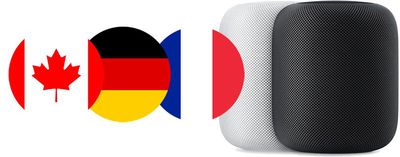
homepod canada france germany
Today's new 11.4 software update for HomePod enables Siri to speak in French, German, and Canadian English in any region, including the United States. Apple says Canadian French will be added in a subsequent software update coming later this year, but it has not provided a specific timeframe as of yet.

The new software update should be pushed to the HomePod automatically after updating to iOS 11.4 on a paired iPhone, iPad, or iPod touch, but it can also be installed manually through the speaker's settings in the Home app.

To change a HomePod's default language, open the Home app on a paired iPhone, iPad, or iPod touch running iOS 11.4, 3D Touch or long press on the HomePod's icon, tap on Details, and tap on Languages. There are now six languages, including the previous options of U.S. English, U.K. English, and Australian English.
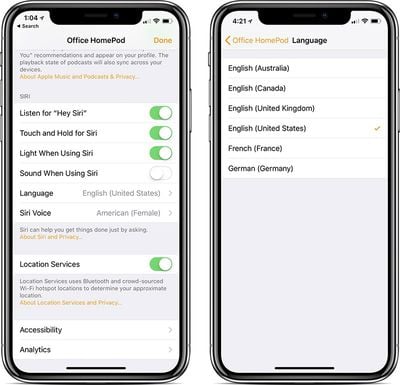
homepod settings languages
Canadian residents who purchased a HomePod in the United States, for example, can now switch from American English to Canadian English.

While the switch from American English to Canadian English doesn't yield any significant differences, it does allow the language of a paired iOS device to be set back to Canadian English as well, as in Canada, a HomePod and paired iOS device must be set to the same language for Siri to deliver Personal Requests.

Despite support for Canadian English, the HomePod still isn't completely localized for Canada, as Siri still doesn't work with music charts, for example, as demonstrated by MacRumors reader Pedro Marques in the video below.


Of course, the HomePod should gain support for additional languages as it launches in more countries in the future.
Related Roundup: HomePod
Buyer's Guide: HomePod (Neutral)

Popular Stories

maxresdefault

Apple Shows Off a Key Reason to Upgrade to the iPhone 17

Saturday February 7, 2026 9:26 am PST by
Apple today shared an ad that shows how the upgraded Center Stage front camera on the latest iPhones improves the process of taking a group selfie. "Watch how the new front facing camera on iPhone 17 Pro takes group selfies that automatically expand and rotate as more people come into frame," says Apple. While the ad is focused on the iPhone 17 Pro and iPhone 17 Pro Max, the regular iPhone...
Finder Siri Feature

Why Apple's iOS 26.4 Siri Upgrade Will Be Bigger Than Originally Promised

Friday February 6, 2026 3:06 pm PST by
In the iOS 26.4 update that's coming this spring, Apple will introduce a new version of Siri that's going to overhaul how we interact with the personal assistant and what it's able to do. The iOS 26.4 version of Siri won't work like ChatGPT or Claude, but it will rely on large language models (LLMs) and has been updated from the ground up. Upgraded Architecture The next-generation...
wwdc sans text feature

Apple Rumored to Announce New Product on February 19

Thursday February 5, 2026 12:22 pm PST by
Apple plans to announce the iPhone 17e on Thursday, February 19, according to Macwelt, the German equivalent of Macworld. The report, citing industry sources, is available in English on Macworld. Apple announced the iPhone 16e on Wednesday, February 19 last year, so the iPhone 17e would be unveiled exactly one year later if this rumor is accurate. It is quite uncommon for Apple to unveil...
apple wallet drivers license feature iPhone 15 pro

Apple Says These 7 U.S. States Plan to Offer iPhone Driver's Licenses

Monday February 9, 2026 6:24 am PST by
In select U.S. states, residents can add their driver's license or state ID to the Apple Wallet app on the iPhone and Apple Watch, and then use it to display proof of identity or age at select airports and businesses, and in select apps. The feature is currently available in 13 U.S. states and Puerto Rico, and it is expected to launch in at least seven more in the future. To set up the...
14 inch MacBook Pro Keyboard

New MacBook Pros Could Now Arrive in March

Sunday February 8, 2026 6:02 am PST by
New MacBook Pro models with the M5 Pro and M5 Max chips could arrive as soon as Monday, March 2, according to Bloomberg's Mark Gurman. In today's "Power On" newsletter, Gurman said that the release of new MacBook Pro models is tied to the release of macOS Tahoe 26.3. The launch is said to be slated for as early as the week of March 2. He added that the M4 Pro and M4 Max models on sale today...

Top Rated Comments

ThisIsNotMe Avatar
101 months ago
LOL. HomePod doesn't even understand English.
Score: 8 Votes (Like | Disagree)
sirozha Avatar
101 months ago
UK, Canadian and Australian English are the one and the same, it's only the U.S that don't get this and invent their own lazy version. When I read the English languages supported I had a laugh.
Australian is the same as Canadian? You must not be a native speaker if you think so. Australian is close to some British dialects but by no stretch of imagination is it close to Canadian.

Canadian English is very close to American English. Canadian English has it's own pronunciation patterns in different parts of Canada, though. I can recognize people from Ontario pretty easily by the way they pronounce "about" (like "a boat"). But, I've met Americans from the areas adjacent to Ontario whose pronunciation is exactly the same as residents of Ontario.

Canadians from the West Coast (in Vancouver and Victoria, BC) speak exactly like Americans who live on the West Coast (in Seattle, Portland, San Francisco, etc.). The only real difference between the Canadian and American English is the spelling, which in Canada mostly follows British standards.
[doublepost=1527637259][/doublepost]
Canadian English is nothing like Australian which is a lot closer to English. Canadian English is American with a few spelling deviations, which, considering English roots, make no sense.

American English spelling- at a minimum was standardised around real-world pronunciation for the American continent.
American spelling was intentionally changed by Noah Webster following the American Revolution. Canadians mostly follow British spelling rules, except for in some words American spelling is acceptable as well.
Score: 7 Votes (Like | Disagree)
gwaizai Avatar
101 months ago
Canadian English, eh?
It's a boat time.
Take off, hoser!
Score: 6 Votes (Like | Disagree)
Smoak5 Avatar
101 months ago
oh this is intere.... no never mind its not.
I think the home pod will look nice on my shelf next to my Apple newton.

Sorry Apple. You are too late to this party. Sonos all the way in my house and not making any changes since I am so vested in sonos.
Score: 2 Votes (Like | Disagree)
sirozha Avatar
101 months ago
I've always had more success when I use Siri in Australian, I'm British, but for some reason it seems to understand me more.

Note: I said more success, not complete success, Siri is still about as much use as a chocolate teapot.
There is very little difference. As you noted Canadians typically use British spelling as opposed to American spelling but the pronunciations of those words is usually identical to American.

I would imagine it just makes the HomePod more compatible with the slight pronunciation variations in words like "sorry" and "home" as well as variations in how Canadians say things like "grade 9" instead of "9th grade" etc.
Or maybe if Canadians say, "Hey Siri, set the second *storey* thermostat to X degrees" instead of *second floor*. Like you said, this may have more to do with word usage than pronunciation.

Also, a Canadian would certainly say something like, "Hey Siri, I locked my house, eh?" Siri would need to understand that this is actually a question.
Score: 1 Votes (Like | Disagree)
Keirasplace Avatar
101 months ago
I'm not an expert in French, but my son is in French immersion school and is fluent in French at the age of 8. He has had teachers from France, Belgium, and Quebec. I've read up on the differences between Metropolitan French and Quebec French, and it doesn't seem that there is that much of a difference. Some words are different, like the word for blueberry is different in France and in Quebec, and of course, the infamous ARRET in Quebec used differently from the way it's used in France. Also, I remember reading that the word for getting out of the car in Quebec is the same word as the word for getting off a ship, whereas in France it's the same word as for getting off a horse. But, French as spoken by educated French speakers in Quebec is completely standard and fully mutually comprehensible with Metropolitan French. Now, when you go to remote areas of Quebec, then all bets are off, but I'm sure it's the same thing in France. I believe that the differences between standard Quebec French (as it's spoken in Montreal and Quebec City) and standard Metropolitan French (e.g as it's spoken in Paris) are minimal. They are two standard dialects of the same language, with the differences between the two being similar to those between standard British English and standard American English.

I can see a reason fo adapting Siri to Quebec French; however, I see no point whatsoever in Siri making a distinction between Canadian and American English. They should name it North American English and call it a day.
Well, even if the words used are the same (they're not), the way they're pronounced is VERY DIFFERENT.

Paris French sounds very different than even how educated people around Quebec would speak (I'm an Engineer and got my degrees from Polytechnique, HEC and McGill). I'm french Canadian and I've lived in France for years (and in the US too) and even dated a french guy for 5 years so I think I'm well versed on the differences.

Of course, we can understand Paris French (cause it's the one mostly used in French movies), but that doesn't mean the different is not significant enough to make speech recognition difficult.

Anyone who thinks Canadian English sounds like US English has a very poor ear for dialects.

It doesn't sound the same as upstate NY, NYC, Connecticut, Massachusetts or Michigan or Illinois.
So, where on earth does it sound similar as?

Just listen to say, the CBC or CTV or GLOBAL national news and tell me it sounds the same as CNN, ABC, CBS news... Come on.
Score: 1 Votes (Like | Disagree)