Apple Heart Study Ends for Some Early Participants Ahead of January Completion Date - MacRumors
Skip to Content

Apple Heart Study Ends for Some Early Participants Ahead of January Completion Date

apple watch heart study completeOver the weekend, Apple informed some users who signed up to its Apple Watch Heart Study that their contributions were complete.

An app notification thanked them for their participation and asked them to complete an exit-survey about the study, which first launched in November 2017.

The study in collaboration with Stanford Medicine was offered to anyone in the United States who was 22 years older with an iPhone 5s or later and an Apple Watch Series 1 or later. Atrial fibrillation, a common form of heart arrhythmia that is covered in the study, can indicate serious medical conditions like heart failure and stroke.

Participants were instructed to download and install the Apple Heart Study app and wear their Apple Watch. When an irregular heart beat is detected, a consultation with a Study Telehealth provider from American Well is offered, with some people asked to wear an ePatch monitor for up to seven days for further investigation.

Apple closed the study to new participants at the beginning of last month. In a prior announcement, Apple said the study would not end until January 1, 2019, but it looks as though the participants who received the notifications over the weekend all enrolled early, suggesting that data collection is winding down over stages as the end date approaches.

Rumors have suggested that 2018 Apple Watch Series 4 models will include enhanced heart rate detection features that could improve the smartwatch's ability to detect diseases linked to higher heart rates and abnormal heart rhythms, but what form the enhanced heart rate features will take remains unclear.

Design wise, the Apple Watch Series 4 looks similar to the Series 3 models, but the display will be bigger, allowing more space for watch faces and complications, as confirmed last week in an image leaked by Apple.
Related Roundup: Apple Watch 11
Buyer's Guide: Apple Watch (Neutral)

Popular Stories

iOS 26

iOS 26.4 Adds Two New Features to CarPlay

Tuesday March 24, 2026 1:55 pm PDT by
iOS 26.4 was released today, and it includes a couple of new features for CarPlay: an Ambient Music widget and support for voice-based chatbot apps. To update your iPhone 11 or newer to iOS 26.4, open the Settings app and tap on General → Software Update. CarPlay will automatically offer the new features so long as the iPhone connected to your vehicle is running iOS 26.4 or later....
Apple Business hero

Apple Unveils 'Apple Business' All-in-One Platform

Tuesday March 24, 2026 8:53 am PDT by
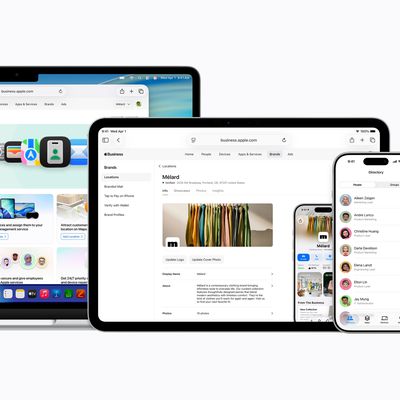
Apple today announced Apple Business, a new all-in-one platform that unifies device management, productivity tools, and customer outreach features. The service is designed to be a consolidated replacement for several of Apple's existing business-focused offerings, including Apple Business Essentials, Apple Business Manager, and Apple Business Connect. It provides organizations with a single...
AirPods Pro Firmware Feature

Apple Releases New Firmware for AirPods Pro 3, AirPods Pro 2 and AirPods 4

Tuesday March 24, 2026 12:31 pm PDT by
Apple today released new firmware for the AirPods Pro 2, AirPods Pro 3, and the AirPods 4. The firmware has a version number of 8B39, up from 8B34 on the AirPods Pro 3, 8B28 on the AirPods Pro 2, and 8B21 on the AirPods 4. There is no word on what's included in the firmware, but Apple has a support document with limited notes. Most updates are limited to bug fixes and performance...

Top Rated Comments

99 months ago
I am just saying that it sucks all smartwatches only show current heart rate and never analyze heart rhythm and I wish Apple finally added this so it becomes a standard.
The reason they don't is because they need data first. It's surprising, but the medical field really doesn't have a lot of data on "normal" because the data was really hard, if not impossible, to get. What are people's normal heart rate? What if you're really big? Really small? They have no idea, for the most part.

I'll bet it's unclear how accurate the sensors are, because to do that you have to compare your data against a known standard, and there isn't one. Do you really want to walk around with a nurse all day calibrating your sensor against a manually-measured value?

And even though the data from all these sensors is an amazing trove of data, but even you still need to correlate it.

The good thing is Apple and its partners are starting to do that.
Score: 7 Votes (Like | Disagree)
Scottsoapbox Avatar
99 months ago
Whew! I thought you meant it *ended* early for them.
Score: 6 Votes (Like | Disagree)
alphaod Avatar
99 months ago
Whew! I thought you meant it *ended* early for them.
Yeah I'm talking to you from down below.
Score: 2 Votes (Like | Disagree)
centauratlas Avatar
99 months ago
I enrolled the day it opened as did my cousin. We both got the "complete" message at the same time this weekend.
Score: 2 Votes (Like | Disagree)
Jax44 Avatar
99 months ago
Got the notification. 2175 contributions over 272 days.
Score: 1 Votes (Like | Disagree)
FloatingBones Avatar
99 months ago
Edison's early design ideas maybe. But DC scales better than AC today.

https://www.powermag.com/a-new-record-for-the-longest-transmission-link/

Um, no. That's talking about a high-voltage DC point-to-point connection. It's flipped to/from AC on both ends. Read the article you cited: "It consists of two 3,150-MW HVDC converter stations placed at either end of the line: at hydropower plants at Porto Velho in northwest Brazil and in the southeast near São Paulo (Figure 2). ABB also delivered an 800-MW HVDC 'back-to-back' station that transmits power to the alternating current (AC) network in the northwest of Brazil."

Nobody is using a network of DC lines for the power grid proper. No transformation from a DC high-voltage transmission lines to lower-voltage DC distribution lines. It doesn't work. West spells out why in Scale ('https://www.penguinrandomhouse.com/books/314049/scale-by-geoffrey-west/9780143110903/') -- it doesn't scale.

I despise AC. It's legacy we're stuck with now unfortunately probably forever. I dream of a DC only world.
As long as electricity is distributed through a grid, your dream is a nightmare. :( Power distribution from big generation facilities can only work in an AC world -- even in Brazil. Impedance matching is crucial.

Interestingly, our mammal circulatory network winds up being essentially DC at the capillaries -- the oscillations of our heartbeats winds up to zero at that tiny scale. That is also covered in West's book. If you wished to rectify your power from the electric company and be DC-only at your house, that would be fine. I think the engineering is fine; you may or may not run into some building code violations. Or just put a bunch of USB-capable outlets in your house -- run as much as possible off of USB.

Your "correction" ends up making my point: people have no intuitive sense whatsoever for electrical or mechanical systems that have stored energy -- and must be modeled with impedance. Understanding why the model is required and how it is applied has pretty well been beyond our comprehension. That's why I was so damn grateful that this book came out. Great thinking -- great concepts to learn.
Score: 1 Votes (Like | Disagree)