Apple Sued Over Not Letting Customers Disable Two-Factor Authentication After Two Weeks - MacRumors
Skip to Content

Apple Sued Over Not Letting Customers Disable Two-Factor Authentication After Two Weeks

New York resident Jay Brodsky has filed a frivolous class action lawsuit against Apple, alleging that the company's so-called "coercive" policy of not letting customers disable two-factor authentication beyond a two-week grace period is both inconvenient and violates a variety of California laws.
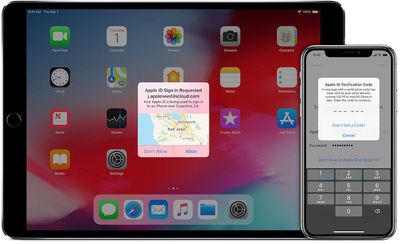
two factor apple
The complaint alleges that Brodsky "and millions of similarly situated consumers across the nation have been and continue to suffer harm" and "economic losses" as a result of Apple's "interference with the use of their personal devices and waste of their personal time in using additional time for simple logging in."

In a support document, Apple says it prevents customers from turning off two-factor authentication after two weeks because "certain features in the latest versions of iOS and macOS require this extra level of security":

If you already use two-factor authentication, you can no longer turn it off. Certain features in the latest versions of iOS and macOS require this extra level of security, which is designed to protect your information. If you recently updated your account, you can unenroll for two weeks. Just open your enrollment confirmation email and click the link to return to your previous security settings. Keep in mind, this makes your account less secure and means that you can't use features that require higher security.

The complaint is riddled with questionable allegations, however, including that Apple released a software update around September 2015 that enabled two-factor authentication on Brodsky's Apple ID without his knowledge or consent. Apple in fact offers two-factor authentication on an opt-in basis.

Brodsky also claims that two-factor authentication is required each time you turn on an Apple device, which is false, and claims the security layer adds an additional two to five minutes or longer to the login process when it in fact only takes seconds to enter a verification code from a trusted device.

The complaint goes on to allege that Apple's confirmation email for two-factor authentication enrollment containing a "single last line" alerting customers that they have a two-week period to disable the security layer is "insufficient."
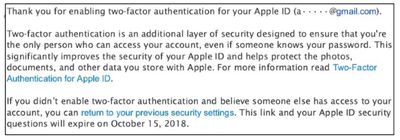
apple two factor email
Brodsky accuses Apple of violating the U.S. Computer Fraud and Abuse Act, California's Invasion of Privacy Act, and other laws. He, on behalf of others similarly situated, is seeking monetary damages as well as a ruling that prevents Apple from "not allowing a user to choose its own logging and security procedure." Read the full document.
Popular Stories

iOS 26

iOS 26.4 Adds Two New Features to CarPlay

Tuesday March 24, 2026 1:55 pm PDT by
iOS 26.4 was released today, and it includes a couple of new features for CarPlay: an Ambient Music widget and support for voice-based chatbot apps. To update your iPhone 11 or newer to iOS 26.4, open the Settings app and tap on General → Software Update. CarPlay will automatically offer the new features so long as the iPhone connected to your vehicle is running iOS 26.4 or later....
Apple Business hero

Apple Unveils 'Apple Business' All-in-One Platform

Tuesday March 24, 2026 8:53 am PDT by
Apple today announced Apple Business, a new all-in-one platform that unifies device management, productivity tools, and customer outreach features. The service is designed to be a consolidated replacement for several of Apple's existing business-focused offerings, including Apple Business Essentials, Apple Business Manager, and Apple Business Connect. It provides organizations with a single...
AirPods Pro Firmware Feature

Apple Releases New Firmware for AirPods Pro 3, AirPods Pro 2 and AirPods 4

Tuesday March 24, 2026 12:31 pm PDT by
Apple today released new firmware for the AirPods Pro 2, AirPods Pro 3, and the AirPods 4. The firmware has a version number of 8B39, up from 8B34 on the AirPods Pro 3, 8B28 on the AirPods Pro 2, and 8B21 on the AirPods 4. There is no word on what's included in the firmware, but Apple has a support document with limited notes. Most updates are limited to bug fixes and performance...

Top Rated Comments

mentaluproar Avatar
93 months ago
Yea, it's such a pain having to remember my PIN too. The ATM should just give me money.
Score: 87 Votes (Like | Disagree)
93 months ago
*rolls eyes*

So stupid lol.
Score: 50 Votes (Like | Disagree)
calzon65 Avatar
93 months ago
Seems if people want to disable this and stupidly reduce their personal security, it should be their right.
Score: 34 Votes (Like | Disagree)
aaronhead14 Avatar
93 months ago
I think this is great, actually.

To be clear, I do think two-factor authentication is much more secure (obviously). But I hate that Apple is so determined to force its users into using it. If someone doesn't want it then they have the right to disable it. Plain and simple. Our devices and accounts should be ours to control.
Score: 26 Votes (Like | Disagree)
93 months ago
While the plaintiff might have some stupid points, I do agree that enabling or disabling two-factor should be the user's choice.
Score: 26 Votes (Like | Disagree)
trusso Avatar
93 months ago

New York resident Jay Brodsky has filed a frivolous class action lawsuit against Apple, alleging that the company's so-called "coercive" policy of not letting customers disable two-factor authentication beyond a two-week grace period is both inconvenient and violates a variety of California laws.
Without commenting on the merits of this case, I'd prefer that the MacRumors team not editorialize like this. Leave that to the pundits. Share the facts and leave it at that.

We can come to our own conclusions, thankyouverymuch. o_O
Score: 25 Votes (Like | Disagree)