Stanford Medicine Publishes Results of Apple Heart Study

Stanford Medicine today published results from the Apple Heart Study that kicked off in 2017, marking the third time data from the study has been shared (via Reuters and CNBC).

The aim of the study, conducted by Stanford and Apple, was to determine whether the Apple Watch is able to detect atrial fibrillation, which can be an indicator of serious heart health problems. Researchers wanted to determine how well the Apple Watch worked and whether it was safe to use.
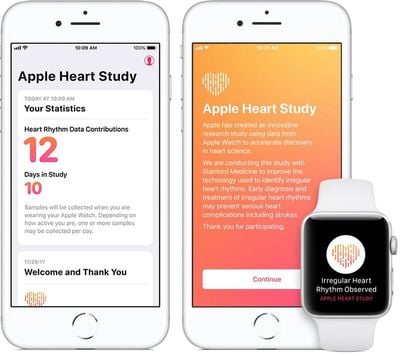
apple heart study
A total of 419,297 people in the United States participated in the study, and 0.52 percent of participants (2,161 people) received an irregular heart rhythm notification over 117 days of monitoring. People who received a notification were sent ECG patches to further monitor for heart problems, but quite a few of those went unreturned.

Of the 450 people who returned the patches with data that could be analyzed, atrial fibrillation was present in 34 percent overall and 35 percent of participants age 65 or older. Of those who had an irregular reading and returned a patch, 84 percent of subsequent notifications were determined to be atrial fibrillation.

Among participants who were notified of an irregular pulse, the positive predictive value was 0.84 (95% CI, 0.76 to 0.92) for observing atrial fibrillation on the ECG simultaneously with a subsequent irregular pulse notification and 0.71 (97.5% CI, 0.69 to 0.74) for observing atrial fibrillation on the ECG simultaneously with a subsequent irregular tachogram. Of 1376 notified participants who returned a 90-day survey, 57% contacted health care providers outside the study. There were no reports of serious app-related adverse events.

According to researchers, the low number of warnings in the study indicates that the device does not cause an excess of false notifications in healthy people who wear the watch.

In some cases, atrial fibrillation detected by the Apple Watch was in the early stages of development, and it didn't happen frequently enough for the patch testing to detect it, something that was more prevalent in younger participants.

The study did ultimately determine that the Apple Watch can detect atrial fibrillation. Stanford cardiologist and co-author of the study Dr. Mintu Turakhia said that the trial was overall a success, especially when it came to determining how many people are going to get heart-related notifications from Apple Watch and what those types of notifications mean for patients, doctors, insurers, and more.

Dr. Daniel Cantillon, a Cleveland cardiologist who was not involved, told Reuters that the technology was promising, but more than half of participants were under 40, a group at low risk for atrial fibrillation, leading to concerns about scaring healthy people.

Separately, a New York cardiologist told CNBC that there's a risk of the Apple Watch finding young people who have early signs of atrial fibrillation that the medical community doesn't know how to treat. "We just don't understand atrial fibrillation well in the 35-year-old, otherwise healthy person," he said.

Wessler treats patients who have visited him based on data gathered from the Apple Watch, and he expects those kind of visits to pick up in the future. Should Apple's research continue, Wessler believes it's important to find the right population that's most at risk to use these tools rather than delivering them to a mainstream audience.

The study was overall beneficial, demonstrating the potential for large-scale studies that use a variety of technologies to monitor patients remotely without requiring on-site visits. Since this study kicked off in 2017, it did not use the new Apple Watch models that are able to take ECG readings, instead relying on the standard heart rate sensor.

The full Apple Heart Study published by Stanford Medicine can be read in The New England Journal of Medicine.
Popular Stories

Apple Logo Zoomed

Tim Cook Teases Plans for Apple's Upcoming 50th Anniversary

Thursday February 5, 2026 12:54 pm PST by
Apple turns 50 this year, and its CEO Tim Cook has promised to celebrate the milestone. The big day falls on April 1, 2026. "I've been unusually reflective lately about Apple because we have been working on what do we do to mark this moment," Cook told employees today, according to Bloomberg's Mark Gurman. "When you really stop and pause and think about the last 50 years, it makes your heart ...
wwdc sans text feature

Apple Rumored to Announce New Product on February 19

Thursday February 5, 2026 12:22 pm PST by
Apple plans to announce the iPhone 17e on Thursday, February 19, according to Macwelt, the German equivalent of Macworld. The report, citing industry sources, is available in English on Macworld. Apple announced the iPhone 16e on Wednesday, February 19 last year, so the iPhone 17e would be unveiled exactly one year later if this rumor is accurate. It is quite uncommon for Apple to unveil...
Finder Siri Feature

Why Apple's iOS 26.4 Siri Upgrade Will Be Bigger Than Originally Promised

Friday February 6, 2026 3:06 pm PST by
In the iOS 26.4 update that's coming this spring, Apple will introduce a new version of Siri that's going to overhaul how we interact with the personal assistant and what it's able to do. The iOS 26.4 version of Siri won't work like ChatGPT or Claude, but it will rely on large language models (LLMs) and has been updated from the ground up. Upgraded Architecture The next-generation...
iOS 26

iOS 26.3 and iOS 26.4 Will Add These New Features to Your iPhone

Tuesday February 3, 2026 7:47 am PST by
While the iOS 26.3 Release Candidate is now available ahead of a public release, the first iOS 26.4 beta is likely still at least a week away. Following beta testing, iOS 26.4 will likely be released to the general public in March or April. Below, we have recapped known or rumored iOS 26.3 and iOS 26.4 features so far. iOS 26.3 iPhone to Android Transfer Tool iOS 26.3 makes it easier...
iphone 17 pro dark blue 1

iPhone 18 Pro Max Rumored to Deliver Next-Level Battery Life

Friday February 6, 2026 5:14 am PST by
The iPhone 18 Pro Max will feature a bigger battery for continued best-in-class battery life, according to a known Weibo leaker. Citing supply chain information, the Weibo user known as "Digital Chat Station" said that the iPhone 18 Pro Max will have a battery capacity of 5,100 to 5,200 mAh. Combined with the efficiency improvements of the A20 Pro chip, made with TSMC's 2nm process, the...

Top Rated Comments

BWhaler Avatar
82 months ago
Simply wonderful.

This is Apple (and Stanford) at their best.

Thanks to all the people who worked on this.
Score: 20 Votes (Like | Disagree)
rp2011 Avatar
82 months ago
The point should be about collecting information even if they don’t know how to treat someone. That alone constitutes as a success. That’s always the first step. You can’t begin to understand anything without first collecting data.
Score: 15 Votes (Like | Disagree)
nfl46 Avatar
82 months ago
Wow! I am impressed. Damn good job, Apple! The watch is only going to get better. I can't wait to see what it does in 5 years or so.
Score: 9 Votes (Like | Disagree)
fmcshan Avatar
82 months ago
This is great! I love how Apple is really making its mark in the health industry.
Score: 8 Votes (Like | Disagree)
realtuner Avatar
82 months ago
According to researchers, the low number of warnings in the study indicates that the device does not cause an excess of false notifications in healthy people who wear the watch.
Isn't this one of things naysayers are always whining about?
Score: 6 Votes (Like | Disagree)
npmacuser5 Avatar
82 months ago
Awesome implementation of an innovative product, Apple Watch.?
Score: 6 Votes (Like | Disagree)