Utah will officially launch a COVID-19 contact tracing system based on Apple and Google's exposure notification API on Wednesday, according to a press release by the State's health department.
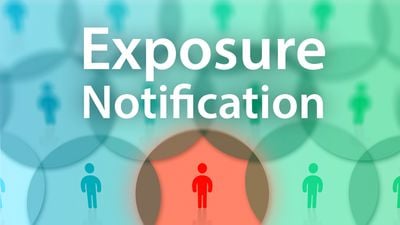
The system will utilize Apple and Google's exposure notification system, which notifies users with the feature enabled if they've come in contact with an individual who has tested positive for COVID-19. Utah is notably one of the few states that initially rejected using the system, and instead opted to use its own system based on less accurate and private GPS and Bluetooth tracking.
Utah's director for the Department of Health Center for Health and Informatics says that contact tracing will enable the state to better manage the pandemic and the outbreak of the virus.
"Contact tracing is an important part of how public health responds and stops disease outbreaks. People who have been in close contact with someone who has COVID-19 are more at risk of getting infected and making others sick,"
Unlike other states which are offering standalone apps, Utah's approach will work without an app and only require{s} users with the latest version of iOS and Android to enable exposure notification within the settings app. In practice, when two individuals with the system enabled come in "close proximity" to one another, they exchange "anonymized 'tokens' that log that close interaction for 14 days."
If someone logs a positive test result for COVID-19 into the system, other individuals who were logged to have come in close contact with them within the last 14 days are alerted to get tested and go into self-quarantine. The system will officially launch on Wednesday, February 17, and Utah residents will receive notification alerts over the course of the week encouraging them to enable the system.
Thursday February 5, 2026 12:54 pm PST by Joe Rossignol
Apple turns 50 this year, and its CEO Tim Cook has promised to celebrate the milestone. The big day falls on April 1, 2026.
"I've been unusually reflective lately about Apple because we have been working on what do we do to mark this moment," Cook told employees today, according to Bloomberg's Mark Gurman. "When you really stop and pause and think about the last 50 years, it makes your heart ...
Thursday February 5, 2026 12:22 pm PST by Joe Rossignol
Apple plans to announce the iPhone 17e on Thursday, February 19, according to Macwelt, the German equivalent of Macworld.
The report, citing industry sources, is available in English on Macworld.
Apple announced the iPhone 16e on Wednesday, February 19 last year, so the iPhone 17e would be unveiled exactly one year later if this rumor is accurate. It is quite uncommon for Apple to unveil...
Friday February 6, 2026 3:06 pm PST by Juli Clover
In the iOS 26.4 update that's coming this spring, Apple will introduce a new version of Siri that's going to overhaul how we interact with the personal assistant and what it's able to do.
The iOS 26.4 version of Siri won't work like ChatGPT or Claude, but it will rely on large language models (LLMs) and has been updated from the ground up.
Upgraded Architecture
The next-generation...
Tuesday February 3, 2026 7:47 am PST by Joe Rossignol
While the iOS 26.3 Release Candidate is now available ahead of a public release, the first iOS 26.4 beta is likely still at least a week away. Following beta testing, iOS 26.4 will likely be released to the general public in March or April.
Below, we have recapped known or rumored iOS 26.3 and iOS 26.4 features so far.
iOS 26.3
iPhone to Android Transfer Tool
iOS 26.3 makes it easier...
The iPhone 18 Pro Max will feature a bigger battery for continued best-in-class battery life, according to a known Weibo leaker.
Citing supply chain information, the Weibo user known as "Digital Chat Station" said that the iPhone 18 Pro Max will have a battery capacity of 5,100 to 5,200 mAh. Combined with the efficiency improvements of the A20 Pro chip, made with TSMC's 2nm process, the...
Ahhh. Okay. Reading back through our comments I must have misunderstood your initial fear. You’re saying an app would be able to see which location you go to frequently (your home) and if you suddenly stay at said location (your home) for a week or two or three, it would guess you’re in quarantine. And then serve you ads. That does make sense, and it does seem easy to do! As long as the user enabled always allow on location. Which I don’t think much do anymore now that iOS reminds you that an app has been using it in the background.
If Facebook were to do it though, people are on that app enough multiples times throughout the day that even if “when using” was on it would have enough time to grab that data. And knowing Facebook, I definitely wouldn’t put it past them.
I think we got off on the wrong page because the article is talking about the covid contact tracing API and you’re talking about an individual app being able to do nefarious things if people quarantine and it notices.
Yeah. My point was the notification encourages behavior changes (which is good) but it could use behavior changes of others to estimate a risk. So it’s using it’s changes to its own location tracking to indirectly identify if you received an exposure notifications. So even if you don’t follow isolation guidelines it could figure out if you were recommended to do so and calculate a risk of infection based on others.
Really? Hmm. I don't see it available when I try to turn on Exposure Notifications here in Georgia... I get this message (attached).
I also have "Availability Alerts" turned on, and haven't gotten one... Is there not an indication like these when the Express version is available?
Availability alert isn't very immediate. As for Georgia, the article says it will be rolled out this week. My iPhone shows Georgia, but I am running iOS 14.5 beta.
My point was that the information provided by the COVID service would likely influence behavior enough, across enough people, to make it easy to use GPS logs to identify individuals who received the notification. If your app justifies location information and has a large enough user base then responding to the alert (by isolating) will increase the likelihood you will be identified. Google and Facebook apps would easily be able to perform this and use it to sell targeted ad space for the duration of your recommended quarantine.
Apple's Exposure Notification API does not log GPS information.
It gathers anonymized Bluetooth device IDs, which is changed every 15 minutes. Device IDs are shared with nearby iPhones and Android phones, which is retained on the device for about 2 weeks. Every day, iPhone and Android phones retrieve device IDs from state government's website, of patients who logged positive test results (which is done manually by the patient with positive test case ID number). If there's a match and the threshold is met (e.g., 15 minutes within 6 feet), you will be notified.
If you are using Exposure Notification Express app, it is not possible for third party to link Bluetooth device ID to you in anyway.