An exploit allows messages and additional data to be sent across Apple's Find My network, according to the findings of a security researcher.

Security researcher Fabian Bräunlein has found a way to leverage Apple's Find My network to function as a generic data transfer mechanism, allowing non-internet-connected devices to upload arbitrary data by using nearby Apple devices to upload the data for them.
The Find My network uses the entire base of active iOS devices to act as nodes to transfer location data. Bräunlein explained in an extensive blog post that it is possible to emulate the way in which an AirTag connects to the Find My network and broadcasts its location. The AirTag sends its location via an encrypted broadcast, so when this data is replaced with a message, it is concealed by the broadcast's encryption.
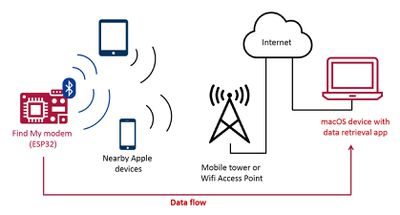
Bräunlein's practical demonstration showed how short strings of text could be sent from a microcontroller running custom firmware over the Find My network. The text was received via a custom Mac app to decode and display the uploaded data.
It is not immediately clear if this Find My network exploit could be used maliciously or what useful purposes it may serve. Nonetheless, it seems that it could be difficult for Apple to prevent this unintended use due to the privacy-focused and end-to-end encrypted nature of the system.
For more information, see Bräunlein's full blog post, which explains in detail the entire technical process behind passing arbitrary data through the Find My network.

Thursday February 5, 2026 12:54 pm PST by Joe Rossignol
Apple turns 50 this year, and its CEO Tim Cook has promised to celebrate the milestone. The big day falls on April 1, 2026.
"I've been unusually reflective lately about Apple because we have been working on what do we do to mark this moment," Cook told employees today, according to Bloomberg's Mark Gurman. "When you really stop and pause and think about the last 50 years, it makes your heart ...
Thursday February 5, 2026 12:22 pm PST by Joe Rossignol
Apple plans to announce the iPhone 17e on Thursday, February 19, according to Macwelt, the German equivalent of Macworld.
The report, citing industry sources, is available in English on Macworld.
Apple announced the iPhone 16e on Wednesday, February 19 last year, so the iPhone 17e would be unveiled exactly one year later if this rumor is accurate. It is quite uncommon for Apple to unveil...
Friday February 6, 2026 3:06 pm PST by Juli Clover
In the iOS 26.4 update that's coming this spring, Apple will introduce a new version of Siri that's going to overhaul how we interact with the personal assistant and what it's able to do.
The iOS 26.4 version of Siri won't work like ChatGPT or Claude, but it will rely on large language models (LLMs) and has been updated from the ground up.
Upgraded Architecture
The next-generation...
Tuesday February 3, 2026 7:47 am PST by Joe Rossignol
While the iOS 26.3 Release Candidate is now available ahead of a public release, the first iOS 26.4 beta is likely still at least a week away. Following beta testing, iOS 26.4 will likely be released to the general public in March or April.
Below, we have recapped known or rumored iOS 26.3 and iOS 26.4 features so far.
iOS 26.3
iPhone to Android Transfer Tool
iOS 26.3 makes it easier...
Saturday February 7, 2026 9:26 am PST by Joe Rossignol
Apple today shared an ad that shows how the upgraded Center Stage front camera on the latest iPhones improves the process of taking a group selfie.
"Watch how the new front facing camera on iPhone 17 Pro takes group selfies that automatically expand and rotate as more people come into frame," says Apple. While the ad is focused on the iPhone 17 Pro and iPhone 17 Pro Max, the regular iPhone...
The first thought that comes to mind is someone installing a compromised IoT device that gains legitimate access to their network and then uses the Find My network to funnel data out of the network, bypassing any firewall rules that prevent the IoT device from communicating with the Internet at large.
It's the type of thing you'd see in a heist or spy movie to try and snag someone's password.
Another “IF YOU SET EVERYTHING UP JUUUUUUUUUST RIGHT, YOU CAN DO A THING!” from a security researcher. AirTags is the security gift that keeps on giving. Next week, “We’ve been able to determine that if you accelerate an AirTag at just the right speed towards a target that’s not trying to dodge and is totally aware and ok that you’re throwing it (though accelerate sounds cooler) YOU MAY BE ABLE TO HIT THEM!”
This could be used for some kind of Denial of Service Attack, couldn't it?
You set up a server that's just spamming the Find My network, then all the Apple devices are constantly bouncing these spam messages around. They may end up drowning out legitimate Find My network messages.
Waiting for someone to show a hack that executed the following steps: 1) uses forgot password 2) clicks try another device for access code pin 3) has a hamster run in a wheel to disrupt radio waves transmitting the secret pin 4) said wheel traps the secret pin and translated via a sudoku puzzle to the hacker 5) hacker inlists a millennial to decrypt the puzzle 6) millennial asks for gluten free juice cleanser for payment 7) hacker gets in!
This could be used for some kind of Denial of Service Attack, couldn't it?
You set up a server that's just spamming the Find My network, then all the Apple devices are constantly bouncing these spam messages around. They may end up drowning out legitimate Find My network messages.
From the source:
With the public key validity check implemented, everything worked flawlessly. While I didn't do extensive performance testing and measurements, here are some estimates:
The sending rate on the microcontroller is currently ~3 bytes/second. Higher speeds could be achieved e.g. simply by caching the encoding results or by encoding one byte per advertisement In my tests, the receiving rate was limited by slow Mac hardware. Retrieving 16 bytes within one request takes ~5 seconds The latency is usually between 1 and 60 minutes depending on how many devices are around and other random factors.