Apple is looking to create an "entirely new application paradigm" for augmented and virtual reality according to a new job listing, highlighting the company's growing ambitions in the AR and VR space as it ramps up the development of its next-generation products.
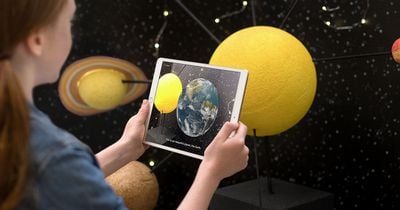
The role will include "working closely with Apple's UI frameworks, Human Interface designers and system software teams" in building out Apple's augmented and virtual reality experiences. "This role will push you to think outside-the-box, and solve incredibly ambitious and interesting problems in the AR/VR space," the job listing adds.
Following years of research and development, Apple is expected to release its first AR-focused device in 2022. The device, likely to come in the form of a headset, will be Apple's first major push into the increasingly vibrant AR and VR space. The company's first headset is not expected to be a mainstream hit at first, with credible reports suggesting it will remain a niche product aimed largely at developers for media consumption, communication, and gaming.
Further down the line, Apple plans to release augmented reality glasses. These glasses, unlike the headset, will be in a smaller form factor and are likely to appeal more to the masses. "Apple Glasses" are expected to debut by 2025 at the earliest, with the second generation of Apple's AR headset now rumored to launch in 2024.
Thursday February 5, 2026 12:54 pm PST by Joe Rossignol
Apple turns 50 this year, and its CEO Tim Cook has promised to celebrate the milestone. The big day falls on April 1, 2026.
"I've been unusually reflective lately about Apple because we have been working on what do we do to mark this moment," Cook told employees today, according to Bloomberg's Mark Gurman. "When you really stop and pause and think about the last 50 years, it makes your heart ...
Thursday February 5, 2026 12:22 pm PST by Joe Rossignol
Apple plans to announce the iPhone 17e on Thursday, February 19, according to Macwelt, the German equivalent of Macworld.
The report, citing industry sources, is available in English on Macworld.
Apple announced the iPhone 16e on Wednesday, February 19 last year, so the iPhone 17e would be unveiled exactly one year later if this rumor is accurate. It is quite uncommon for Apple to unveil...
Friday February 6, 2026 3:06 pm PST by Juli Clover
In the iOS 26.4 update that's coming this spring, Apple will introduce a new version of Siri that's going to overhaul how we interact with the personal assistant and what it's able to do.
The iOS 26.4 version of Siri won't work like ChatGPT or Claude, but it will rely on large language models (LLMs) and has been updated from the ground up.
Upgraded Architecture
The next-generation...
Tuesday February 3, 2026 7:47 am PST by Joe Rossignol
While the iOS 26.3 Release Candidate is now available ahead of a public release, the first iOS 26.4 beta is likely still at least a week away. Following beta testing, iOS 26.4 will likely be released to the general public in March or April.
Below, we have recapped known or rumored iOS 26.3 and iOS 26.4 features so far.
iOS 26.3
iPhone to Android Transfer Tool
iOS 26.3 makes it easier...
The iPhone 18 Pro Max will feature a bigger battery for continued best-in-class battery life, according to a known Weibo leaker.
Citing supply chain information, the Weibo user known as "Digital Chat Station" said that the iPhone 18 Pro Max will have a battery capacity of 5,100 to 5,200 mAh. Combined with the efficiency improvements of the A20 Pro chip, made with TSMC's 2nm process, the...
AR is where it is at. Walk into a store. Look at items on the shelves. Eye tracking knows what you are looking at. HUD displays the price of the product, how often you buy the product. If you buy the product often and have run out at home, a reminder might pop up and indicate how many items would be worth purchasing (based on your purchase history).
You pick up a pack of biscuits, instantly the ingredients list pops up (no more impossibly small ingredients lists on packages). If you are someone with allergies it can warn you if their are ingreients that might cause you a problem. Perhaps even indicate a similar item that does not have something you are allergic to.
As you scan the isles looking for something, the system notices you are searching - prompting you to indicate what you are looking for. You say 'cheese', and a pop up on the display shows 'isle 14' with an arrow indicating the direction to head in.
All pricing labels, paper notices, stickers etc will all dissappear. As a store owner - when there is need to change the price of something - change it in the system and you are done. No meed to update signs or anything - customers see the new proce via their AR immediately. Add a new product to shelves, same story.
Repairing something - HUD shows which screws to remove next, their type and size by highlighting them on the item you are looking at using AR. Complete a step and it shows you the next step. Diagnosing a hardware problem, status shows on the HUD.
It goes on and on, and it is all AR. VR might be 'cool' or useful in training, but I really think AR is where it is at.
The biggest issue is to have a data interchange format that all AR devices support, image recognition that works, and the ability for people to easily create AR resources such as a repair guide for a peice of hardware, or a map of a store and where items are on shelves. The likelyhood that AR itself could be used as a tool for inputting this data in the first place is immesly high. Walk around your store amd it creats a map, look at shelves and it picks up on products and where they are located. No need to type all this data in, making it easy for people to start using in the first place.
Interesting comments here calling for a "killer app".
An anecdote: I was watching a presentation at a large mobile phone conference (GSM World, maybe) just when mobile internet was becoming available. Everyone was looking for the "killer app" that would make it take off. The presenter said "You're all looking for the killer app, but the killer app for mobile phones is voice!" The entire audience, many hundreds of mobile professionals, gave a standing ovation at that comment.
That was the view of professionals back then, and they completely failed to understand the usefulness of data on the phone. They couldn't envision anything beyond incremental progress. Look at what we have now, and realize that there is no single "killer app" for VR/AR. Entire industries will be created, and we have no idea what they will be from our perspective of today. Don't make the mistake of the phone people.