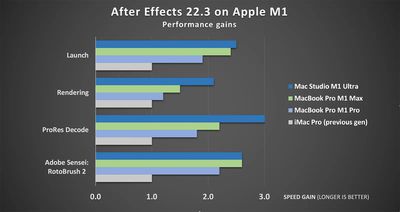
Adobe has updated its professional video editing software After Effects with native M1 support, offering customers up to 3x faster render speeds on Apple's latest Macs compared to high-end Macs with Intel processors.
On M1 computers, Adobe promises up to 2x faster performance in rendering and general app responsiveness. On M1 Ultra, Apple's most high-end chip found in the Mac Studio, Adobe says After Effects will be up to 3x faster for video editors. One specific way Adobe has optimized After Effects is with multi-frame rendering, which utilizes all available cores on Apple silicon to provide a playback experience that's up to 4x faster than a high-end iMac Pro with a 10-core Intel Xeon processor.
The newest version of After Effects will be rolling out to users in the coming days. Adobe also announced several other new features for After Effects and Premiere Pro such as Scene Edit Detection, Auto Color powered by AI, and more.
iOS 26.4 was released today, and it includes a couple of new features for CarPlay: an Ambient Music widget and support for voice-based chatbot apps.
To update your iPhone 11 or newer to iOS 26.4, open the Settings app and tap on General → Software Update. CarPlay will automatically offer the new features so long as the iPhone connected to your vehicle is running iOS 26.4 or later....
Apple today announced Apple Business, a new all-in-one platform that unifies device management, productivity tools, and customer outreach features.
The service is designed to be a consolidated replacement for several of Apple's existing business-focused offerings, including Apple Business Essentials, Apple Business Manager, and Apple Business Connect. It provides organizations with a single...
Tuesday March 24, 2026 12:31 pm PDT by Juli Clover
Apple today released new firmware for the AirPods Pro 2, AirPods Pro 3, and the AirPods 4. The firmware has a version number of 8B39, up from 8B34 on the AirPods Pro 3, 8B28 on the AirPods Pro 2, and 8B21 on the AirPods 4.
There is no word on what's included in the firmware, but Apple has a support document with limited notes. Most updates are limited to bug fixes and performance...
So many benchmarks seem to have had the goal of painting the Apple Silicon Macs in a bad light - usually through disingenuous tactics. I have seen many benchmarks optimised for non-apple API's (openGL anyone?) or comparing non-hardware accelerated against hardware accelerated. for example Handbrake encoding on Intel by default uses hardware acceleration, I have seen benchmarks comparing software rendering on M1 against hardware rendering on Intel/Windows. So much murky stuff designed to confirm a conclusion.
Anyone else wish Adobe just rewrote all their apps from the ground up? Illustrator, Photoshop and Indesign all run as if they've just been running the same code since PowerPC days...
I guess when all those “experts” used adobe for benchmarking, and we commented they didn’t know what they were talking about because adobe wasn’t optimized. Well, we were right, those benchmarks were crap