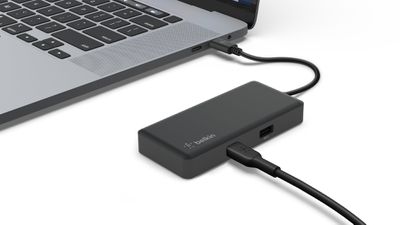
The Hub is designed to be mounted to the back of a monitor, computer stand, or monitor base, and tucked away from view. It features two USB-A ports, one USB-C port, one SD card slot, and a microSD card reader.
It mounts to the back of an iMac or other computer using two 3M Command strips, and there's a quick release button in case you need to use the hub on the go. It supports transfer speeds of up to 10Gb/s.
Belkin today also introduced the $80 USB-C 5-in-1 Multiport Adapter. Though designed for Chromebooks, the adapter is compatible with Macs, offering two USB-A ports, a Gigabit Ethernet port, an HDMI port that supports one 4K display at 60Hz, and an 86W USB-C power delivery port.
iOS 26.4 was released today, and it includes a couple of new features for CarPlay: an Ambient Music widget and support for voice-based chatbot apps.
To update your iPhone 11 or newer to iOS 26.4, open the Settings app and tap on General → Software Update. CarPlay will automatically offer the new features so long as the iPhone connected to your vehicle is running iOS 26.4 or later....
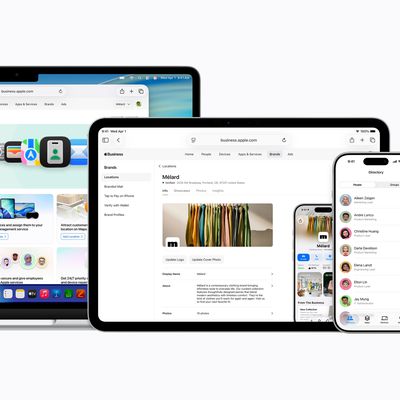
Apple today announced Apple Business, a new all-in-one platform that unifies device management, productivity tools, and customer outreach features.
The service is designed to be a consolidated replacement for several of Apple's existing business-focused offerings, including Apple Business Essentials, Apple Business Manager, and Apple Business Connect. It provides organizations with a single...
Tuesday March 24, 2026 12:31 pm PDT by Juli Clover
Apple today released new firmware for the AirPods Pro 2, AirPods Pro 3, and the AirPods 4. The firmware has a version number of 8B39, up from 8B34 on the AirPods Pro 3, 8B28 on the AirPods Pro 2, and 8B21 on the AirPods 4.
There is no word on what's included in the firmware, but Apple has a support document with limited notes. Most updates are limited to bug fixes and performance...
I'm sure everybody wants to make their iMac as ugly as this by attaching one of these. Not me, I'll take a big pass.
I went with the USB-C Slim Dock by Satechi in June for $120. ('https://www.amazon.com/gp/product/B08V83JZH4/ref=ppx_od_dt_b_asin_title_s00?ie=UTF8&psc=1')
I also added the 1TB SAMSUNG 980 SSD 1TB M.2 NVMe Interface Internal Solid State Drive with V-NAND Technology for Gaming, Heavy Graphics, Full Power Mode, MZ-V8V1T0B/AM ('https://www.amazon.com/gp/product/B08V83JZH4/ref=ppx_od_dt_b_asin_title_s00?ie=UTF8&psc=1')
Modern technology is really odd. It seems obvious that all these hubs are the same boards repackaged because they always have the same spec. 1 usb c , 1 card reader etc.
So what is actually going on here? If you find a hub with more than 1 usb c it’s ridiculous money. And usb c doesn’t even mean thunderbolt 4. So how does all of this work? Is there only 1 company building the guts of these interfaces? Why is it so hard for someone to make multiple USB ports?
I’d love to know the story about this because it’s been going on for years now.