Google Chrome has announced it has gained support for passkeys, a new industry-wide standard with the hope of replacing passwords by making it easier and safer to log into websites and apps.
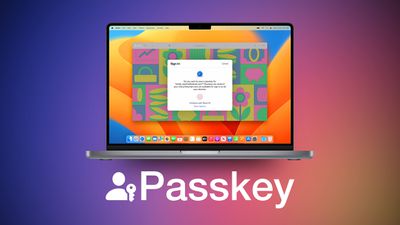
With passkeys, users can authenticate and log into websites using their iPhone or Android devices, replacing the need for a password. On newer versions of iOS and Android, users visiting websites that support passkeys can use biometric authentication on a trusted device to confirm their identity. Writing in a blog post, Google said it was adding passkey support to Chrome, which will let users scan a QR code on their Android or iPhone device to log in. Passkey support is also coming to Chrome on Android.
On a desktop device you can also choose to use a passkey from your nearby mobile device and, since passkeys are built on industry standards, you can use either an Android or iOS device. A passkey doesn't leave your mobile device when signing in like this. Only a securely generated code is exchanged with the site so, unlike a password, there's nothing that could be leaked.
A number of other companies and apps have introduced or announced upcoming support for passkeys, including 1Password, PayPal, Microsoft, eBay, and more. Passkey support in Google Chrome is available now with the latest update. To learn more about passkeys, check out our explainer.
Thursday February 5, 2026 12:54 pm PST by Joe Rossignol
Apple turns 50 this year, and its CEO Tim Cook has promised to celebrate the milestone. The big day falls on April 1, 2026.
"I've been unusually reflective lately about Apple because we have been working on what do we do to mark this moment," Cook told employees today, according to Bloomberg's Mark Gurman. "When you really stop and pause and think about the last 50 years, it makes your heart ...
Thursday February 5, 2026 12:22 pm PST by Joe Rossignol
Apple plans to announce the iPhone 17e on Thursday, February 19, according to Macwelt, the German equivalent of Macworld.
The report, citing industry sources, is available in English on Macworld.
Apple announced the iPhone 16e on Wednesday, February 19 last year, so the iPhone 17e would be unveiled exactly one year later if this rumor is accurate. It is quite uncommon for Apple to unveil...
Friday February 6, 2026 3:06 pm PST by Juli Clover
In the iOS 26.4 update that's coming this spring, Apple will introduce a new version of Siri that's going to overhaul how we interact with the personal assistant and what it's able to do.
The iOS 26.4 version of Siri won't work like ChatGPT or Claude, but it will rely on large language models (LLMs) and has been updated from the ground up.
Upgraded Architecture
The next-generation...
Tuesday February 3, 2026 7:47 am PST by Joe Rossignol
While the iOS 26.3 Release Candidate is now available ahead of a public release, the first iOS 26.4 beta is likely still at least a week away. Following beta testing, iOS 26.4 will likely be released to the general public in March or April.
Below, we have recapped known or rumored iOS 26.3 and iOS 26.4 features so far.
iOS 26.3
iPhone to Android Transfer Tool
iOS 26.3 makes it easier...
Saturday February 7, 2026 9:26 am PST by Joe Rossignol
Apple today shared an ad that shows how the upgraded Center Stage front camera on the latest iPhones improves the process of taking a group selfie.
"Watch how the new front facing camera on iPhone 17 Pro takes group selfies that automatically expand and rotate as more people come into frame," says Apple. While the ad is focused on the iPhone 17 Pro and iPhone 17 Pro Max, the regular iPhone...
That's not the way it works. In fact it's the total opposite of the way it works. Maybe have a look at how the Passkeys standard works? There's an explainer link in the main article.
More parties to rely on at an authentication boundary is not necessarily a better thing. You are at the mercy of everyone one of them.
I will continue to use MacPass and keep everything in a domain I fully control.
It’s just asymmetric key cryptography. There is no third party other than your key storage provider, let it be your trusted Apple devices’ Secure Enclave or 1Password vault or Google‘s vault or multiple vaults.
More parties to rely on at an authentication boundary is not necessarily a better thing. You are at the mercy of everyone one of them.
I will continue to use MacPass and keep everything in a domain I fully control.
I don't understand this comment. For most people, Passkeys won't increase the number of parties involved in the authentication process. Assuming of course, that most people, like you seem to do, use a tool to store their passwords. With Passkeys, what's being transferred between authenticatee and authenticator is different (not a password) but other than that, the process is very similar. A "secret" held on your client (probably using a software tool or the built-in key-chain) is used to authenticate with the target website.
If this becomes a standard, 1Password could see a massive decline in users…
Why exactly? It will continue to offer cross platform management of Passcodes where it were passwords in the future, combined with sharing and plenty of native apps. They’re not sitting in the Fido alliance for no reason.