The M2 Pro and M2 Max MacBook Pro models feature a considerably smaller heatsink due to supply chain issues, teardowns suggest.
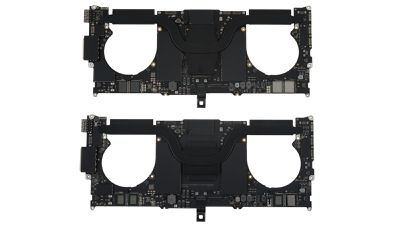
Top: M1 Pro logic board with larger heatsink. Bottom: M2 Pro logic board with smaller heatsink (via iFixit).
The new MacBook Pro's revised thermal architecture appears to be caused by the reduced overall footprint of the M2 Pro and M2 Max SoCs inside the device, as noted by iFixit and Max Tech. The M1 Pro and M1 Max MacBook Pro models contained two, large memory modules, but the M2 Pro and M2 Max MacBook Pro models contain four slimmer memory modules. Even though the M2 Pro and M2 Max dies are physically larger than those of the M1 Pro and M1 Max, the SoCs as a whole take up less space.
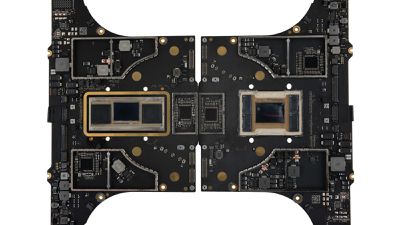
Left: M1 Pro SoC. Right: M2 Pro SoC (via iFixit).
This means that the M2 Pro and M2 Max MacBook Pro models do not require a heatsink as large as the one used for the previous generation. It is not clear if this significantly impacts thermal efficiency.
The reason for the use of four smaller memory modules appears to be supply chain issues. The entire SoC is mounted on a substrate, so four smaller modules allow Apple to use a smaller substrate, making a saving on materials and reducing complexity as a result. Dylan Patel, Chief Analyst at SemiAnalysis, told iFixit:
ABF substrates were in very short supply when Apple made the design choice. By using four smaller modules rather than two larger ones, they can decrease routing complexity within the substrate from the memory to the SoC, leading to fewer layers on the substrate. This allows them to stretch the limited substrate supply further.
The M2 Pro and M2 Max deliver up to 20 percent better CPU performance and 30 percent better GPU performance than their predecessors, but since the chips continue to be based on TSMC's 5nm process, some users have noted that Apple may have made thermal tradeoffs in order to deliver improved performance.
Thursday February 5, 2026 12:54 pm PST by Joe Rossignol
Apple turns 50 this year, and its CEO Tim Cook has promised to celebrate the milestone. The big day falls on April 1, 2026.
"I've been unusually reflective lately about Apple because we have been working on what do we do to mark this moment," Cook told employees today, according to Bloomberg's Mark Gurman. "When you really stop and pause and think about the last 50 years, it makes your heart ...
Thursday February 5, 2026 12:22 pm PST by Joe Rossignol
Apple plans to announce the iPhone 17e on Thursday, February 19, according to Macwelt, the German equivalent of Macworld.
The report, citing industry sources, is available in English on Macworld.
Apple announced the iPhone 16e on Wednesday, February 19 last year, so the iPhone 17e would be unveiled exactly one year later if this rumor is accurate. It is quite uncommon for Apple to unveil...
Friday February 6, 2026 3:06 pm PST by Juli Clover
In the iOS 26.4 update that's coming this spring, Apple will introduce a new version of Siri that's going to overhaul how we interact with the personal assistant and what it's able to do.
The iOS 26.4 version of Siri won't work like ChatGPT or Claude, but it will rely on large language models (LLMs) and has been updated from the ground up.
Upgraded Architecture
The next-generation...
Tuesday February 3, 2026 7:47 am PST by Joe Rossignol
While the iOS 26.3 Release Candidate is now available ahead of a public release, the first iOS 26.4 beta is likely still at least a week away. Following beta testing, iOS 26.4 will likely be released to the general public in March or April.
Below, we have recapped known or rumored iOS 26.3 and iOS 26.4 features so far.
iOS 26.3
iPhone to Android Transfer Tool
iOS 26.3 makes it easier...
The iPhone 18 Pro Max will feature a bigger battery for continued best-in-class battery life, according to a known Weibo leaker.
Citing supply chain information, the Weibo user known as "Digital Chat Station" said that the iPhone 18 Pro Max will have a battery capacity of 5,100 to 5,200 mAh. Combined with the efficiency improvements of the A20 Pro chip, made with TSMC's 2nm process, the...
That's not a heatsink. That's just the interface block that you are describing. The heat is transferred to the two radiator fins. The fans then blow air across the fins. The radiator fins are the heat sink. At least, that's what I classically think of as the heatsink.
This interface block completely covers the chip. It's fine.