Bluetooth 6 Launches, Could Enhance iPhone's Precision Finding Feature

The latest version of Bluetooth was released this week, and it includes a new feature that could benefit the Find My app across Apple devices.
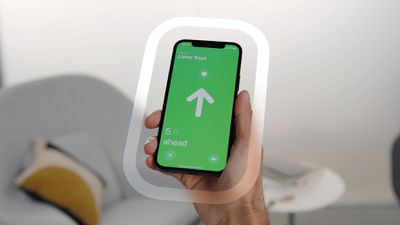
precision finding airtag design session
Bluetooth 6.0 introduces "Channel Sounding," a feature that will bring "true distance awareness" to billions of future Bluetooth devices and accessories. The organization behind Bluetooth promises that this technology will achieve "centimeter-level accuracy over considerable distances," making it easier and quicker for users to locate lost items.

Apple already offers a Precision Finding feature in the Find My app that leverages Ultra Wideband technology to help users pinpoint the specific location of select accessories. The feature is available on the iPhone 11 and newer, and currently it can be used to find an AirTag or a second-generation AirPods Pro charging case.

Apple could use both Bluetooth 6.0 and Ultra Wideband technologies in unison to improve Precision Finding. Bluetooth 6.0 also paves the way for Precision Finding-like location accuracy for devices that are not equipped with Ultra Wideband chips, such as the Apple TV's Siri Remote and devices released by other companies.

It is unclear when the first devices with Bluetooth 6.0 will be released, but given that the specification is only just now available to hardware manufacturers and developers, the first Apple devices with support are likely at least a year away.

Popular Stories

Apple Logo Zoomed

Tim Cook Teases Plans for Apple's Upcoming 50th Anniversary

Thursday February 5, 2026 12:54 pm PST by
Apple turns 50 this year, and its CEO Tim Cook has promised to celebrate the milestone. The big day falls on April 1, 2026. "I've been unusually reflective lately about Apple because we have been working on what do we do to mark this moment," Cook told employees today, according to Bloomberg's Mark Gurman. "When you really stop and pause and think about the last 50 years, it makes your heart ...
wwdc sans text feature

Apple Rumored to Announce New Product on February 19

Thursday February 5, 2026 12:22 pm PST by
Apple plans to announce the iPhone 17e on Thursday, February 19, according to Macwelt, the German equivalent of Macworld. The report, citing industry sources, is available in English on Macworld. Apple announced the iPhone 16e on Wednesday, February 19 last year, so the iPhone 17e would be unveiled exactly one year later if this rumor is accurate. It is quite uncommon for Apple to unveil...
Finder Siri Feature

Why Apple's iOS 26.4 Siri Upgrade Will Be Bigger Than Originally Promised

Friday February 6, 2026 3:06 pm PST by
In the iOS 26.4 update that's coming this spring, Apple will introduce a new version of Siri that's going to overhaul how we interact with the personal assistant and what it's able to do. The iOS 26.4 version of Siri won't work like ChatGPT or Claude, but it will rely on large language models (LLMs) and has been updated from the ground up. Upgraded Architecture The next-generation...
iOS 26

iOS 26.3 and iOS 26.4 Will Add These New Features to Your iPhone

Tuesday February 3, 2026 7:47 am PST by
While the iOS 26.3 Release Candidate is now available ahead of a public release, the first iOS 26.4 beta is likely still at least a week away. Following beta testing, iOS 26.4 will likely be released to the general public in March or April. Below, we have recapped known or rumored iOS 26.3 and iOS 26.4 features so far. iOS 26.3 iPhone to Android Transfer Tool iOS 26.3 makes it easier...
maxresdefault

Apple Shows Off a Key Reason to Upgrade to the iPhone 17

Saturday February 7, 2026 9:26 am PST by
Apple today shared an ad that shows how the upgraded Center Stage front camera on the latest iPhones improves the process of taking a group selfie. "Watch how the new front facing camera on iPhone 17 Pro takes group selfies that automatically expand and rotate as more people come into frame," says Apple. While the ad is focused on the iPhone 17 Pro and iPhone 17 Pro Max, the regular iPhone...

Top Rated Comments

antiprotest Avatar
19 months ago

confused. It will bring this technology to billions of existing devices? Last paragraph seems to contradict?
It's like when someone tells you to download more RAM.
Score: 21 Votes (Like | Disagree)
MrRom92 Avatar
19 months ago
Yes! We can do sounding with our apple Pencils now!
Score: 12 Votes (Like | Disagree)
Joe Rossignol Avatar
19 months ago

confused. It will bring this technology to billions of existing devices? Last paragraph seems to contradict?
Yes, the Bluetooth SIG says billions of Bluetooth devices are released every year. I added a "future" there for clarity.
Score: 11 Votes (Like | Disagree)
TheWraith Avatar
19 months ago

the technology to ping/find a device has been around for 5+ years on Apple's devices, yet 1)it works only with Apple sanctioned products and 2)it works ONLY with AirTags or 2nd Gen AirPods Pro charging cases.

Really? That's the best Apple can do over the past 5+ years?
I don’t understand how you want Apple to have rolled this out industry wide.
Score: 10 Votes (Like | Disagree)
MayaUser Avatar
19 months ago
This can also enable true lossless audio
Score: 7 Votes (Like | Disagree)
name99 Avatar
19 months ago

You ever notice new standards come out really fast on paper then take years to implement?
Must be a Lawyer thing slows it all down.
Wifi 7
Bluetooth 6.0
PCIe-7
Thunderbolt 5
This is because you have no idea how the standards process works...

Pretty much every "consumer facing" standard has two elements. Take, for example, 802.11
There is the IEEE which puts together the technical standard. This process takes many many years, in part because the IEEE is trying to ensure that every weird edge case that the spec is supposed to cover is in fact covered, and covered correctly. This, in turn, is because some elements of the spec are very niche, only of interest to a few specific use cases, but those elements still have to be correct, and to work correctly with the rest of the spec,

Then there is the WiFi Alliance, which is a group of companies selling hardware to consumers. The WiFi Alliance is not interested in niche cases, they are interested in INTEROPERABILITY. So what they will do is, once the IEEE DRAFT spec is solid enough with respect to the elements that matter to consumers, the WiFi Alliance will essentially lock down which of the (many many elements, most of them optional) of the new spec MUST be present in "WiFi" equipment.
The IEEE will say things like "an 802.11 device may choose methods A, B, or C for indicating that it wants to switch modulation modes"; WiFi will say "a WIFI device MUST support method A" and doesn't care if B and C are supported, they are for specialist use of some sort, not for the consumer market.

And so depending on exactly what you are interested in, standards become "available" at very different times.
At a certain point the WiFi Alliance will decide on the elements of WiFi 7, based on a particular version of the draft IEEE 802.11be spec. They will announce this, because these details matter to SOME people (for example companies writing SW targeting WiFi 7, and companies planning chipsets to be labelled WiFi 7). There will still be a year or two before you can buy anything because it takes time to convert the agreed upon WiFi 7 spec into hardware+software.

Meanwhile, on a different track, the IEEE will continue wrangling about ever more esoteric and specialized elements on the 802.11be spec and at some point (generally a year or two later than when WiFi7 HW is available) the final 802.11be spec will be released.

This basically works because the adults in the process understand that consumers have one set of needs, while various specialized users have a very different set of needs, and they're all working together to sync these different use cases.
Where it fails to work is when whiny twits can't tell the difference between one group (802.11 vs WiFi) or pretend that their super-specialized use case is in fact a generic consumer use case, and then get angry that the WiFi 7 equipment they bought is, in fact WIFI 7 spec and not 802.11be spec (specifically that it doesn't support some, by definition OPTIONAL, part of the 802.11be spec).

There can be legal elements that slow this down, submarine patents and such like, but USUALLY that is not the case. It's simply a fact that this stuff is astonishingly complex (and by definition more so with every spec - if something was easy we would have done it in version 2 of the spec, not version 7!)
Score: 7 Votes (Like | Disagree)