A rare, operational Apple-1 Computer was recently put up for auction, and it ended up selling for $375,000. The Apple-1 was the first computer sold by Apple co-founders Steve Jobs and Steve Wozniak, and so few remain that they fetch high prices at auction.
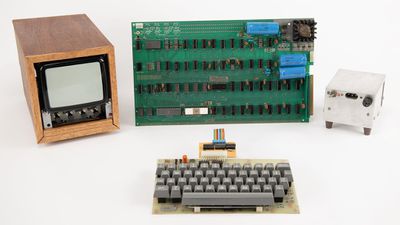
The Apple-1 that sold is known as the "Bayville" Apple-1, and it is number 91 on the Apple-1 Registry. The Apple-1 Registry aggregates all known remaining Apple-1 computers, and it includes details and a history for each one. The registry has 104 Apple-1 machines listed.
The Bayville Apple-1 was part of the first batch of Apple-1 machines sold in 1976, and it has a handwritten serial number that was likely penned by Steve Jobs. It was sold with an original manual with a handwritten note by Daniel Kottke, who was Apple employee number 12.
The Apple-1 was sold alongside many other Apple-related items as part of a "Steve Jobs and the Apple Revolution" auction event. A 1976 Apple Computer check signed by Steve Jobs sold for $112,054, and a sealed, first-generation 4GB iPhone sold for $87,514.
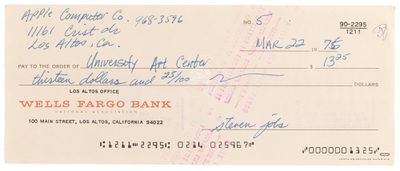
Another check signed by Steve Jobs sold for $62,500, and an Apple Lisa Computer sold for $56,818. The auction earned a total of $1,308,251.
Thursday February 5, 2026 12:54 pm PST by Joe Rossignol
Apple turns 50 this year, and its CEO Tim Cook has promised to celebrate the milestone. The big day falls on April 1, 2026.
"I've been unusually reflective lately about Apple because we have been working on what do we do to mark this moment," Cook told employees today, according to Bloomberg's Mark Gurman. "When you really stop and pause and think about the last 50 years, it makes your heart ...
Thursday February 5, 2026 12:22 pm PST by Joe Rossignol
Apple plans to announce the iPhone 17e on Thursday, February 19, according to Macwelt, the German equivalent of Macworld.
The report, citing industry sources, is available in English on Macworld.
Apple announced the iPhone 16e on Wednesday, February 19 last year, so the iPhone 17e would be unveiled exactly one year later if this rumor is accurate. It is quite uncommon for Apple to unveil...
Friday February 6, 2026 3:06 pm PST by Juli Clover
In the iOS 26.4 update that's coming this spring, Apple will introduce a new version of Siri that's going to overhaul how we interact with the personal assistant and what it's able to do.
The iOS 26.4 version of Siri won't work like ChatGPT or Claude, but it will rely on large language models (LLMs) and has been updated from the ground up.
Upgraded Architecture
The next-generation...
Tuesday February 3, 2026 7:47 am PST by Joe Rossignol
While the iOS 26.3 Release Candidate is now available ahead of a public release, the first iOS 26.4 beta is likely still at least a week away. Following beta testing, iOS 26.4 will likely be released to the general public in March or April.
Below, we have recapped known or rumored iOS 26.3 and iOS 26.4 features so far.
iOS 26.3
iPhone to Android Transfer Tool
iOS 26.3 makes it easier...
The iPhone 18 Pro Max will feature a bigger battery for continued best-in-class battery life, according to a known Weibo leaker.
Citing supply chain information, the Weibo user known as "Digital Chat Station" said that the iPhone 18 Pro Max will have a battery capacity of 5,100 to 5,200 mAh. Combined with the efficiency improvements of the A20 Pro chip, made with TSMC's 2nm process, the...
The average home price in the United States… makes sense.
Edit: I don’t know if it’s worse that the average home costs as much as an historic Apple computer or that an old Apple computer costs as much as the average American home.
It looks interesting but I wonder what this computer could do ?
This: The Apple I, introduced in 1976, was Apple’s first personal computer and a pioneer in the early personal computing era.
Key Features: • Processor: Equipped with a MOS Technology 6502 microprocessor running at approximately 1.023 MHz. • Memory: Came standard with 4 KB of RAM, expandable up to 8 KB on the motherboard, and further to 64 KB with additional expansion cards. • Display: Featured built-in video output, allowing users to connect to a composite video monitor or a standard television via an RF modulator. This capability provided a 40×24 character display, facilitating direct interaction without the need for specialized equipment. • Input: Required an external ASCII keyboard for user input, enabling users to type commands and programs directly. • Storage: An optional cassette interface allowed data storage and retrieval using standard audio cassette tapes, making it possible to save and load programs.
Functional Capabilities: • Programming: Users could write and execute programs in machine code or using a BASIC interpreter, facilitating the creation of custom applications and simple games. • Text Display: The system could display text on the screen, supporting basic word processing and text-based applications. • Educational Use: Served as a learning tool for computer enthusiasts and hobbyists, offering hands-on experience with programming and computer operations.