Apple Wins Dismissal in Payments Conspiracy Lawsuit - MacRumors
Skip to Content

Apple Wins Dismissal in Payments Conspiracy Lawsuit

Apple has successfully secured the dismissal of a federal lawsuit accusing it of conspiring with Visa and Mastercard to suppress competition in the payments network industry and inflate merchant transaction fees (via Reuters).

tap to pay on iphone credit card
The Southern District of Illinois ruled in favor of Apple, Visa, and Mastercard in the case brought by Illinois-based beverage retailer Mirage Wine & Spirits and other merchants, which alleged that Apple had entered into anticompetitive agreements with the two major card networks. The plaintiffs claimed that Visa and Mastercard made ongoing payments to Apple, described as "a very large and ongoing cash bribe," to ensure Apple would not build its own rival payment network.

According to the complaint, these payments amounted to 0.15% on the value of all U.S. credit transactions and 0.5 cents on each U.S. debit transaction processed through Apple Pay on the Visa and Mastercard networks. The plaintiffs argued that the arrangement disincentivized innovation, preserved high transaction fees, and ultimately harmed merchants by limiting competitive pressure in the payments ecosystem.

Since its launch in 2014, ‌Apple Pay‌ has relied on existing card networks, including Visa, Mastercard, and American Express, to process transactions. Similarly, Apple Card is operated on the Mastercard network. Likewise, Apple Cash uses Visa's network.

In the original complaint, plaintiffs argued that Apple's long-standing exclusive reliance on these networks constituted evidence that the company had foregone competition in exchange for a steady stream of payments. They further alleged that Apple's control over its iPhone's near-field communication (NFC) hardware, which facilitates tap-to-pay transactions, effectively blocks third parties from launching alternative payment solutions on the device, further entrenching Visa and Mastercard's market position.

The court concluded that the plaintiffs had failed to provide sufficient factual allegations to support their claims, saying that they were largely circumstantial and speculative. The judge noted that Apple's existing agreements with Visa and Mastercard included language that explicitly preserved Apple's right to compete with them. He also pointed to the inherent complexity, risk, and cost associated with launching a new payment network as additional context undercutting the plausibility of the plaintiffs' claims.

While the current version of the lawsuit has been dismissed, the plaintiffs have been granted 30 days to amend their complaint and refile a second amended class action complaint. If they do not meet this deadline, the case will be dismissed with prejudice.
Popular Stories

iOS 26

iOS 26.4 Adds Two New Features to CarPlay

Tuesday March 24, 2026 1:55 pm PDT by
iOS 26.4 was released today, and it includes a couple of new features for CarPlay: an Ambient Music widget and support for voice-based chatbot apps. To update your iPhone 11 or newer to iOS 26.4, open the Settings app and tap on General → Software Update. CarPlay will automatically offer the new features so long as the iPhone connected to your vehicle is running iOS 26.4 or later....
Apple Business hero

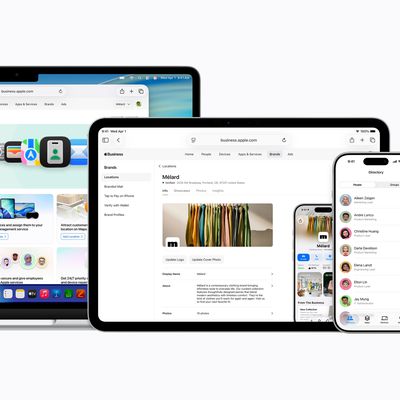
Apple Unveils 'Apple Business' All-in-One Platform

Tuesday March 24, 2026 8:53 am PDT by
Apple today announced Apple Business, a new all-in-one platform that unifies device management, productivity tools, and customer outreach features. The service is designed to be a consolidated replacement for several of Apple's existing business-focused offerings, including Apple Business Essentials, Apple Business Manager, and Apple Business Connect. It provides organizations with a single...
AirPods Pro Firmware Feature

Apple Releases New Firmware for AirPods Pro 3, AirPods Pro 2 and AirPods 4

Tuesday March 24, 2026 12:31 pm PDT by
Apple today released new firmware for the AirPods Pro 2, AirPods Pro 3, and the AirPods 4. The firmware has a version number of 8B39, up from 8B34 on the AirPods Pro 3, 8B28 on the AirPods Pro 2, and 8B21 on the AirPods 4. There is no word on what's included in the firmware, but Apple has a support document with limited notes. Most updates are limited to bug fixes and performance...

Top Rated Comments

9 months ago
Sorry, I'm a bozo when it comes to reading legal complaints. Was the plaintiff saying that Apple should have built their own card processing network? And that by bringing this suit they hoped the compel Apple to get into the credit processing business?

Wouldn't this be like a musician saying that because Apple Music is working with publishers and music licensing groups to get music on their platform that it constitutes a conspiracy for which the only remedy is that Apple should be forced to open a recording studio?
Score: 4 Votes (Like | Disagree)
9 months ago

The Visa and mastercard duopoly is a cartel. The idea that their transaction fees are simply a 'free market' finding the optimum 'value to the consumer' is 'a naive notion rooted in economic ignorance'. Small businesses are being hammered: "A single café or retailer with £500k in card turnover could be paying £10,000–£15,000 in fees every year."
Regardless of whether or not an illegal cartel exists, it is absurd to sue Apple for not creating a competing service.
Score: 4 Votes (Like | Disagree)
9 months ago

How does this work in the US? Over here in Europe you just link your bank card to Apple Pay and then you can use your phone to pay at any (contactless) terminal in the continent.

The article makes it seem like it's different in the US? Do you guys not have standardised payment systems?
It works the same in the US. I’ve got Visa and Mastercard based credit and debit cards linked to my Apple Pay. I’ve never had trouble using any card with the system. This suit is BS. The store is claiming Apple should have build a competing network to avoid a 0.15% of transaction fees and ½ penny on debit transactions. There’s no evidence that if Apple had built its own network it would have lower transaction fees. In fact, the standard pricing strategy taught at every business school (EVC — Economic Value to Consumer) would have Apple set fees equivalent to what is being charged now since that is the going rate. So, those fees wouldn’t go down, they would just go to Apple through a different channel. People need to rid themselves of the idea that capitalism and competition always reduces prices. It is a naïve notion rooted in economic ignorance.
Score: 4 Votes (Like | Disagree)
retrocool Avatar
9 months ago

It works the same in the US. I’ve got Visa and Mastercard based credit and debit cards linked to my Apple Pay. I’ve never had trouble using any card with the system. This suit is BS. The store is claiming Apple should have build a competing network to avoid a 0.15% of transaction fees and ½ penny on debit transactions. There’s no evidence that if Apple had built its own network it would have lower transaction fees. In fact, the standard pricing strategy taught at every business school (EVC — Economic Value to Consumer) would have Apple set fees equivalent to what is being charged now since that is the going rate. So, those fees wouldn’t go down, they would just go to Apple through a different channel. People need to rid themselves of the idea that capitalism and competition always reduces prices. It is a naïve notion rooted in economic ignorance.
The Visa and mastercard duopoly is a cartel. The idea that their transaction fees are simply a 'free market' finding the optimum 'value to the consumer' is 'a naive notion rooted in economic ignorance'. Small businesses are being hammered: "A single café or retailer with £500k in card turnover could be paying £10,000–£15,000 in fees every year."
Score: 3 Votes (Like | Disagree)
The_Gream Avatar
9 months ago

It works the same in the US. I’ve got Visa and Mastercard based credit and debit cards linked to my Apple Pay. I’ve never had trouble using any card with the system. This suit is BS. The store is claiming Apple should have build a competing network to avoid a 0.15% of transaction fees and ½ penny on debit transactions. There’s no evidence that if Apple had built its own network it would have lower transaction fees. In fact, the standard pricing strategy taught at every business school (EVC — Economic Value to Consumer) would have Apple set fees equivalent to what is being charged now since that is the going rate. So, those fees wouldn’t go down, they would just go to Apple through a different channel. People need to rid themselves of the idea that capitalism and competition always reduces prices. It is a naïve notion rooted in economic ignorance.
I remember when I was working in a store a few years back. They were updating the card terminals to handle contactless. The where only going to do android because the tech guys thought Apple charged the stores to use Apple Pay.
I brought up the terms and conditions that explained Apple’s cut came from the fee they (the business) was already paying.
They added Apple Pay.
Ignorance is everywhere.
Score: 3 Votes (Like | Disagree)
Rajani Isa Avatar
9 months ago

Sorry, I'm a bozo when it comes to reading legal complaints. Was the plaintiff saying that Apple should have built their own card processing network? And that by bringing this suit they hoped the compel Apple to get into the credit processing business?

Wouldn't this be like a musician saying that because Apple Music is working with publishers and music licensing groups to get music on their platform that it constitutes a conspiracy for which the only remedy is that Apple should be forced to open a recording studio?
Pretty much, yeah.
Score: 2 Votes (Like | Disagree)